Friday, August 14, 2015

7 Sculptures - Native American Wooden Kachina Dolls and Sculpturs, with footnotes

FOUR HOPI KACHINA DOLLS

Kachinas can be grouped according to their purpose. Groups of Kachinas include the following: Ogres, Guards or Warriors, Hunters, Whippers,  Runners, Chiefs, Women or Maidens, Animals, Plants, Dancers, Borrowed and Others.

Ronald Honyouti | Kachina Chief
Ronald Honyouti (Hopi) b. 1955
Kachina Chief
Wood and paint
11 by 4 by 5 inches
Private collection

The status of the Chief Kachina doll is quickly spotted by its elaborate and large featured headdress, which symbolizes authority. Usually posed with hands extended and carrying a spear or stick, the Chief Kachina is certainly a sight to behold.

The spiritual meaning of the Chief Kachina within Hopi tribes is their role akin to the Hopi Elders who often share their headdress designs. Because of their meaningful ties with the Elders, the Chief Kachina is believed to look after the well-being of the tribe and ensure its safety and harmony. Often, members of the Hopi tribe would dance in the presence of the Kachina doll to portray the importance the Chief held. More on  the Chief Kachina 

Ron Honyouti (1955- ) from Bacavi, Hotevilla, Third Mesa, AZ has been carving since the early 1970s and has more awards than he can count. His favorite figures include the Longhair and the Crow Mother. He is an award-winning carver from a family of talented artists. He lives in the rhythm of Hopi life. Ron has a unique ability to carve fabulous detail into his miniature carvings. Ron Honyouti 

Ronald Honyouti (Hopi) b. 1955
Longhair Mask
Wood and paint
6 1/2 by 2 1/2 by 2 1/2 inches
Private collection

Ronald Honyouti was born in 1955 and has been carving Kachina dolls since the age of 12. He learned to carve from his father Clyde and his elder brother Brian Honyouti. He is known for his realistic single piece carvings which he carefully details with oil paints rather than acrylics. He has won numerous awards and in 1985 was the recipient of a Fellowship award from the South West American Indian Association (SWAIA). His carvings can be found in the collections of the Museum of Northern Arizona, the Kolbe Collection, Anthropology Museum at the University of Missouri, the Heard Museum and the University of Oklahoma Museum of Art. More on Ronald Honyouti

Ronald Honyouti (Hopi) b. 1955
Albino Kachina
Wood and paint
12 by 5 by 6 inches
Private collection

Albino Kachina; his kachina was brought from Zuni by the Asa Clan when they came to Sichomovi. Since that time he has spread to the other mesas. However, Chakwaina originally came from much farther east for he has homologues in Keresan and Tanoan pueblos along the Rio Grande.

It has been stated that this kachina represents Estevan the Moor, who led Fray Marcos de Niza in search of Cibola and was killed at Zuni. This does not seem too reasonable considering the direction of his diffusion and the complex relationship of the Chakwaina group to the various pueblos where it is found. More on the Albino Kachina


Neal David Sr
Bear Kachina
Wood and paint
12 by 5 by 6 inches
Private collection

Hon (White Bear). This Kachina represents great strength. Of the Bear Kachinas, the White Bear is the most popular, because of the color contrasts against the white background. This Kachina appears in the dances and opening ceremonies of the Kachina season, which begins in December. More on the Bear Kachina

Neil Randall David, Sr., Hopi/Tewa American Indian, artist and Kachina doll carver, was born June 4, 1944 on the Hopi Reservation in Polacca Arizona. David’s interest in art was stimulated at an early age. David was self-taught as an artist. He sold his first Kachina doll while a high school freshman to Byron Hunter, who managed the trading store in Polacca. He saw the young man’s talent in art and as his mentor encouraged him. Hunter bought many of David’s drawings, paintings, and Kachina carvings and sold them through McGee’s trading store. David lives and continues to create his painting and carving on the Hopi Reservation in Polacca on First Mesa, Arizona. More on Neil Randall David, Sr.

Doug Hyde b. 1946
Grandma, Kitty and Me
Alabaster 
26 by 19 by 17 inches
Private collection

For the last two decades, Doug Hyde has been a recognized leader among Native American artists. From images evoked by Indian lore to those reflecting the modern Native American, his work exudes emotion, strength, and beauty and is resonating of his Native American heritage. 

Hyde was born in Oregon of Nez Perce and Assiniboine background. He studied at the Institute of American Indian Art in Santa Fe and continued his studies at the San Francisco Institute of Art. Hyde then served with the army in Vietnam, and upon his return moved back to Santa Fe where he continued his work in sculpture and served as a faculty member at IAIA until 1974. 


Hyde works with a wide array of materials including marble, alabaster, onyx, limestone and bronze. His work has evolved in even greater diversity through his bronzes, a relatively new medium for Hyde. The contrast and texture he achieves by sculpting in bronze and working with different patinas is remarkable. More on Doug Hyde

Oreland C. Joe, Sr. b. 1958 CAA 
Blackfoot Ritual
Bronze
12 1/2 by 14 by 9 inches
Private collection

Blackfeet ceremonies were highly symbolic in character. Ritual dances sometimes involved imitation of sacred animals. Colour symbolism was very important: red and black respectivley symbolised the sun and the moon. Geometrical figures such as the circle were used to represent the sun, moon and morning star. Today the Siksika use a logo consisting of a by a buffalo surrounded by a circle, beneath which is a peace pipe and a tomahawk. The buffalo symbolises food, shelter and clothing; the peace pipe, which crosses over the tomahawk, indicate that for the Blackfeet peace has permanently replaced war. More on Blackfeet ceremonies

Oreland C. Joe grew up on the Navajo Reservation in Shiprock, New Mexico. When his first grade teacher encouraged his crayon drawings, he decided that art was what he wanted to do with his life. His family also nurtured his talent; his father gave him drawings to copy, especially in church to keep him quiet. His mother supplied plenty of Big Chief notebooks.

After high school, Joe became an illustrator for the school print shop. But a 1978 trip to Paris was the turning point in his artistic career. He was there to perform as an Indian Hoop Dancer, but “During the day, I visited the art museums and galleries and was most struck by the gardens of Versailles. Something clicked in me when I saw the statuary. I had to know how it was done, how to use marble.”


Without any kind of formal training, Joe taught himself the rudiments of sculpture, often inventing his own tools to create the results he wanted. Today, his works in stone reflect simplistic styling and deep emotion. His own family, and the Southern Ute culture of his father inspire many of his pieces. More on Oreland C. Joe

Peter Fillerup b. 1953
Minnetaree Drumer, c. 1987
Bronze
21 by 9 by 9 inches
Private collection

The Minnetaree are North American Indian people (also known as the Atsina) variously identified with the Arapaho and Blackfoot.

Peter Fillerup (b. 1953) was born in Cody, Wyoming, and grew up in the Wyoming Rockies. Living on a small ranch twenty miles east of Yellowstone National Park gave him the opportunity of firsthand observation of the colorful and legendary American West. With the wonders of nature around him and the availability of Yellowstone’s wildlife, Fillerup developed a profound respect for nature and a love for the western way of life.

His interest in sculpture came at an early age when his father, Mel Fillerup brought him his first brick of clay. “I was amazed at all the things a person could make with a piece of clay. At an early age I was making small animals,” Fillerup said. He cast two small figures while still in high school.

After high school, Peter studied sculpture. Later he went to Brigham Young University. He began an apprenticeship with one of America’s foremost sculptors, Dr. Avard Fairbanks. Fillerup’s internship lasted several years. During this time he aided in such projects as the Peace Monument erected in the International Peace Garden in Salt Lake City and the fifteen foot Angel Moroni for the Mormon Temple in Seattle, Washington. He also accompanied Dr. Fairbanks to Italy where he became familiar with the arts of enlarging and working in marble, and gained valuable training in various foundry techniques. 

Establishing himself as a western artist, Fillerup is the youngest artist to have his work accepted and displayed at the Buffalo Bill Historical Center, and was selected to erect an equestrian monument to John “Jerimiah” Johnson, that now graces Johnson’s grave at the Old West Trail Town in Cody, Wyoming. More on Peter Fillerup


Acknowledgment: Altermann Galleries, Hopi Kachinas


Please visit my other blogs: Art CollectorMythologyMarine ArtPortrait of a Lady, The OrientalistArt of the Nude and The Canals of VeniceMiddle East Artists365 Saints and 365 Days, also visit my Boards on Pinterest

Images are copyright of their respective owners, assignees or others. Some Images may be subject to copyright

I don't own any of these images - credit is always given when due unless it is unknown to me. if I post your images without your permission, please tell me.

I do not sell art, art prints, framed posters or reproductions. Ads are shown only to compensate the hosting expenses.

If you enjoyed this post, please share with friends and family.

Thank you for visiting my blog and also for liking its posts and pages.

Please note that the content of this post primarily consists of articles available from Wikipedia or other free sources online.


Thursday, August 13, 2015

20 Automobile Classics, with footnotes

1938 Delahaye 135 MS Coupe by Figoni et Falaschi

160 hp, 3,557 cc overhead-valve inline six-cylinder engine, Cotal electro-mechanical four-speed gearbox, independent front suspension with a transverse leaf spring, live rear axle with quarter-elliptic springs, and four-wheel-assisted mechanically actuated Bendix drum brakes. Wheelbase: 114 in.

A particular highlight of the mid-1930s, and arguably the height of the French coachbuilt era, was Figoni et Falaschi’s introduction of the Goutte d’Eau, or teardrop streamliners, which were built as coupes and cabriolets on both Delahaye and Talbot-Lago chassis. 

Although teardrop cars were made in relatively small numbers, they were so immediately eye-catching that they became instant icons, and they remain so today. This particular example of Figoni coachwork was built on Delahaye’s Type 135 chassis, a model that was introduced in 1935 at the Paris Salon and was enthusiastically received. It proved delightful to drive, producing 160 horsepower in this most-powerful MS configuration. Of its performance, The Motor wrote in 1938, “There are few cars with such superb roadholding and steering, such performance, and such instantly responsive controls.”

1956 BMW 502 Cabriolet by Baur
Only 57 examples built

BMW aficionados will recognize the 502 as a special model in the famed German marque’s pantheon. It had been derived from the 501 saloon—the first automobile manufactured and sold by BMW after World War II—and was a significant step in the evolution of BMW’s reputation for luxury and performance.

The 501 was introduced in April 1951 at the Frankfurt Motor Show and was heralded as BMW’s emphatic return to motoring. It made an immediate impression, with its solid engineering and luxurious appointments, it was very much an elite automobile. Peter Szymanowski, one-time head of BMW design, preserved traditional BMW cues, including the double-kidney grille and flared fenders. The 501, as well as the 502, was nicknamed the “Baroque Angel,” for its flowing, curvaceous looks. 

The 502 was introduced in 1954, making it post-war Germany’s first V-8-powered car, as it had a 2.6-liter engine with an aluminum alloy block that was capable of churning out 100 horsepower. It was said to be Germany’s fastest production sedan, with an open-road speed of 100 mph, and it could easily outpace Mercedes-Benz competitors. Beyond improved performance, the 502 distinguished itself with elegant interior fittings and an exterior ornamented with additional chrome trim. Standard features on the car included fog lamps and individual front seats. The 502 was available in saloon, coupe, and two-door and four-door cabriolet versions. 

BMW entrusted Baur, a respected Stuttgart coachbuilder, to produce the cabriolet and coupe bodies, as BMW production facilities had been compromised by the war. Baur had been building BMW convertibles since the 1930s and was well acquainted with BMW’s high standards. From the time the 502 Cabriolet was introduced for 1956, 57 two-door cabriolets were produced by Baur. The cars were sold through the BMW dealer network and built to order. Buyers had to be affluent, as the list price was DM 21,900, as well as patient, since delivery could take upwards of six months. The combination of price and patience made ownership of a 502 an exclusive investment.

1927 Stutz Vertical Eight Custom Black Hawk Two-Passenger Speedster by Robbins
The fastest American-built production car of 1927

110 bhp, 298.6 cu. in. SOHC inline eight-cylinder engine, three-speed manual transmission, solid front axle and live rear axle with semi-elliptic leaf springs, and four-wheel hydraulic drum brakes. Wheelbase: 131 in.

The 1927 Black Hawk Speedster was the modern successor to the legendary Stutz Bearcat of the Brass Era, and it was the first “boattail” speedster to be produced by a major American manufacturer. With its powerful straight-eight engine, which was fed by dual Zenith carburetors, and a strong chassis with underslung worm drive and lightweight Robbins bodywork, it was able to capture the Stevens Trophy Cup at Indianapolis, as well as the AAA Stock Car Championship.

1952 Kurtis Kraft 4000 “Bowes Seal Fast" Special
One of approximately 15 built; certified AACA champ car

Est. 350 bhp, 270 cu. in. DOHC inline four-cylinder engine with methanol fuel injection, two-speed racing transmission, front independent suspension with leaf springs, live rear axle with torsion bars, and four-wheel disc brakes. Wheelbase: 96 in.

The legendary Frank Kurtis reached his zenith during the 1950s, when he produced four Indianapolis-winning cars. At one point, the Indy 500 lineup included as many as 23 cars of his manufacture, which was an unheard-of feat. Kurtis Kraft was incredibly diverse and prolific, unlike no other American race car builder in history. In addition to Indianapolis cars, the company produced midgets, sprint cars, sports cars, quarter midgets, and even aircraft-starter carts.

The Kurtis Kraft 4000 was first produced in 1951, and it is believed that as many as 15 examples were built. The model was designed as a traditional upright car that could be equally comfortable on the bricks at Indianapolis or the dirt tracks of the AAA championship circuit. Attractive styling and workhorse abilities gave the KK 4000 an amazing lifecycle as a race car, and many were still being actively run on the dirt champ circuit throughout the early 1960s.

1952 Fiat 500C Topolino
1952 Mille Miglia, Fiat 500C captured 1st place in the Turismo Nazionale 750 class.

16 hp, 34.9 cu. in. OHV inline four-cylinder engine with a single carburetor, four-speed manual transmission, independent front suspension with a transverse leaf spring and wishbones, live rear axle with radius rods and quarter-elliptic springs, and hydraulic drum brakes. Wheelbase: 78.7 in.

The 1952 Fiat 500C Topolino Transformable is a later example of the innovative Fiat 500 produced between 1936 and 1955, which is sometimes called the most popular, stylish, and best-loved small car of its time.

The 569-cubic centimeter (34.9-cubic inch) engine was mounted “backwards,” with the radiator located behind the engine, and in 1952, it could produce 16 horsepower, which was delivered through a modern four-speed manual transmission. A single Solex carburetor fed fuel to the engine from a 6.1-gallon gasoline tank. Its top speed (originally 53 mph) had risen to 59 mph by 1952, which was aided by a 4.875:1 rear end and perhaps a sympathetic downhill stretch of road.

Ferrari 250 GT/L Berlinetta 'Lusso' by Scaglietti (1964).
1964 Ferrari 250 GT/L Berlinetta 'Lusso' by Scaglietti

250 bhp, 2,953 cc DOHC V-12 engine, four-speed manual gearbox, independent front suspension with unequal-length A-arms and coil springs, live rear axle with semi-elliptical leaf springs and parallel trailing arms, and four-wheel hydraulic disc brakes. Wheelbase: 94.5 in.

Appearing for the first time in prototype form at the Paris Motor Show in October 1962, Ferrari’s 250 GT/L, or Lusso (for Luxury) as it became known, was instantly regarded as one of the most exquisitely proportioned Ferraris ever built. Ferrari’s intentions with the car were laid bare in its nomenclature; this new Ferrari was to beautifully combine power, performance, comfort, and elegance in order to create the world’s finest high-speed grand tourer.

The Lusso was considered a design triumph for Pininfarina and the coachbuilder Scaglietti. Its elegant lines were reminiscent of the 250 GT SWB Berlinetta but were more sensuous and far less aggressive, in an effort to reflect the character of the car. Characterized by its Kamm tail and thick C-pillars, the design helped to bathe the car’s interior in natural light and greatly reduced any blind spots for the driver.

As this was the final car of the 250 series, this would be the last time this engine was fitted to a Ferrari, as its replacement would be the 3.3-liter 275 engine. Production concluded in late 1964, and by that time, a modest quantity of just 350 examples were produced. 

1993 Jaguar XJ220 | Monterey 2015 | The Pinnacle Portfolio | RM Sotheby's
1993 JAGUAR XJ220
One of only 281 examples built between 1992 and 1994

542 bhp, 3,498 cc DOHC V-6 engine with twin turbochargers and Zytek fuel injection, five-speed manual transmission, independent front and rear double-wishbone suspension with coil springs, and four-wheel disc brakes.

In 1992, the XJ220 was the latest and greatest Jaguar sports car and more than worthy of being mentioned in the same breath as its forefathers. Like its predecessors, it was clothed in svelte and aerodynamic bodywork and its origins were rooted in Jaguar’s rich motorsport heritage. The car was conceived by Jim Randall, the then director of engineering, who was inspired by Jaguar’s sports racers of past. Randall brought a model he built into work and it was decided that it would be made into a full-scale concept. He then recruited a band of volunteers to get to work on the car, as a quasi-skunk-works project that would challenge the fastest automobiles on the planet.

1966 Shelby 427 Cobra

Est. 410 bhp, 427 cu. in. “side-oiler” V-8 engine, Ford Toploader four-speed manual transmission, independent front suspension with unequal-length upper and lower wishbones, coil springs, and telescopic dampers, independent rear suspension with unequal-length upper and lower wishbones with additional lower trailing links, coil springs, and telescopic dampers, and four-wheel hydraulic disc brakes. Wheelbase: 90 in.

With Shelby’s leadership, the era’s top drivers, and many other racing luminaries, the Ford-powered, AC Ace-derived Cobra was brutally quick and dead reliable, earning its stripes and winning virtually everywhere it appeared. The Cobra won the U.S. Manufacturers' Championship three years running in 1963, 1964, and 1965, and with the sleek Pete Brock-designed Daytona coupe, Shelby American Inc. won the hotly contested 1965 FIA World Manufacturers' Championship.

The cars were fiercely quick. Driving one continues to be a mind-bending experience. One of the most memorable stories about the 427 Cobra involves a test arranged for Sports Car Graphic magazine by Shelby’s Ken Miles. A few years earlier, Aston Martin claimed that their DB4 was capable of accelerating from zero to 100 mph and back down to zero in less than 30 seconds. Miles had the idea to restage the test using the new 427 Cobra. The result, according to SCG Editor Jerry Titus, was an astounding 13.2 seconds!

2008 Koenigsegg CCXR
SWEDEN’S SUPERCAR

1,018 bhp, 4,700 cc DOHC aluminum V-8 with twin Rotex centrifugal superchargers, six-speed manual transmission, four-wheel independent suspension with double wishbones and two-way adjustable VPS gas-hydraulic shock absorbers, and four-wheel ventilated carbon-ceramic disc brakes. Wheelbase: 104.7 in.

Koenigsegg began building their first production car, the CC8S, in 2002. Remarkably, it was instantly lauded as one of the best supercars ever built and was crowned the World’s Most Powerful Production Car by The Guinness Book of World Records.

Its replacement, the CCR, took to the Nardo ring in Italy in 2005, where it reached a top speed of 388 km/h, besting the record held by the McLaren F1 for nearly seven years, to become the world’s fastest production car.

The CCXR can run on regular petrol or pure E85 or in any mixture in between as it features flex-fuel technology. While running on normal petrol, the CCXR’s engine can produce 806 brake horsepower, but when fueled by E85 ethanol, the car can produce a monstrous 1,018 brake horsepower, allowing Koenigsegg to reclaim its title as the producer of the world’s fastest production car. 

A 0–100 km/h sprint takes 3.1 seconds, doubling that in just 8.9 seconds. Furthermore, accelerating from a stop to 200 km/h and braking back down to a full stop again takes only an incredible 13.7 seconds.

The CCX holds the 7th fastest lap time on the Top Gear test track, and the CCXR is even faster than its non-E85 powered sibling. It was named #1 Power Car by the German magazine Power Cars in 2008 and Forbes Magazine called the CCXR "One of the 10 Most Beautiful Cars in History" in 2009.

1952 Jaguar XK120 Supersonic by Ghia
One of three built with Giovanni Savonuzzi’s Supersonic coachwork

Est. 220 bhp, 3,442 cc DOHC inline six-cylinder engine with triple Weber two-barrel carburetors, four-speed manual transmission, independent front suspension with solid rear axle and semi-elliptical leaf springs, and four-wheel drum brakes. Wheelbase: 102 in.

Much as aircraft design influenced the automobiles of the 1920s, the emerging aerospace industry and rocket technology influenced styling of the early 1950s. With supersonic speeds finally achieved, it was natural that an automobile would emerge dubbed the Supersonic—and that it would come out of Italy, the forefront of worldwide automotive styling at the time.

The Supersonic was created by Ghia designer Giovanni Savonuzzi and originally appeared on a Conrero-tuned Alfa Romeo 1900 entered in the 1953 Mille Miglia. Its ultra-streamlined curves, appearing to have been stretched in aluminum over a chassis, would be copied on a small run of Fiat 8V chassis, an Aston Martin, and no fewer than three Jaguar XK120s.

1940 Aston Martin Speed Model Type C
23 full competition-specification Speed Models were produced

125 bhp, 1,949 cc SOHC inline four-cylinder engine with twin SU carburetors, four-speed manual transmission, front and rear live-axle suspension, and four-wheel Lockheed hydraulic drum brakes. Wheelbase: 102 in.

By the mid-1930s, Aston Martin was one of the most admired of British sporting marques. They were purposeful, solidly engineered, hand-built, quick, and agile.

In early 1936, a new engine, was being developed. Two liters in capacity, it was producing about 25 percent more power than the previous 1½-liter engine. These Works engines eventually produced 125 brake horsepower. A decision was taken to design a new chassis into which it could be fitted. This was to become the Speed Model, the first two purpose-built in 1936 to uphold the extraordinary successes for Aston Martin at Le Mans in 1934 and 1935.

The planned entry in the 1936 24 Hours of Le Mans race did not take place due to a labor action by French workers, so the two factory team cars were quickly sold to defray the costs of development. However, work did progress on more than half of the remaining chassis required to homologate the car for Le Mans. These had a mix of coachwork styles, as, for the first time, there was not a single readily recognizable body for a production Aston Martin. The last eight cars to be assembled, late in 1939 and into 1940, had very unusual steel-framed bodies designed by Claude Hill (the “Type C”), with a real emphasis on aerodynamic efficiency. 

1958 Aston Martin DB2/4 Mk III Drophead Coupe
Only 84 Mk III Drophead Coupes were built

178 bhp, 2,922 cc DOHC inline six-cylinder engine with three SU H6 carburetors, five-speed manual transmission, independent front suspension with coil springs, live-axle rear suspension with coil springs and radius rods, and hydraulic front disc and rear drum brakes. Wheelbase: 99 in.

Aston Martin was left to pick up the ashes at the end of World War II and try their best to get back on their feet. Luckily, the company was rescued from liquidation by an industrialist by the name of David Brown. While the first post-war Aston, the 2-Litre Sports, only found 14 buyers, the car that followed would be a resounding success, with its W.O. Bentley-designed six-cylinder engine appropriated from Lagonda, which Brown acquired in parallel with Aston Martin.

The DB2 was introduced in 1949 in prototype form, and it incorporated everything that anyone could ever want from a sports car at the time. The next model was named the DB2/4, in reference to the occasional rear seating found below a folding panel. By 1957, 1,175 DB2s and DB2/4s had been sold, as the company was still a boutique operation. Then, the final and most sophisticated version of the line, often just called “DB Mark III,” added 551 units to the total by 1959.

This final DB2-series iteration is central to Aston Martin’s heritage, as it is the first production Aston Martin to feature the marque’s now trademark grille, which appeared on later versions of the legendary racer, the DB3S. The updated “DBA” engine benefitted from a stiffer block, stronger crankshaft, high-lift camshafts, and bigger valves. 

1933 Duesenberg Model SJ 'Riviera' Phaeton by Brunn

Three Duesenberg Model Js were built with Brunn & Company’s beautiful Riviera Phaeton body, a four-door convertible sedan with a disappearing convertible top. The latter was quite an engineering feat for such a large top, which bundles neatly and then swings back under the reverse-hinged rear deck. The effect is of clean lines and abundant power, which is appropriate, as two of the Riviera Phaetons were originally installed on supercharged chassis—the Phaeton.

The important period for this car was not when it was new but in its “used car” years, what we would today refer to as the enthusiast age of car collecting, when the men who gathered old cars were generally not wealthy but simply eccentric gearheads with a passion for keeping old iron running.

1910 American Underslung Traveler Toy Tonneau

50 bhp, 499.2 cu. in. T-head inline four-cylinder engine, three-speed manual transmission, front and rear semi-elliptical leaf-spring suspension, and rear-wheel expanding drum brakes. Wheelbase: 122 in.

The American Underslung, a factory-bestowed nickname of sorts, not a model name, was one of the foremost automobiles built in Indianapolis, in an era when the Crown City was another Midwestern center of motor car production. Designed by Fred Tone, it featured an advanced chassis design that ran under and dipped between the axles, lowering the car’s body closer to the ground and, therefore, also its center of gravity. This resulted not only in beautiful, slinky styling—the E-Type of its era—but in superb handling to match the performance of brutal T-head four-cylinder engines. The American was expensive and worth it: a beautifully constructed performance car that represented the best of American performance at the time.

American built the Underslung model from 1907 until 1914, with various engines and in various sizes. It is the four-passenger Traveler that is perhaps the most desired today, on account of its dramatic four-passenger Toy Tonneau styling, with close-coupled lines incorporating a snug rear seat for two, which is tucked into the back, along with dual rear-mounted spares.

1967 Jaguar E-Type Series 1 4.2-Litre Roadster

265 bhp, 4,235 cc DOHC inline six-cylinder engine with three SU carburetors, four-speed manual transmission, independent front suspension with transverse wishbones, torsion bars, telescopic shocks, and an anti-roll bar, independent rear suspension with lower transverse tubular links and twin coil springs, and four-wheel Dunlop twin-circuit hydraulic disc brakes. Wheelbase: 96 in.

Launched in 1961 at the Geneva show, the E-Type echoed the sensation of its predecessor, the XK120, by offering an astonishing performance package with amazing speed and handling. In many ways, it revolutionized and invigorated the sports car market, which has never been the same since. Its brand-new four-wheel independent suspension, in particular, was so well conceived that it would be used by Jaguar for over 30 years.

The Series 1 4.2 model featured a 4.2-liter engine with three SU carburetors, a fully synchronized transmission, a fully instrumented dashboard with toggle switches, a center console and armrests, a steep windshield, and taillights mounted high above the bumper line on the rear deck, echoed by parking lights that are mounted high on the front fenders. This combination of features, along with its top speed of 140 mph, has made this among the most desirable of all E-Types—a user-friendly and sporty driver that also looks absolutely stunning.

1954 Mercedes-Benz 300 SL Gullwing

215 bhp (DIN), 240 bhp (SAE), 2,992 cc SOHC inline six-cylinder engine with Bosch mechanical fuel injection, four-speed manual transmission, coil-spring independent front suspension, coil-spring and swing-axle rear suspension, and four-wheel hydraulic drum brakes. Wheelbase: 94.5 in.

Mercedes-Benz’s 300 SL claimed 2nd in the Mille Miglia, 1-2-3 in the Sports Car Race in Berne, Switzerland, 1st and 2nd at Le Mans, 1-2-3-4 at the Nürburgring, and 1st and 2nd at La Carrera Panamericana. 

The “SL” moniker (translated to English as Sport Light) reflected the pioneering use of a welded, tubular-steel, ultra-light frame construction that weighed only 182 pounds. The car also featured fully independent suspension in addition to its fuel-injected, 3.0-liter (2,996 cubic centimeter), OHC straight-six with dry-sump lubrication, and the motor was inclined to the side in order to reduce the height of the front end. The power, rated at 240 brake horsepower at 6,100 rpm (SAE) and 215 brake horsepower at 5,800 rpm (DIN), with the factory-optional or dealer-installed “sport” camshaft, was delivered through a four-speed manual gearbox. A 161-mph top speed and 0–60 acceleration of approximately eight seconds, depending on the rear-end ratio selected from five options, made the 300 SL the fastest production automobile of its time.

The production 300 SL made its debut in the United States, not in Germany, which was a Mercedes first. More than 1,000 of the 1,400 cars produced between 1954 and early 1957. The 300 SL was as much a status symbol in its time as it is today, as it was favored by everyone from Hollywood stars to racing legends to genuine royalty.

“A thoroughbred in every sense of the word,” advertising boasted, “and a car which will be recognized by all enthusiasts as the ‘last word’ in sporting automobiles; a car which puts indescribable pleasure into driving!”

1960 Mercedes-Benz 190 SL
1960 Mercedes-Benz 190 SL.

120 bhp, 1,897 cc inline four-cylinder engine with two Solex 44PHH carburetors, four-speed manual transmission, independent dual-wishbone front suspension with coil springs and tube shocks, rear single-pivot swing axle with coil springs and tube shocks, and four-wheel hydraulic drum brakes. Wheelbase: 94.5 in.

The automotive world was turned upside down in February 1954 when Mercedes-Benz unveiled the 300 SL Gullwing Coupe and 190 SL Roadster on its stand at the New York International Motor Sports Show. The two cars had been conceived by American auto importer Max Hoffmann to appeal to the growing appetite for fashionable sports cars in the United States, and they were designed by Mercedes-Benz only after Hoffmann guaranteed to buy a sufficient number to justify production.

While the Gullwing would figure in the dreams of schoolboys for years to come, it was the practical nature of the 190 SL, with its comfortable seats, well-tailored convertible top, and roll-up windows enveloped in lines that echoed those of the Gullwing, that promised something different than the current sports cars coming from Europe. Both cars were in production by the end of 1955, and Grace Kelly was driving a silver 190 SL on the movie screen, with Frank Sinatra as her passenger in the movie High Society.

1915 Rolls-Royce 40/50 HP Silver Ghost Limousine by Hamshaw

50 bhp, 7,428 cc L-head inline six-cylinder engine, four-speed manual transmission with direct-drive fourth gear, live front and rear axles with semi-elliptical front and cantilever rear leaf-spring suspension, and rear drum brakes. Wheelbase: 138 in.

Chassis 2BD was one of the very last Silver Ghosts built prior to World War I and, therefore, one of the last with the  iconic early “parallel bonnet” styling. Following testing, the chassis was delivered to coachbuilders H.A. Hamshaw Ltd., of Leicester, and fitted with a handsomely designed and beautifully appointed limousine body—one of reportedly only five they constructed for Rolls-Royce chassis.

1935 Auburn Eight Supercharged Speedster

Model 851. 150 bhp, 280 cu. in. L-head inline eight-cylinder engine with a single two-barrel carburetor and Schwitzer-Cummins centrifugal supercharger, three-speed manual transmission with a Columbia dual-ratio rear axle, solid front and rear axles with semi-elliptical leaf springs, and four-wheel hydraulic drum brakes. Wheelbase: 127 in.

In the days when Bugattis crossed France and 4½-Litre Bentleys tore through the British countryside, the American equivalent was the Auburn Speedster. Indiana’s Auburn Automobile Company revealed its first version of this dashing body style, inspired by a Duesenberg show car, for the 1928 model year and would offer variations on the theme through to the end of production in 1936.

The 1935–1936 Speedsters were designed by the legendary Gordon Buehrig. Audacious by the standards of their time, they featured curvaceous bodywork with a straight hood line shooting back from the radiator to a sharply vee’d windshield, down between pontoon fenders, over gently sloping doors, and descending in a graceful taper to the rear bumper. It was this distinctive rear design, elegantly outlined by chrome and striping, that gave the Speedster its everlasting nickname, “the boattail.”

Each Speedster bore on its dashboard a plaque inscribed, “This certifies that this AUBURN AUTOMOBILE has been driven 100.8 miles per hour before shipment.” It was signed by David “Ab” Jenkins, the speed record driver who achieved some of his greatest successes at Bonneville behind the wheel of a late Auburn Speedster.

1954 Talbot-Lago T26 GSL

210 bhp, 4,482 cc OHV inline six-cylinder engine, four-speed Wilson pre-selector transmission, independent front suspension with coil springs, live rear axle with leaf springs, and four-wheel drum brakes. Wheelbase: 114.2 in.

By 1952, sales of the 2.65-meter short-wheelbase Talbot-Lago Grand Sport chassis had dwindled to almost nothing, and the company was in dire financial straits. The writing was on the wall, yet Anthony Lago refused to give up the fight. Talbot-Lago had absolutely no money with which to develop a completely new sports car chassis, but Lago’s engineering genius remained, and he put it to good use.

The Grand Prix-derived T26 Grand Sport chassis with transverse-leaf front suspension was quietly dropped. To create his new car, Lago redesigned, lightened, and shortened the existing Lago Record chassis to a wheelbase of 2.90 meters. It was a good choice; with its independent front suspension by coils, it had proven to have excellent road manners and sporting driving qualities.

The magnificent six-cylinder T26 engine was given three inverted Solex carburetors but was otherwise left alone, as it was already one of the most powerful and strongest passenger-car engines in the world. Power was up by 20 horsepower to 210 horsepower at 4,500 rpm. For a short time, Lago could glory in the fact that the new model was to be the fastest chassis in the world. On these gratifying underpinnings, a slinky factory body was mounted to a design by Carlo Delaisse, a prolific freelance designer who, in terms of creativity, can be seen as a French Giovanni Michelotti.

The new model was named the T26 GSL, or Grand Sport Longue, and made its debut at the Paris Salon in October 1953. Since the new GSL carried a factory body, there were only detail differences between the cars that were built. Somewhere between a third and half of production have an air vent in the front fender while the rest do not. A few cars were given a two-tone paint scheme, with the roof, including the A- and C-pillars, in a contrasting color to the body. The show cars at the Paris salons were given wide whitewall tires, but some cars had blackwalls for road use.

Acknowledgment: Sothebeys, RM Auctions


Please visit my other blogs: Art CollectorMythologyMarine ArtPortrait of a Lady, The OrientalistArt of the Nude and The Canals of VeniceMiddle East Artists365 Saints and 365 Days, also visit my Boards on Pinterest

Images are copyright of their respective owners, assignees or others. Some Images may be subject to copyright

I don't own any of these images - credit is always given when due unless it is unknown to me. if I post your images without your permission, please tell me.

I do not sell art, art prints, framed posters or reproductions. Ads are shown only to compensate the hosting expenses.

If you enjoyed this post, please share with friends and family.

Thank you for visiting my blog and also for liking its posts and pages.

Please note that the content of this post primarily consists of articles available from Wikipedia or other free sources online.


Monday, August 10, 2015

14 Paintings - Le Chevalier de Montagu, EDWARD WORTLEY MONTAGU (1713–1776), No Ordinary Traveller

A wildly eccentric man, Edward Wortley Montagu was the only son of Sir Edward Wortley Montagu (1678–1761), British Ambassador to the Ottoman Empire, and his wife, the infamous and equally eccentric writer, traveller and orientalist, Lady Mary Wortley Montagu (circa 1689–1762). 


Edward Montagu, 2nd Earl of Manchester by Sir Peter Lely (2).jpg
Portrait of the Earl of Manchester by Sir Peter Lely, circa 1661-1665


Portrait of a Lady thought to be Lady Mary Wortley Montagu
George Knapton
oil on Canvas

Montagu began his adventures in 1716, at just three, his mother took him on a hair-raising journey across Europe to join his father at the Ottoman Porte in Constantinople. 


Lady Mary Wortley Montagu with her son, Edward Wortley Montagu, and attendants, attributed to Jean Baptiste Vanmour, circa 1717 - NPG 3924 - © National Portrait Gallery, London
Lady Mary Wortley Montagu with her son, Edward Wortley Montagu, and attendants
attributed to Jean Baptiste Vanmour
oil on canvas, circa 1717
27 1/4 in. x 35 3/4 in. (693 mm x 909 mm)

Before starting for the East with her son, Lady Mary Wortley Montagu, had met Alexander Pope, and during her absence he wrote her a series of extravagant letters, which appear to have been chiefly exercises in the art of writing gallant epistles. While Pope may have been fascinated by her wit and elegance, Lady Mary's replies to his letters reveal that she was not equally smitten. Lady Louisa Stuart says Pope had made Lady Mary a declaration of love, which she had received with an outburst of laughter. 


File:18firth Pope.jpg
William Powell Frith depicts the moment after Alexander Pope declared his ardent love to Lady Mary. She has burst into a fit of laugher. He sits in pain, his pride hurt. William Powell Frith, Pope makes love to Lady Mary Montagu, 1852.

Returning to England for his education, Edward was sent to Westminster School, but ran away frequently, one on occasion, at the age of thirteen, enrolling himself in a course of oriental languages and taking up with a mistress seven years his senior. On another occasion he made it to Portugal, and managed to elude capture for two years. Despairing of their son, his parents packed him off to the West Indies for three years with a tutor. In 1730, at the age of just seventeen, he inexplicably married ‘a woman of very low degree' said to be a washerwoman named Sally. The marriage did not last long and the affair was hushed up. He was again sent abroad by his parents, whilst his father took advice about disinheriting him.

A fine scholar and a brilliant linguist, Montagu spent three years travelling through Europe with his tutor, John Anderson. Prone to excessive indulgence in both women and drink, and leaving huge debts behind wherever he went, in the autumn of 1734, having come of age, he finally gave Anderson the slip and returned to England incognito. He then travelled in the Netherlands, and to Italy. In 1741 he enrolled at the University of Leiden to study oriental languages. Within three months, however, he had abandoned Leiden, having again run up significant debts, and was back in Italy living wildly and keeping low company. 


7th Hussars

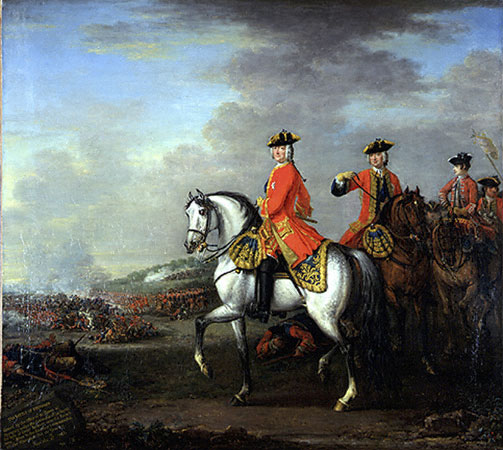
In 1742 he returned to England and, following a short spell in debtors’ prison, with the impending War of Austrian Succession looming, he joined the army as a cornet in the 7th Hussars; later promoted a Captain. He fought at the Battles of Dettingen and Fontenoy. 


John Wootton (1682–1764)
King George II at the Battle of Dettingen, with the Duke of Cumberland and Robert, 4th Earl of Holderness, 27 June 1743
oil on canvas
National Army Museum


IMA_BatailleFontenoyPhil2
Felix Philippoteaux (1815-1884)
Battle of Fontenoy during the Austrian Succession War between the British, Hanoverians, Austrian and Dutch and the French, 11th June 1745. 1873 (painted)
oil on canvas

Montagu made the acquaintance of a cousin, John Montagu, 4th Earl of Sandwich and Second Sea Lord, and through whose influence Montagu managed to secure a seat in Parliament, thus gaining him much sought after immunity from his creditors.


John Montagu, The Fourth Earl of Sandwich
Etienne Liotard (1702 - 1789)

Montagu resigned from the army in 1748 and returned to England to become secretary to his cousin, the Earl of Sandwich. Sandwich, who was by now First Lord of the Admiralty In London he lived fashionably, gambled heavily, was elected to the Royal Society, and regularly frequented the Divan Club; a society formed of young Englishmen who had travelled to the East and affected admiration for the Turks, headed by Sandwich and the notorious bon vivant Sir Francis Dashwood (1708–81).

Joseph Highmore (1692–1780)
John Montagu, 4th Earl of Sandwich, c. 1740
Sandwich's interest in the Middle East led him to found the Divan Club
Medium oil on canvas
Dimensions 121.9 × 91.4 cm (48 × 36 in)
National Portrait Gallery

In July 1751 Montagu bigamously married his second wife, Elizabeth Ashe. However he left her within three months having fathered a son, also Edward Wortley Montagu, one of several illegitimate children that he fathered by different women, including another son, George, as well as a daughter, Mary.

Portrait of Edward Wortley, Lord Montagu
Attributed to George Romney, R.A. (1734-1802l) 
Portrait of Edward Wortley, Lord Montagu 
oil on canvas, in a painted oval 
22 x 20 in. (55.9 x 50.8 cm.)

In April 1763 he set sail for Alexandria and an extensive tour of the East. Adopting the alias 'The Chevalier de Montagu', he travelled through Armenia, Sinai and Jerusalem accompanied by Caroline Dormer Feroe, the beautiful, twenty-one year old wife of the Danish Consul in Alexandria. Montagu had persuaded Caroline to marry him having convinced her that her husband, away in Europe at the time, was dead. When she eventually discovered that she had been duped, Montagu, who had been received into the Roman Catholic faith at Jerusalem, simply declared that her marriage to a Protestant was void anyway. By then however, Caroline had rather gotten used to the idea of being 'La Contesse de Montagu', and instead of returning to her life as the wife of the rather dull Danish Consul she remained with Montagu for several years

George Romney - DALTON 1734 - 1802 KENDAL
PORTRAIT OF EDWARD WORTLEY MONTAGU (1713–1776)
oil on canvas
162.7 by 119 cm..; 64 by 46 3/4  in

The exact route of his travels is hard to follow, but he lived for some time at Rosetta, on the Nile Delta in Egypt, and travelled through Ottoman held Greece. In 1767 he visited Zante, Salonica and Constantinople; and for several years travelled extensively throughout Turkey, Palestine, Egypt, and possibly even as far afield as Ethiopia; sporadically returning to Italy, which he used as a base. By this time professing himself a Muslim, Montagu adopted Eastern dress and perpetrated the story that he was the illegitimate son of the Turkish Sultan, a claim that raised no complaint from the Sultan himself, and entitled him to wear the saffron turban and jewelled aigrette of a prince of the Ottoman Empire

Edward Wortley Montagu, by Matthew William Peters, 1775 - NPG 4573 - © National Portrait Gallery, London
Edward Wortley Montagu
by Matthew William Gainsborough
oil on canvas, 1775
45 3/4 in. x 33 7/8 in. (1162 mm x 862 mm)

In July 1773 he finally returned to Venice, where after years of adventuring in the Middle East he lived in grand Oriental style. His many visitors included such distinguished figures as the King’s brother, Prince William Henry, Duke of Gloucester (1743–1805), and Montagu considered himself ‘part of the polite education of any noble youth who comes to this place on the grand tour’.

HRH William Henry, 1st Duke of Gloucester c.1775
Thomas Gainsborough
Oil on canvas
231 x 139.5 cm
National Army Museum

Montagu died of choking on a fish-bone; he left a number of illegitimate children, some of whom were addressed in his will.

Edward Wortley Montagu, 1713-1776: The man in the iron wig
by Jonathan Curling


Acknowledgment: Wikipedia