Showing posts with label Antoine-Jean Gros. Show all posts

Friday, February 24, 2017

11 Paintings, PORTRAIT OF A LADY, with Footnotes. # 14

Vigée Le Brun, (1779-1857)
Countess Kagenek as Flora, c. 1793
oil on canvas, within a painted oval,
29-5/8" x 24-5/8", 75.3 x 62.6 cm 
Private Museum

Toulouse Foundation Georges Bemberg, France On display at l'hotel d'Assézat. Anna Flora von Kaganeck, later Grafin Wrbna (1779-1857).

Countess Kagenek was the daughter of Count Frederich Kagenek and Countess Maria Theresa Salm Reiffersheidt and the cousin and close friend of Prince Clemens von Metternich (1773-1859). 

Even though she married Count Eugene Wrbna in 1798 the couple lived in the Metternich residence where the Countess assumed the role of hostess to foreign dignitaries during the Congress of Vienna (September 1814- June 1815). 

As a young bride, she was the toast of society and possessed great beauty and grace. Even in this youthful portrait one can easily see these traits.


Vigée Le Brun wrote, “... I found lodgings within the city of Vienna … and immediately set about painting the portrait of the Ambassador of Spain’s daughter, Mlle Kaguenek, a very pretty sixteen year old...” 

The portrait is Signed and dated lower left L.E. Vigée LeBrun/ á Vienne 1792 and inscribed on the reverse of the canvas Flore. Comtesse de Kagenek/ agée de 13 ans/ née le 23 septembre 1779

Offered for sale by Sotheby's New York on 23 Jan 2003. $500K to $700K. Sold to collector, Mr. Georges Bemberg and placed it in his private museum in France. More Countess Kagenek

Louise Élisabeth Vigée Le Brun (Marie Élisabeth Louise; 16 April 1755 – 30 March 1842), also known as Madame Lebrun, was a prominent French painter.

Her artistic style is generally considered part of the aftermath of Rococo, while she often adopts a neoclassical style. Vigée Le Brun cannot be considered a pure Neoclassicist, however, in that she creates mostly portraits in Neoclassical dress rather than the History painting. While serving as the portrait painter to Marie Antoinette, Vigée Le Brun works purely in Rococo in both her color and style choices.

Vigée Le Brun left a legacy of 660 portraits and 200 landscapes. In addition to private collections, her works may be found at major museums, such as the Hermitage Museum, London's National Gallery, and museums in continental Europe and the United States. More

Henry Nelson O'Neil, (1817–1880)
Eastern Lady, c. 1849
Oil on canvas
36.4 x 31 cm
Aberdeen Art Gallery & Museums

Henry Nelson O'Neil ARA (1817 in Russia – 1880) was an historical genre painter and minor Victorian writer. He worked primarily with historical and literary subjects. He also had popular successes with romantic scenes portraying the deaths of Mozart and Raphael.

O'Neil was a member of The Clique, a group of artists in the 1840s who, like the later Pre-Raphaelite Brotherhood, met regularly to discuss and criticize one another's works. 

O'Neil came to England with his family in 1823. He became a student at the Royal Academy Schools in 1836, and sent his first picture to the Royal Academy exhibition in 1838. He  began to pursue modern­life subjects that had a strong emotional component. His choice of subjects was considered to be striking, but his composition faulty. Although made an A.R.A. in 1860, O'Neil was never elected an R.A., despite exhibiting nearly one hundred works at the Royal Academy. More Henry Nelson O'Neil

Antoine-Jean Gros (1771–1835)
Portrait of Madame Fravega, c. 1795
Oil on canvas
128 × 126 cm (50.4 × 49.6 in)
Musée des Beaux-Arts de Marseille

The identity of the model has been speculated. Perhaps a portrait of Celeste Coltellini Meuricoffre.

Celeste Coltellini (26 November 1760 - 24 July 1828 ) was an Italian soprano. She was a well-known singer of opera buffa in Europe in the late 18th century. Born in Livornoi. In 1780, she made her debut at Teatro alla Scala in Milan, performing in three operas. She then sang at Teatro San Carlo in Naples, where she had the opportunity to meet Emperor Joseph II, who later invited her to perform in Vienna.

When her voice changed to soprano, she accepted the Emperor's invitation. In 1785, she went to Vienna with her mother, and stayed there for a year. She returned to Vienna again in 1788, but stayed just for a few month. She was seen with Mozart several times at music performances and parties, however, there was no record or any official report mentioning about any affairs or collaboration works between them.

Coltellini was famous for her excellent interpretation of the title role Nina, o sia La pazza per amore by Giovanni Paisiello. Her sister, Annetta also a singer, often accompanied her in the production.

In 1792, at the age of 32, Celeste retired from the opera stage and married the Swiss banker Jean-Georges Meuricoffre who owned a bank in Naples. Coltellini died in Naples in 1828. More Celeste Coltellini Meuricoffre.

Antoine-Jean Gros, (1771–1835)
Madame Pasteur, between 1795 and 1796
Oil on canvas
Height: 86 cm (33.9 in). Width: 67 cm (26.4 in).
Louvre Museum

Refugee in Italy during the Revolution, Gros painted several portraits, mainly in Genoa in 1795-96. 

Antoine-Jean Baron Gros (born March 16, 1771, Paris, France—died June 26, 1835, Paris), was a French Romantic painter principally remembered for his historical pictures depicting significant events in the military career of Napoleon.

Gros received his first art training from his father, who was a painter of miniatures. In 1785 he entered the studio of his father’s friend Jacques-Louis David, whom he revered but whose cerebral Neoclassical style was uncongenial to Gros’s romantically passionate nature. As a student, he was more influenced by the energetic brushwork and colour of Peter Paul Rubens and the Venetians than the hard linearism of his contemporary Neoclassicists.

In 1793 Gros went to Italy, where he met Joséphine de Beauharnais and, through her, Napoleon. In 1796 he followed the French army to Arcole and was present when Napoleon planted the French flag on the bridge. This incident he immortalized in his first major work. Napoleon bestowed on him the rank of inspecteur aux revues. He accompanied Napoleon on his campaigns and also helped select works of art from Italy for the Louvre.

After the fall of Napoleon and the restoration of the Bourbons (who gave Gros the title of baron); as the heir of Neoclassicism. He continued to paint large compositions—e.g., the ceiling of the Egyptian room of the Louvre. His best works after 1815 were portraits, some of which approached the quality of his Napoleonic pictures. He became increasingly dissatisfied with his accomplishments, and he committed suicide. More Antoine-Jean Baron Gros

In Ottoman Turkey of the 16th and 17th centuries, when religious and cultural mores kept most females secluded behind harem walls, five generations of women fulfilled their quest for influence. Each entered the Ottoman world as a slave, where the love of a powerful man meant access to power. They dominated the lives of their husbands and sons so that each became the power behind the throne, and influenced policy through their men. This period became known as the Reign of Women (Turkish: Kadinlar Saltanati). More Reign of Women

Titian (1490–1576) 
La Sultana Rossa, c. circa 1550
Oil on canvas
Current location
Ringling Museum of Art, Sarasota

Hürrem Sultan; Ottoman Turkish, c. 1502 – 15 April 1558, also known as Roxelana was the favourite and later the chief consort and legal wife of Ottoman Sultan Suleiman the Magnificent, the Lawgiver.  She was one of the most powerful and influential women in Ottoman history and a prominent and controversial figure during the era known as the Sultanate of Women. When her husband, Suleiman I, reigned as the Ottoman sultan, she achieved power and influenced the politics of the Ottoman Empire through her husband and played an active role in state affairs of the Empire.

Hürrem was a native of Poland. She was born in the town of Rohatyn, in the Crown of the Kingdom of Poland (today in Western Ukraine). In the 1520s Crimean Tatars captured her during one of their frequent raids into this region, took her as a slave and selected her for Suleiman's harem. More Hürrem Sultan

Anonymous
Suleiman's wife, Roxelana (1500-1558), circa 18 century
Oil on canvas
Topkapi Palace Museum

Tiziano Vecelli or Tiziano Vecellio, or Titian (1488/1490 – 27 August 1576), was an Italian painter, the most important member of the 16th-century Venetian school. He was born in Pieve di Cadore, near Belluno (in Veneto, Republic of Venice). During his lifetime he was often called da Cadore, taken from the place of his birth.

Recognized by his contemporaries as "The Sun Amidst Small Stars", Titian was one of the most versatile of Italian painters, equally adept with portraits, landscape backgrounds, and mythological and religious subjects. His painting methods, particularly in the application and use of color, would exercise a profound influence not only on painters of the Italian Renaissance, but on future generations of Western art.


During the course of his long life, Titian's artistic manner changed drastically but he retained a lifelong interest in color. Although his mature works may not contain the vivid, luminous tints of his early pieces, their loose brushwork and subtlety of tone are without precedent in the history of Western painting. More Titian

Anonymous
Safiye Sultan

Safiye Sultan, (1550 – 1619), the favourite consort of the Ottoman sultan Murad III (reigned 1574–95) and the mother of his son Mehmed III (reigned 1595–1603); she exercised a strong influence on Ottoman affairs during the reigns of both sultans.

Safiye, whose name means “pure one,” is said to have been a native of Rezi, a mountain town in Albania. Until the death in 1583 of Nur Banu, the valide sultan (mother of the sultan on the throne), Safiye’s influence was limited. Thereafter, as haseki sultan (mother of the heir to the throne) and after 1595 as valide sultan, she wielded great influence at the Ottoman court. Among those who enjoyed her favour was the thrice grand vizier (chief minister) İbrahim Paşa. During the years of her greatest influence, she is said to have been partial to the interests of Venice. She was sent into retirement after the death of Mehmed III.

A mosque at Cairo, the Malikah Ṣafiyyah, bears her name. Another mosque, in Istanbul, the Yeni Valide Cami, was begun on her orders and completed under Sultan Mehmed IV (reigned 1648–87). More Safiye Sultan

Frank Duveneck, 1848 - 1919
Seated Nude, 1879
 Oil on artist board
32 1/2 x 24 1/2 in.
Private collection

Frank Duveneck, (born October 9, 1848, Covington, Kentucky, U.S.—died January 3, 1919, Cincinnati, Ohio), American painter, sculptor, and art teacher who helped awaken American interest in European naturalism. At age 21 Duveneck studied in Germany with Wilhelm Dietz at the Munich Academy and was greatly influenced by the works of Frans Hals, Rembrandt, and Peter Paul Rubens. His success was immediate, and in 1871 he won a medal from the Bavarian Royal Academy. Fellow artists and critics responded to his bold, vital brushstrokes and strong contrasts of light and dark. Two years later, he arranged his first solo exhibition in Munich, further establishing his international reputation.

After returning to the United States in 1873 and settling in Cincinnati, Ohio, Duveneck burst upon the American scene with an exhibition in Boston in 1875. His work was characterized by dark, earthy colours and broad, painterly brushwork clearly reminiscent of the European masters Duveneck admired. Both the writer Henry James and the artist William Morris Hunt championed Duveneck’s art. Although emboldened by this response, Duveneck returned to Munich and sent works to exhibitions in the United States. More Frank Duveneck

Frank Duveneck, (1848–1919)
Portrait of Marie Danforth Page, circa 1889
Oil on canvas
Cincinnati Art Museum

Marie Danforth Page (1869–1940) was an American painter, mainly of portraits. A native of Boston, Page began drawing lessons at 17. These continued until 1889, when she began five years of lessons at the School of the Museum of Fine Arts, Boston. In 1903 she traveled to Europe, where she copied paintings of Diego Velazquez while in Spain; on her return she took lessons at Harvard University in color theory. In 1896 she married and settled in Boston.

Page soon began to receive commissions. Three of her paintings were accepted for the Panama-Pacific Exhibition of 1915 in San Francisco, and one won a bronze medal. Further prizes followed, at the National Academy of Design – to which she was elected as an associate in 1927 – and the Newport Art Association, and her first one-woman show came in 1921 at the Guild of Boston Artists. She continued to win prizes, including an honorary MA from Tufts University, and show work until her death.

Page's papers are currently held by the Archives of American Art. One of her portraits, a c. 1911 painting of a boy titled Portrait of Henry, was included in the inaugural exhibition of the National Museum of Women in the Arts, American Women Artists 1830–1930, in 1987. More Marie Danforth Page

Attributed to Jean Raoux, (1677–1734)
Girl with a Pearl Necklace.
Oil on canvas
Museum of Fine Arts in Marseille

Jean Raoux (1677 – 10 February 1734), French painter, was born at Montpellier. After the usual course of training he became a member of the Academy in 1717 as an historical painter. His reputation had been previously established by the credit of decorations executed during his three years in Italy on the palace of Giustiniani Solini at Venice, and by some easel paintings. To this latter class of subject Raoux devoted himself, nor did he even paint portraits except in character. The list of his works is a long series of sets of the Seasons, of the Hours, of the Elements, or of those scenes of amusement and gallantry in the representation of which he was immeasurably surpassed by his younger rival Watteau. After his stay in England (1720) he lived much in the Temple, where he decorated several rooms. He died in Paris in 1734. More Jean Raoux

Egon Schiele, (1890–1918)
Seated girl with bare torso and light blue skirt, c. 1917
Watercolor, paper
Author
Gemeentemuseum den Haag, Hague, Netherlands

Egon Schiele (German: 12 June 1890 – 31 October 1918) was an Austrian painter. A protégé of Gustav Klimt, Schiele was a major figurative painter of the early 20th century. His work is noted for its intensity and its raw sexuality, and the many self-portraits the artist produced, including naked self-portraits. The twisted body shapes and the expressive line that characterize Schiele's paintings and drawings mark the artist as an early exponent of Expressionism. More


Images are copyright of their respective owners, assignees or others

Wednesday, November 25, 2015

19 Artists Embedded With Napoleon's French Campaign In Egypt And Syria - Part II

Continued from Part I

When the Ottomans in Constantinople received news of the French fleet's destruction at Aboukir, they believed this spelled the end for Bonaparte and his expedition. Sultan Selim III decided to wage war against France, and sent two armies to Egypt. The Ottomans planned two offensives against Cairo: from Syria, across the desert of Salhayeh-Belbays-El Kankah, and from Rhodes by sea landing in the Aboukir area or the port city of Damietta.

In January 1799, during the canal expedition, the French learned of the hostile Ottoman movements and that they had seized the desert fort of El-Arich ten miles (16 km) from Syria's frontier with Egypt. Certain that war with the Ottoman sultan was imminent and that he would be unable to defend against the Ottoman army, Bonaparte decided that his best defence would be to attack them first in Syria, where a victory would give him more time to prepare against the Ottoman forces on Rhodes.


Gustav Bauernfeind
Jaffa, Recruiting of Turkish Soldiers in Palestine

The French army quickly arrived before Arish, captured it, destroyed part of the garrison and forced the rest to take refuge in the castle. They marched another 60 miles (97 km) across the desert arriving in Gaza, and then moved onto Jaffa. The city was one of the ways into Syria, its port could be used by his fleet and a large part of the expedition's success depended on its fall. This meant Bonaparte had to capture the city before advancing further, and so he laid siege to it from 3 to 7 March.


File:MarktJaffaGustavBauernfeind1887.jpg
Gustav Bauernfeind
Markt in Jaffa, c. 1877

Despite the defenders' desperate resistance, Jaffa fell. Two days and two nights of carnage were enough to assuage the French soldiers' fury – 4,500 prisoners were shot or beheaded by an executioner taken on in Egypt. This vengeful execution found apologists, who wrote that Napoleon could neither afford to hold such a large number of prisoners nor let them escape to join enemy ranks.


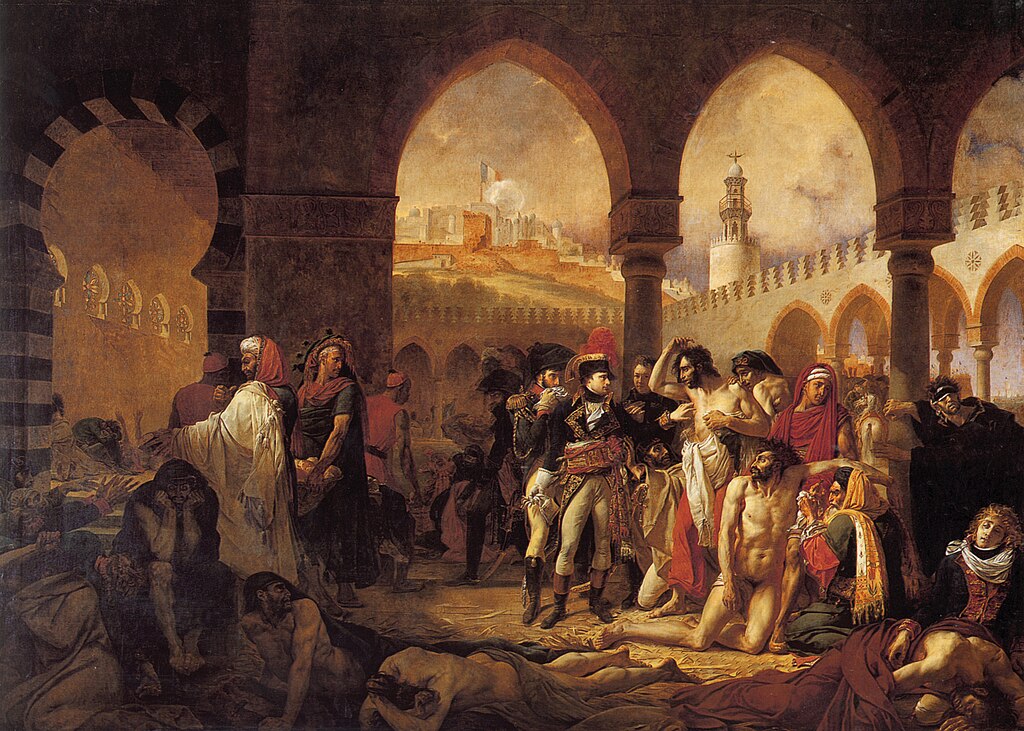
Antoine-Jean Gros (1771–1835)
Pest House at Jaffa, c. 1804
Oil on Canvas

Antoine-Jean Gros was the leading figure in disseminating the image of Napoleon as a mythic hero through large-scale narrative history paintings that glorified his deeds. Here Gros has immortalized Napoleon’s visit on March 11, 1799 to a military hospital at Jaffa to console the dying troops who had fought in the Egyptian campaign. Although the General is portrayed unflinchingly holding a swooning plague victim, Napoleon rejected this preliminary version as not heroic enough. The final, large-scale version in the Louvre depicts Napoleon as a Christ-like figure, bravely touching the sore of a plague victim.

Before leaving Jaffa, Bonaparte set up a divan for the city along with a large hospital on the site of the Carmelite monastery at Mount Carmel to treat those of his soldiers who had caught the plague, whose symptoms had been seen among them since the start of the siege. A report from generals Bon and Rampon on the plague's spread worried Bonaparte. To calm his army, it is said he went into the sufferers' rooms, spoke with and consoled the sick and touched them, saying "See, it's nothing", then left the hospital and told those who thought his actions unwise "It was my duty, I'm commander-in-chief". 


Antoine-Jean Gros - Bonaparte visitant les pestiférés de Jaffa.jpg
Antoine-Jean Gros (1771–1835)
Bonaparte Visiting the Pesthouse in Jaffa, c. 1804
Oil on canvas
715 × 523 cm
Louvre Museum

Antoine-Jean Gros (16 March 1771 – 25 June 1835), Baron Gros, also known as Jean-Antoine Gros, was both a French history and neoclassical painter.

However, some later historians state that Napoleon avoided touching or even meeting plague-sufferers to avoid catching it and that his visits to the sick were invented by later Napoleonic propaganda. For example, long after the campaign, Antoine-Jean Gros produced the propaganda painting Bonaparte visiting the plague-victims of Jaffa in 1804. This showed Napoleon touching a sick man's body, modelling him on an Ancien Régime king-healer touching sufferers from the "King's Evil" during his coronation rites – this was no coincidence, since 1804 was the year Napoleon Bonaparte crowned himself emperor.

From Jaffa the army set off for the coastal town of Acre. En route it captured Haifa and the munitions and provisions stored there, along with the castle at Jaffe, the castle at Nazareth and the town of Tyre. The siege of Acre began on 18 March but the French were unable to take it and it was here that the Syrian campaign came to an abrupt halt. The city was defended by newly created Ottoman infantry elites (Nizam-ı Cedid) under the command of Jezzar Pasha and was right on the coast, enabling it to be reinforced and resupplied by the British and Ottoman fleets.


File:Antoine-Jean Gros 010.jpg
Antoine-Jean Gros (1771–1835)
Battle of Nazareth, c. 1801
Oil on canvas
135 × 195 cm (53.1 × 76.8 in)
Deutsch: Museum of Fine Arts

After sixty days' repeated attacks and two murderous and inconclusive assaults, the city remained uncaptured. Even so, it was still awaiting reinforcements by sea as well as a large army forming up in Asia on the sultan's orders to march against the French. To find out the latter's movements, Jezzar ordered a general sortie against Bonaparte's camp. This sortie was supported by its own artillery and a naval bombardment from the British. 


Ottoman Empire - Battle of Nazareth - Junot - Napoleon Bonaparte - Napoleonic Wars - 1799
Original typogravure by Boussod & amp; Valadon after Armand-Charles Caraffe. 1890
 Third Republic

With his usual impetuosity, Bonaparte pushed Jezzar's columns back against their own walls and then went to help Kléber, who was retrenched in the ruins with 4,000 Frenchmen and 20,000 Ottomans under his command. Bonaparte conceived a trick which used all the advantages offered him by the enemy position, sending Murat and his cavalry across the River Jordan to defend the river crossing and Vial and Rampon to march on Nablus, while Bonaparte himself put his troops between the Ottomans and the magazines. 

Léon Cogniet (1794-1880) et Félix Philippoteaux (1815-1884)
The Battle of Mount Tabor 16 April 1799


Napoleonic Wars - Egyptian Campaign - The Battle of Mount Tabor which opposed French Forces under General Kleber to an Ottoman Force led by the Pasha of Damascus (1799)
Original steel engraving drawn by Martinet, engraved by Couché. Hand watercolored. 1835

These manoeuvres were successful, in what was known as the battle of Mount Tabor. The enemy army, taken by surprise at many points at once, was routed and forced to retreat, leaving their camels, tents, provisions and 5,000 dead on the battlefield.


Louis Francois Couche 1782-1849
The Battle of Mount Tabor
oil on Canvas

Returning to besiege Acre, Bonaparte learned that Rear-Admiral Perrée had landed seven siege artillery pieces at Jaffa. Bonaparte then ordered two assaults, both vigorously repulsed. A fleet was sighted flying the Ottoman flag and Bonaparte realised he must capture the city before that fleet arrived there with reinforcements. A fifth general attack was ordered, which took the outer works, planted the French tricolour on the rampart, pushed the Ottomans back into the city and forced the Ottoman fire to relent. Acre was thus taken or about to capitulate.


File:La Bataille du mont Tabor, en Syrie, le 27 germinal an VI by Louis François Lejeune Salon de 1804.jpg
Louis François Lejeune
The Battle of Mount Tabor, Syria, circa 1804

However, one of those fighting on the Ottoman side was the French émigré and engineer officer Phélippeaux, one of Bonaparte's classmates at the École Militaire. Phélippeaux ordered cannon to be placed in the most advantageous positions and new trenches dug as if by magic behind the ruins which Bonaparte's forces had captured. At the same time Sidney Smith, commander of the British fleet, and his ships' crews landed. 


Art on demand:
BOMBARDMENT OF ST. JEAN D'ACRE 3 NOVEMBER
R.F. Stopford

Art on demand:
THE BATTLE OF ST. JEAN D'ACRE, 3 NOVEMBER
J.K. Wilson

Art on demand:
ATTACK AND CAPTURE OF ST JEAN D'ACRE BY A COMBINED SQUADRON UNDER ADMIRAL SIR ROBERT STOPFORD, 3 NOVEMBER, c. 1840
JAMES KENNETT WILLSON

Art on demand:
BOMBARDMENT OF ST JEAN D'ACRE BY ADMIRAL SIR CHARLES NAPIER
H WINKLES

These factors renewed the courage of the besieged and they pushed Bonaparte's force back, with stubborn fury on both sides. Three final consecutive assaults were all repulsed, convincing Bonaparte that it would be unwise to continue trying to capture Acre. He raised the siege in May and consoled his soldiers with the proclamation:

“ After feeding the war for three months in the heart of Syria with a handful of men, taking forty guns, fifty flags, 10,000 prisoners, razing the fortifications of Gaza, Kaïffa, Jaffa, Acre, we shall return to Egypt. ”


Leon Cogniet and Henri-Felix-Emmanuel Philippoteaux.
The Battle of Mount Tabor, Syria, circa 1837

The French force's situation was now critical – the enemy could harass its rear as it retreated, it was tired and hungry in the desert, it was carrying a large number of plague-sufferers. To carry these sufferers in the middle of the army would spread the disease, so they had to be carried in the rear, where they were most at risk from the fury of the Ottomans, keen to avenge the massacres at Jaffa. There were two hospital depots, one in the large hospital on Mount Carmel and the other at Jaffa. On Bonaparte's orders, all those at Mount Carmel were evacuated to Jaffa and Tentura. The gun horses were abandoned before Acre and Bonaparte and all his officers handed their horses over to the transport officer Daure, with Bonaparte walking to set an example.


Ottoman Empire - Siege of Acre - Jezzar Pasha - Napoleon Bonaparte - Napoleonic Wars - 1799
Original typogravure by Boussod & amp; Valadon. 1890
Third Republic

To conceal its withdrawal from the siege, the army set off at night. Arriving at Jaffa, Bonaparte ordered three evacuations of the plague sufferers to three different points – one by sea to Damietta, one by land to Gaza and one by land to Arish. During the retreat the army picked clean all the lands through which they passed, with livestock, crops and houses all destroyed by sword and fire and Gaza the only place to be spared, in return for remaining loyal to Bonaparte. To speed the retreat, Bonaparte also took the controversial step of killing prisoners and plague-stricken men along the way. His supporters argued that this was necessary given continuing harassment of stragglers by Ottoman forces.

Finally, after four months away from Egypt, the expedition arrived back at Cairo with 1800 wounded, after losing 600 men to the plague and 1200 to enemy action. In the meantime Ottoman and British emissaries had brought news of Bonaparte's setback at Acre to Egypt, stating that his expeditionary force was largely destroyed and Bonaparte himself was dead. On his return Bonaparte scotched these rumours by re-entering Egypt as if he was at the head of a triumphal army, with his soldiers carrying palm branches, emblems of victory. In his proclamation to the inhabitants of Cairo, Bonaparte told them:

“ He is back in Cairo, the Bien-Gardé, the head of the French army, general Bonaparte, who loves Mahomet's religion ; he is back sound and well, thanking God for the favours he has given him. He has entered Cairo by the gate of Victory. This day is a great day; no one has ever seen its like; all the inhabitants of Cairo have come out to meet him. They have seen and recognised that it is the same commander in chief, Bonaparte, in his own person; but those of Jaffa, having refused to surrender, he handed them all over to pillage and death in his anger. He has destroyed all its ramparts and killed all those found there. There were around 5,000 of Jezzar's troops in Jaffa – he destroyed them all. ”


 Louis-François, Baron Lejeune , French ,1775 - 1848
The Battle of Aboukir, 25th July 1799, (1801)

At Cairo the army found the rest and supplies it needed to recover, but its stay there could not be a long one. Bonaparte had been informed that Murad Bay had evaded the pursuit by generals Desaix, Belliard, Donzelot and Davoust and was descending on Upper Egypt. Bonaparte thus marched to attack him at Giza, also learning that 100 Ottoman ships were off Aboukir, threatening Alexandria.


 Louis-François, Baron Lejeune , French ,1775 - 1848
The Battle of Aboukir, 25th July 1799, (1801) (Detail)

Without losing time or returning to Cairo, Bonaparte ordered his generals to make all speed to meet the army commanded by the pasha of Rumelia, Saïd-Mustapha, which had joined up with the forces under Murad Bey and Ibrahim. Before leaving Giza, where he found them, Bonaparte wrote to Cairo's divan, stating:

“ 80 ships have dared to attack Alexandria but, beaten back by the artillery in that place, they have gone to anchor in Aboukir Bay, where they began disembarking [troops]. I leave them to do this, since my intention is to attack them, to kill all those who do not wish to surrender, and to leave others alive to led in triumph to Cairo. This will be a handsome spectacle for the city. ”

First Bonaparte advanced to Alexandria, from which he marched to Aboukir, whose fort was now strongly garrisoned by the Ottomans. Bonaparte deployed his army so that Mustapha would have to win or die with all his family. Mustapha's army was 18,000 strong and supported by several cannon, with trenches defending it on the landward side and free communication with the Ottoman fleet on the seaward side. Bonaparte ordered an attack on 25 July and the Battle of Abukir ensued. 


File:Antoine-Jean Gros - Bataille d'Aboukir, 25 juillet 1799 - Google Art Project.jpg
Antoine-Jean Gros (1771–1835)
The Battle of Abukir, 25 July 1799, c.  1807
Oil on canvas
578 × 968 cm (227.6 × 381.1 in)
Palace of Versailles

n a few hours the trenches were taken, 10,000 Ottomans drowned in the ocean and the rest captured or killed. Most of the credit for the French victory that day goes to Murat, who captured Mustapha himself. Mustapha's son was in command of the fort and he and all his officers survived but were captured and sent back to Cairo as part of the French triumphal procession. Seeing Bonaparte return with these high-ranking prisoners, the population of Cairo superstitiously welcomed him as a prophet-warrior who had predicted his own triumph with such remarkable precision.

The land battle at Abukir was Bonaparte's last action in Egypt, partly restoring his reputation after the French naval defeat at the same place a year earlier. However, with the Egyptian campaign stagnating and political instability developing back home, a new phase in Bonaparte's career was beginning – he felt that he had nothing left to do in Egypt which was worthy of his ambition and that (as had been shown by the defeat at Acre) the forces he had left to him there were not sufficient for an expedition of any importance outside of Egypt. He also foresaw that the army was getting yet weaker from losses in battle and to disease and would soon have to surrender and be taken prisoner by its enemies, which would destroy all the prestige he had won by his many victories. Bonaparte thus spontaneously decided to return to France. During the prisoner exchange at Aboukir and notably via the Gazette de Francfort Sidney Smith had sent him, he was in communication with the British fleet, from which he had learned of events in France. As Bonaparte saw (and later mythologised) it France was thrown back into retreat, its enemies had recaptured France's conquests, France was unhappy at its dictatorial government and was nostalgic for the glorious peace it had signed in the Treaty of Campo Formio – as Bonaparte saw it, this meant France needed him and would welcome him back.


Louis-François, Baron Lejeune, 1775 - 1848
The battle of the Pyramids 1808

He only shared the secret of his return with a small number of friends whose discretion and loyalty were well-known. He left Cairo in August 1799 on the pretext of a voyage in the Nile Delta without arousing suspicion, accompanied by the scholars Monge and Berthollet, the painter Denon, and generals Berthier, Murat, Lannes and Marmont. On 23 August 1799 a proclamation informed the army that Bonaparte had transferred his powers as commander in chief to General Kléber. This news was taken badly, with the soldiers angry with Bonaparte and the French government for leaving them behind, but this indignation soon ended, since the troops were confident in Kléber, who convinced them that Bonaparte had not left permanently but would soon be back with reinforcements from France. As night fell, the frigate Muiron silently moored by the shore, with three other ships escorting her. Some became worried when a British corvette was sighted at the moment of departure, but Bonaparte cried "Bah! We'll get there, luck has never abandoned us, we shall get there, despite the English."


Jacques Francois Joseph Swebach, French , 1769 -1823
The Battle of the Pyramids

On their 41-day voyage back they did not meet a single enemy ship to stop them, with some sources suggesting that Bonaparte had purchased the British fleet's neutrality via a tacit agreement, though others hold this unlikely, since many would argue that he also had a pact with Nelson to leave him to board on the Egyptian coast unopposed with the fleet bearing his large army. It has been suggested that Sidney Smith and other British commanders in the Mediterranean helped Napoleon evade the British blockade, thinking that he might act as a Royalist element back in France, but there is no solid historical evidence in support of this conjecture. 
François André Vincent.
The Battle of the Pyramid, c. 1800
Oil on canvas
80 x 125 cm
Musée du Louvre

On 1 October Napoleon's small flotilla entered port at Ajaccio, where contrary winds kept them until 8 October, when they set out for France. When the coast came in sight, ten British ships were sighted. Contre-amiral Ganteaume suggested changing course towards Corsica, but Bonaparte said "No, this manoeuvre would lead us to England, and I want to get to France.". This courageous act saved them and on 8 October 1799 (16 vendémiaire year VIII) the frigates anchored in the roads off Fréjus. As there were no sick men on board and the plague in Egypt had ended six months before their departure, Bonaparte and his entourage were allowed to land immediately without waiting in quarantine. At 6 pm he set off for Paris, accompanied by his chief of staff Berthier. He stopped off at Saint-Raphaël, where he built a pyramid commemorating the expedition.


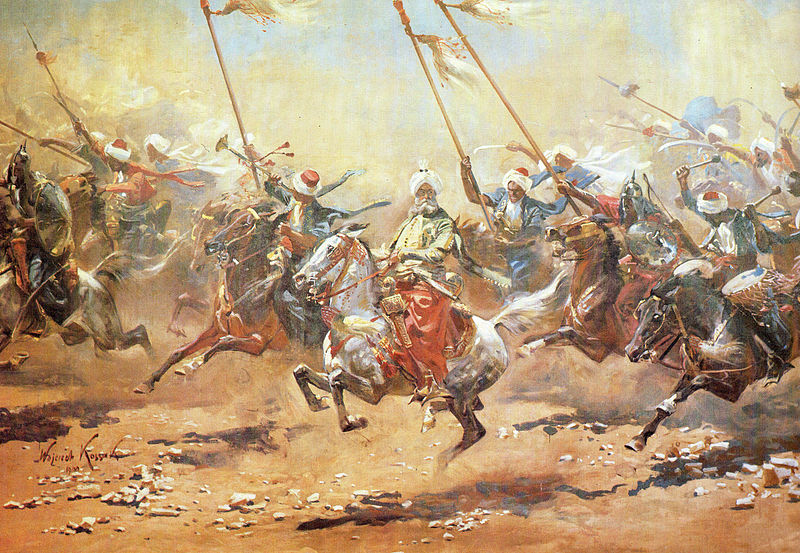
File:WKossak030.jpg
Wojciech Kossak, (Paris 1857 - Kraków 1942)
The Charge of the Mamelukes, led by Murad Pasha. Part of the panorama "The Battle of the Pyramids", c. 1900. 
Oil on canvas
288 x 510 cm. 
The National Museum, Poznan

The troops Bonaparte left behind were supposed to be honourably evacuated under the terms of a treaty Kléber had negotiated with Smith in early 1800, but British Admiral Keith reneged on this treaty, sending an amphibious assault force of 30,000 Mamlukes against Kléber.


by Kossak
Wojciech Kossak, (Paris 1857 - Kraków 1942)
Battle of the Pyramids. Sketch for the panorama, c. 1896. 
Oil on Canvas 
75.5 x 105 cm. 
The National Museum, Warsaw.

Kléber defeated the Mamlukes at the battle of Heliopolis in March 1800, and then suppressed an insurrection in Cairo. However, on 14 June (26 prairial) 1800 a Syrian student called Suleiman al-Halabi assassinated Kléber with a dagger in the heart, chest, left forearm and right thigh. 


File:Assassination of Kleber f4925505.jpg
Antoine-Jean Gros (1771–1835)
Assassination of General Kleber
Oil on canvas
Strasbourg Historical museum

Command of the French army passed to General Menou, who held command from 3 July 1800 until August 1801. Menou's letter was published in Le Moniteur on 6 September, with the conclusions of the committee charged with judging those responsible for the assassination:


Battle of Alexandria 21 March 1801


Under continual harassment from the new Anglo-Ottoman land offensive, defeated by the British in the Battle of Alexandria on March 21, and at Fort Julien in April and then besieged in Alexandria from 17 August – 2 September 1801, Menou eventually capitulated to the British. 


File:Philip James de Loutherbourg - The Battle of Alexandria, 21 March 1801 - Google Art Project.jpg
Philip James de Loutherbourg (1740–1812)
The Battle of Alexandria, 21 March 1801, c. 1802
Oil on canvas
Height: 1,066 mm (41.97 in). Width: 1,526 mm (60.08 in).
Scottish National Gallery

Under the terms of his capitulation, the British general Ralph Abercromby allowed the French army to be repatriated in British ships. Menou also signed over to Britain the priceless hoard of Egyptian antiquities such as the Rosetta Stone which it had collected. After initial talks in Al Arish on 30 January 1800, the Treaty of Paris on 25 June 1802 ended all hostilities between France and the Ottoman Empire, resecuring Egypt for the Ottomans.

If you enjoyed this post, please share!


Acknowledgement: Wikipedia, 

19 Artists Embedded With Napoleon's French Campaign In Egypt And Syria - Part II

Continued from Part I

When the Ottomans in Constantinople received news of the French fleet's destruction at Aboukir, they believed this spelled the end for Bonaparte and his expedition. Sultan Selim III decided to wage war against France, and sent two armies to Egypt. The Ottomans planned two offensives against Cairo: from Syria, across the desert of Salhayeh-Belbays-El Kankah, and from Rhodes by sea landing in the Aboukir area or the port city of Damietta.

In January 1799, during the canal expedition, the French learned of the hostile Ottoman movements and that they had seized the desert fort of El-Arich ten miles (16 km) from Syria's frontier with Egypt. Certain that war with the Ottoman sultan was imminent and that he would be unable to defend against the Ottoman army, Bonaparte decided that his best defence would be to attack them first in Syria, where a victory would give him more time to prepare against the Ottoman forces on Rhodes.


Gustav Bauernfeind
Jaffa, Recruiting of Turkish Soldiers in Palestine

The French army quickly arrived before Arish, captured it, destroyed part of the garrison and forced the rest to take refuge in the castle. They marched another 60 miles (97 km) across the desert arriving in Gaza, and then moved onto Jaffa. The city was one of the ways into Syria, its port could be used by his fleet and a large part of the expedition's success depended on its fall. This meant Bonaparte had to capture the city before advancing further, and so he laid siege to it from 3 to 7 March.


File:MarktJaffaGustavBauernfeind1887.jpg
Gustav Bauernfeind
Markt in Jaffa, c. 1877

Despite the defenders' desperate resistance, Jaffa fell. Two days and two nights of carnage were enough to assuage the French soldiers' fury – 4,500 prisoners were shot or beheaded by an executioner taken on in Egypt. This vengeful execution found apologists, who wrote that Napoleon could neither afford to hold such a large number of prisoners nor let them escape to join enemy ranks.


Antoine-Jean Gros (1771–1835)
Pest House at Jaffa, c. 1804
Oil on Canvas

Antoine-Jean Gros was the leading figure in disseminating the image of Napoleon as a mythic hero through large-scale narrative history paintings that glorified his deeds. Here Gros has immortalized Napoleon’s visit on March 11, 1799 to a military hospital at Jaffa to console the dying troops who had fought in the Egyptian campaign. Although the General is portrayed unflinchingly holding a swooning plague victim, Napoleon rejected this preliminary version as not heroic enough. The final, large-scale version in the Louvre depicts Napoleon as a Christ-like figure, bravely touching the sore of a plague victim.

Before leaving Jaffa, Bonaparte set up a divan for the city along with a large hospital on the site of the Carmelite monastery at Mount Carmel to treat those of his soldiers who had caught the plague, whose symptoms had been seen among them since the start of the siege. A report from generals Bon and Rampon on the plague's spread worried Bonaparte. To calm his army, it is said he went into the sufferers' rooms, spoke with and consoled the sick and touched them, saying "See, it's nothing", then left the hospital and told those who thought his actions unwise "It was my duty, I'm commander-in-chief". 


Antoine-Jean Gros - Bonaparte visitant les pestiférés de Jaffa.jpg
Antoine-Jean Gros (1771–1835)
Bonaparte Visiting the Pesthouse in Jaffa, c. 1804
Oil on canvas
715 × 523 cm
Louvre Museum

Antoine-Jean Gros (16 March 1771 – 25 June 1835), Baron Gros, also known as Jean-Antoine Gros, was both a French history and neoclassical painter.

However, some later historians state that Napoleon avoided touching or even meeting plague-sufferers to avoid catching it and that his visits to the sick were invented by later Napoleonic propaganda. For example, long after the campaign, Antoine-Jean Gros produced the propaganda painting Bonaparte visiting the plague-victims of Jaffa in 1804. This showed Napoleon touching a sick man's body, modelling him on an Ancien Régime king-healer touching sufferers from the "King's Evil" during his coronation rites – this was no coincidence, since 1804 was the year Napoleon Bonaparte crowned himself emperor.

From Jaffa the army set off for the coastal town of Acre. En route it captured Haifa and the munitions and provisions stored there, along with the castle at Jaffe, the castle at Nazareth and the town of Tyre. The siege of Acre began on 18 March but the French were unable to take it and it was here that the Syrian campaign came to an abrupt halt. The city was defended by newly created Ottoman infantry elites (Nizam-ı Cedid) under the command of Jezzar Pasha and was right on the coast, enabling it to be reinforced and resupplied by the British and Ottoman fleets.


File:Antoine-Jean Gros 010.jpg
Antoine-Jean Gros (1771–1835)
Battle of Nazareth, c. 1801
Oil on canvas
135 × 195 cm (53.1 × 76.8 in)
Deutsch: Museum of Fine Arts

After sixty days' repeated attacks and two murderous and inconclusive assaults, the city remained uncaptured. Even so, it was still awaiting reinforcements by sea as well as a large army forming up in Asia on the sultan's orders to march against the French. To find out the latter's movements, Jezzar ordered a general sortie against Bonaparte's camp. This sortie was supported by its own artillery and a naval bombardment from the British. 


Ottoman Empire - Battle of Nazareth - Junot - Napoleon Bonaparte - Napoleonic Wars - 1799
Original typogravure by Boussod & amp; Valadon after Armand-Charles Caraffe. 1890
 Third Republic

With his usual impetuosity, Bonaparte pushed Jezzar's columns back against their own walls and then went to help Kléber, who was retrenched in the ruins with 4,000 Frenchmen and 20,000 Ottomans under his command. Bonaparte conceived a trick which used all the advantages offered him by the enemy position, sending Murat and his cavalry across the River Jordan to defend the river crossing and Vial and Rampon to march on Nablus, while Bonaparte himself put his troops between the Ottomans and the magazines. 


Léon Cogniet (1794-1880) et Félix Philippoteaux (1815-1884)
The Battle of Mount Tabor 16 April 1799


Napoleonic Wars - Egyptian Campaign - The Battle of Mount Tabor which opposed French Forces under General Kleber to an Ottoman Force led by the Pasha of Damascus (1799)
Original steel engraving drawn by Martinet, engraved by Couché. Hand watercolored. 1835

These manoeuvres were successful, in what was known as the battle of Mount Tabor. The enemy army, taken by surprise at many points at once, was routed and forced to retreat, leaving their camels, tents, provisions and 5,000 dead on the battlefield.


Louis Francois Couche 1782-1849
The Battle of Mount Tabor
oil on Canvas

Returning to besiege Acre, Bonaparte learned that Rear-Admiral Perrée had landed seven siege artillery pieces at Jaffa. Bonaparte then ordered two assaults, both vigorously repulsed. A fleet was sighted flying the Ottoman flag and Bonaparte realised he must capture the city before that fleet arrived there with reinforcements. A fifth general attack was ordered, which took the outer works, planted the French tricolour on the rampart, pushed the Ottomans back into the city and forced the Ottoman fire to relent. Acre was thus taken or about to capitulate.


File:La Bataille du mont Tabor, en Syrie, le 27 germinal an VI by Louis François Lejeune Salon de 1804.jpg
Louis François Lejeune
The Battle of Mount Tabor, Syria, circa 1804

However, one of those fighting on the Ottoman side was the French émigré and engineer officer Phélippeaux, one of Bonaparte's classmates at the École Militaire. Phélippeaux ordered cannon to be placed in the most advantageous positions and new trenches dug as if by magic behind the ruins which Bonaparte's forces had captured. At the same time Sidney Smith, commander of the British fleet, and his ships' crews landed. 


Art on demand:
BOMBARDMENT OF ST. JEAN D'ACRE 3 NOVEMBER
R.F. Stopford

Art on demand:
THE BATTLE OF ST. JEAN D'ACRE, 3 NOVEMBER
J.K. Wilson

Art on demand:
ATTACK AND CAPTURE OF ST JEAN D'ACRE BY A COMBINED SQUADRON UNDER ADMIRAL SIR ROBERT STOPFORD, 3 NOVEMBER, c. 1840
JAMES KENNETT WILLSON

Art on demand:
BOMBARDMENT OF ST JEAN D'ACRE BY ADMIRAL SIR CHARLES NAPIER
H WINKLES

These factors renewed the courage of the besieged and they pushed Bonaparte's force back, with stubborn fury on both sides. Three final consecutive assaults were all repulsed, convincing Bonaparte that it would be unwise to continue trying to capture Acre. He raised the siege in May and consoled his soldiers with the proclamation:

“ After feeding the war for three months in the heart of Syria with a handful of men, taking forty guns, fifty flags, 10,000 prisoners, razing the fortifications of Gaza, Kaïffa, Jaffa, Acre, we shall return to Egypt. ”


Leon Cogniet and Henri-Felix-Emmanuel Philippoteaux.
The Battle of Mount Tabor, Syria, circa 1837

The French force's situation was now critical – the enemy could harass its rear as it retreated, it was tired and hungry in the desert, it was carrying a large number of plague-sufferers. To carry these sufferers in the middle of the army would spread the disease, so they had to be carried in the rear, where they were most at risk from the fury of the Ottomans, keen to avenge the massacres at Jaffa. There were two hospital depots, one in the large hospital on Mount Carmel and the other at Jaffa. On Bonaparte's orders, all those at Mount Carmel were evacuated to Jaffa and Tentura. The gun horses were abandoned before Acre and Bonaparte and all his officers handed their horses over to the transport officer Daure, with Bonaparte walking to set an example.


Ottoman Empire - Siege of Acre - Jezzar Pasha - Napoleon Bonaparte - Napoleonic Wars - 1799
Original typogravure by Boussod & amp; Valadon. 1890
Third Republic

To conceal its withdrawal from the siege, the army set off at night. Arriving at Jaffa, Bonaparte ordered three evacuations of the plague sufferers to three different points – one by sea to Damietta, one by land to Gaza and one by land to Arish. During the retreat the army picked clean all the lands through which they passed, with livestock, crops and houses all destroyed by sword and fire and Gaza the only place to be spared, in return for remaining loyal to Bonaparte. To speed the retreat, Bonaparte also took the controversial step of killing prisoners and plague-stricken men along the way. His supporters argued that this was necessary given continuing harassment of stragglers by Ottoman forces.

Finally, after four months away from Egypt, the expedition arrived back at Cairo with 1800 wounded, after losing 600 men to the plague and 1200 to enemy action. In the meantime Ottoman and British emissaries had brought news of Bonaparte's setback at Acre to Egypt, stating that his expeditionary force was largely destroyed and Bonaparte himself was dead. On his return Bonaparte scotched these rumours by re-entering Egypt as if he was at the head of a triumphal army, with his soldiers carrying palm branches, emblems of victory. In his proclamation to the inhabitants of Cairo, Bonaparte told them:

“ He is back in Cairo, the Bien-Gardé, the head of the French army, general Bonaparte, who loves Mahomet's religion ; he is back sound and well, thanking God for the favours he has given him. He has entered Cairo by the gate of Victory. This day is a great day; no one has ever seen its like; all the inhabitants of Cairo have come out to meet him. They have seen and recognised that it is the same commander in chief, Bonaparte, in his own person; but those of Jaffa, having refused to surrender, he handed them all over to pillage and death in his anger. He has destroyed all its ramparts and killed all those found there. There were around 5,000 of Jezzar's troops in Jaffa – he destroyed them all. ”


 Louis-François, Baron Lejeune , French ,1775 - 1848
The Battle of Aboukir, 25th July 1799, (1801)

At Cairo the army found the rest and supplies it needed to recover, but its stay there could not be a long one. Bonaparte had been informed that Murad Bay had evaded the pursuit by generals Desaix, Belliard, Donzelot and Davoust and was descending on Upper Egypt. Bonaparte thus marched to attack him at Giza, also learning that 100 Ottoman ships were off Aboukir, threatening Alexandria.


 Louis-François, Baron Lejeune , French ,1775 - 1848
The Battle of Aboukir, 25th July 1799, (1801) (Detail)

Without losing time or returning to Cairo, Bonaparte ordered his generals to make all speed to meet the army commanded by the pasha of Rumelia, Saïd-Mustapha, which had joined up with the forces under Murad Bey and Ibrahim. Before leaving Giza, where he found them, Bonaparte wrote to Cairo's divan, stating:

“ 80 ships have dared to attack Alexandria but, beaten back by the artillery in that place, they have gone to anchor in Aboukir Bay, where they began disembarking [troops]. I leave them to do this, since my intention is to attack them, to kill all those who do not wish to surrender, and to leave others alive to led in triumph to Cairo. This will be a handsome spectacle for the city. ”

First Bonaparte advanced to Alexandria, from which he marched to Aboukir, whose fort was now strongly garrisoned by the Ottomans. Bonaparte deployed his army so that Mustapha would have to win or die with all his family. Mustapha's army was 18,000 strong and supported by several cannon, with trenches defending it on the landward side and free communication with the Ottoman fleet on the seaward side. Bonaparte ordered an attack on 25 July and the Battle of Abukir ensued. 


File:Antoine-Jean Gros - Bataille d'Aboukir, 25 juillet 1799 - Google Art Project.jpg
Antoine-Jean Gros (1771–1835)
The Battle of Abukir, 25 July 1799, c.  1807
Oil on canvas
578 × 968 cm (227.6 × 381.1 in)
Palace of Versailles

n a few hours the trenches were taken, 10,000 Ottomans drowned in the ocean and the rest captured or killed. Most of the credit for the French victory that day goes to Murat, who captured Mustapha himself. Mustapha's son was in command of the fort and he and all his officers survived but were captured and sent back to Cairo as part of the French triumphal procession. Seeing Bonaparte return with these high-ranking prisoners, the population of Cairo superstitiously welcomed him as a prophet-warrior who had predicted his own triumph with such remarkable precision.

The land battle at Abukir was Bonaparte's last action in Egypt, partly restoring his reputation after the French naval defeat at the same place a year earlier. However, with the Egyptian campaign stagnating and political instability developing back home, a new phase in Bonaparte's career was beginning – he felt that he had nothing left to do in Egypt which was worthy of his ambition and that (as had been shown by the defeat at Acre) the forces he had left to him there were not sufficient for an expedition of any importance outside of Egypt. He also foresaw that the army was getting yet weaker from losses in battle and to disease and would soon have to surrender and be taken prisoner by its enemies, which would destroy all the prestige he had won by his many victories. Bonaparte thus spontaneously decided to return to France. During the prisoner exchange at Aboukir and notably via the Gazette de Francfort Sidney Smith had sent him, he was in communication with the British fleet, from which he had learned of events in France. As Bonaparte saw (and later mythologised) it France was thrown back into retreat, its enemies had recaptured France's conquests, France was unhappy at its dictatorial government and was nostalgic for the glorious peace it had signed in the Treaty of Campo Formio – as Bonaparte saw it, this meant France needed him and would welcome him back.


Louis-François, Baron Lejeune, 1775 - 1848
The battle of the Pyramids 1808

He only shared the secret of his return with a small number of friends whose discretion and loyalty were well-known. He left Cairo in August 1799 on the pretext of a voyage in the Nile Delta without arousing suspicion, accompanied by the scholars Monge and Berthollet, the painter Denon, and generals Berthier, Murat, Lannes and Marmont. On 23 August 1799 a proclamation informed the army that Bonaparte had transferred his powers as commander in chief to General Kléber. This news was taken badly, with the soldiers angry with Bonaparte and the French government for leaving them behind, but this indignation soon ended, since the troops were confident in Kléber, who convinced them that Bonaparte had not left permanently but would soon be back with reinforcements from France. As night fell, the frigate Muiron silently moored by the shore, with three other ships escorting her. Some became worried when a British corvette was sighted at the moment of departure, but Bonaparte cried "Bah! We'll get there, luck has never abandoned us, we shall get there, despite the English."


Jacques Francois Joseph Swebach, French , 1769 -1823
The Battle of the Pyramids

On their 41-day voyage back they did not meet a single enemy ship to stop them, with some sources suggesting that Bonaparte had purchased the British fleet's neutrality via a tacit agreement, though others hold this unlikely, since many would argue that he also had a pact with Nelson to leave him to board on the Egyptian coast unopposed with the fleet bearing his large army. It has been suggested that Sidney Smith and other British commanders in the Mediterranean helped Napoleon evade the British blockade, thinking that he might act as a Royalist element back in France, but there is no solid historical evidence in support of this conjecture. 
François André Vincent.
The Battle of the Pyramid, c. 1800
Oil on canvas
80 x 125 cm
Musée du Louvre

On 1 October Napoleon's small flotilla entered port at Ajaccio, where contrary winds kept them until 8 October, when they set out for France. When the coast came in sight, ten British ships were sighted. Contre-amiral Ganteaume suggested changing course towards Corsica, but Bonaparte said "No, this manoeuvre would lead us to England, and I want to get to France.". This courageous act saved them and on 8 October 1799 (16 vendémiaire year VIII) the frigates anchored in the roads off Fréjus. As there were no sick men on board and the plague in Egypt had ended six months before their departure, Bonaparte and his entourage were allowed to land immediately without waiting in quarantine. At 6 pm he set off for Paris, accompanied by his chief of staff Berthier. He stopped off at Saint-Raphaël, where he built a pyramid commemorating the expedition.


File:WKossak030.jpg
Wojciech Kossak, (Paris 1857 - Kraków 1942)
The Charge of the Mamelukes, led by Murad Pasha. Part of the panorama "The Battle of the Pyramids", c. 1900. 
Oil on canvas
288 x 510 cm. 
The National Museum, Poznan

The troops Bonaparte left behind were supposed to be honourably evacuated under the terms of a treaty Kléber had negotiated with Smith in early 1800, but British Admiral Keith reneged on this treaty, sending an amphibious assault force of 30,000 Mamlukes against Kléber.


by Kossak
Wojciech Kossak, (Paris 1857 - Kraków 1942)
Battle of the Pyramids. Sketch for the panorama, c. 1896. 
Oil on Canvas 
75.5 x 105 cm. 
The National Museum, Warsaw.

Kléber defeated the Mamlukes at the battle of Heliopolis in March 1800, and then suppressed an insurrection in Cairo. However, on 14 June (26 prairial) 1800 a Syrian student called Suleiman al-Halabi assassinated Kléber with a dagger in the heart, chest, left forearm and right thigh. 


File:Assassination of Kleber f4925505.jpg
Antoine-Jean Gros (1771–1835)
Assassination of General Kleber
Oil on canvas
Strasbourg Historical museum

Command of the French army passed to General Menou, who held command from 3 July 1800 until August 1801. Menou's letter was published in Le Moniteur on 6 September, with the conclusions of the committee charged with judging those responsible for the assassination:


Battle of Alexandria 21 March 1801


Under continual harassment from the new Anglo-Ottoman land offensive, defeated by the British in the Battle of Alexandria on March 21, and at Fort Julien in April and then besieged in Alexandria from 17 August – 2 September 1801, Menou eventually capitulated to the British. 


File:Philip James de Loutherbourg - The Battle of Alexandria, 21 March 1801 - Google Art Project.jpg
Philip James de Loutherbourg (1740–1812)
The Battle of Alexandria, 21 March 1801, c. 1802
Oil on canvas
Height: 1,066 mm (41.97 in). Width: 1,526 mm (60.08 in).
Scottish National Gallery

Under the terms of his capitulation, the British general Ralph Abercromby allowed the French army to be repatriated in British ships. Menou also signed over to Britain the priceless hoard of Egyptian antiquities such as the Rosetta Stone which it had collected. After initial talks in Al Arish on 30 January 1800, the Treaty of Paris on 25 June 1802 ended all hostilities between France and the Ottoman Empire, resecuring Egypt for the Ottomans.


Acknowledgement: Wikipedia, 

Images are copyright of their respective owners, assignees or others. Some Images may be subject to copyright

I do not sell art, art prints, framed posters or reproductions. Ads are shown only to compensate the hosting expenses.

If you enjoyed this post, please share with friends and family.


Thank you for visiting my blog and also for liking its posts and pages.