Showing posts with label Pontormo. Show all posts

Friday, January 31, 2025

10 works, PORTRAIT OF A LADY, Margaret, Duchess of Parma, with Footnotes. #137

Antonis Mor  (1519–1575)
Margaret, Duchess of Parma, c. 1562
Oil on canvas
height: 106 cm (41.7 in); width: 76 cm (29.9 in)
Staatliche Museen, Berlin

The court painter Anthonis Mor probably made this portrait of Margaret, Duchess of Parma (1522-1586), around the time her half-brother, Philip II of Spain, appointed her to be governor of the Netherlands in August of 1559. The cross shape of her broach refers to the symbol of both their patron saints, Margaret and Philip. Mor painted over an earlier dress and hanging pearl necklace to depict the somber cloak and necklace seen here, most likely in order to acknowledge Margaret's appointment and new authority. The pearls refer to her name, as "margarita" is the Latin word for pearl. More on this painting

Anthonis Mor, also known as Anthonis Mor van Dashorst and Antonio Moro (c. 1517 – 1577), was a Netherlandish portrait painter, much in demand by the courts of Europe. He has also been referred to as Antoon, Anthonius, Anthonis or Mor van Dashorst, and as Antonio Moro, António Mouro, Anthony More, etc., but signed most of his portraits as Anthonis Mor.

Mor developed a formal style for court portraits, largely based on Titian, that was extremely influential on court painters across Europe, especially in the Iberian Peninsula, where it created a tradition that led to Diego Velázquez. It can include considerable psychological penetration, especially in portraits of men, but always gives the subject a grand and self-possessed air. More on Anthonis Mor

Margaret of Parma (5 July 1522 – 18 January 1586) was Governor of the Netherlands from 1559 to 1567 and from 1578 to 1582. She was the illegitimate daughter of the then 22-year-old Holy Roman Emperor Charles V and Johanna Maria van der Gheynst. She was a Duchess of Florence and a Duchess of Parma and Piacenza by her two marriages.

Margaret was brought up in Mechelen, under the supervision of two powerful Spanish and Austrian Habsburg Imperial family relatives, her great-aunt, the Archduchess Margaret of Austria, and her aunt Mary of Austria, who were successive governors of the Netherlands from 1507 to 1530 and from 1530 to 1555, respectively.

Bernard van Orley  (circa 1491/1492–1542)
Portrait of Margaret of Austria, Duchess of Savoy (1480-1530)
Portrait of Archduchess Margaret of Austria, Duchess of Savoy (1480–1530), in widow's dress
Oil on panel
height: 37.1 cm (14.6 in); width: 27.5 cm (10.8 in)
Royal Museums of Fine Arts of Belgium

Bernard van Orley (between 1487 and 1491 – 6 January 1541), was a leading artist in Dutch and Flemish Renaissance painting, though he was at least as active as a leading designer of Brussels tapestry and, at the end of his life, stained glass. Although he never visited Italy, he belongs to the group of Italianizing Flemish painters called the Romanists, who were influenced by Italian Renaissance painting, in his case especially by Raphael.
 
He was born and died in Brussels, and was the court artist of the Habsburg rulers, and "served as a sort of commissioner of the arts for the Brussels town council". He was extremely productive, concentrating on the design of his works, and leaving their actual execution largely to others in the case of painting. 
 
Accordingly, his many surviving works (somewhat depleted in number by Reformation iconoclasm) vary considerably in quality. His paintings are generally either religious subjects or portraits, these mostly of Habsburgs repeated in several versions by the workshop, with few mythological subjects. More on Bernard van Orley

Attributed to Hans Maler (c. 1480–c. 1526/9)
Mary of Austria (1505-1558), c. 15200
Oil on vellum, stretched on panel
485 x 360mm
Burlington House

Mary of Austria (1505–58) was Queen Consort of Hungary in 1522–6 and Regent of the Burgundian Netherlands in 1531–56. This three-quarter-length portrait depicts Mary at the age of fourteen. The crimson and gold hat that she wears appears in another picture of her, now in Coburg, Bavaria, making it likely that both are representations of an actual hat. In this Society’s unique, three-quarter length portrait image of the fourteen year old Mary of Austria, she is seen against a background that now graduates from green at the top to yellow at the bottom. She is turned slightly to her right in the direction of her gaze, her hands folded and partly concealed by the wide sleeves of her garment. The composition is dominated by her long, pale face, brown eyes and full red-lipped mouth – all Hapsburg family traits – but equally by her expensive hat and striking high-waisted, crimson gown. More on this painting

Hans Maler zu Schwaz (1480/1488–1526/1529) was a German painter born in Ulm and active as portraitist in the village of Schwaz, near Innsbruck. He painted numerous portraits of members of the Habsburg court at Innsbruck as well as of wealthy merchants such as the Fuggers.

Maler's two most important patrons were Ferdinand I of Austria, who at the time was Archduke (Later Emperor) and the celebrated Fuggers. Ferdinand is known to have commissioned at least three portraits of himself and four of his wife, Anna of Bohemia and Hungary. Maler also painted portraits in 1517 of Sebastian Andorfer, a successful metal maker and merchant from Schwaz. His portrait style rarely varied from his bust-format, where the subject's hands were not shown and without eye contact to the viewer.

He received commissions early on in his career from Ferdinand's grandfather, Maximilian I and was also commissioned in 1508 for frescoes depicting the Habsburg family tree in Ambras Castle. More on Hans Maler zu Schwaz

Her early life followed a strict routine set forth by her father, Charles V, who used his daughter as part of his plans to secure his empire.

Pontormo  (1494–)
Portrait of Alessandro de' Medici, c. Before December 1535
Oil on panel
height: 100 cm (39.3 in); width: 81 cm (31.8 in)
Philadelphia Museum of Art

Alessandro de’ Medici (born c. 1511), duke of Florence from 1530 until his assassination in 1537, is shown not as a powerful ruler, but in a private chamber making a drawing of a woman in metalpoint. At the time, drawing was considered an acceptable activity for a gentleman, but here the reference may be to love poetry. The fourteenth-century poet Petrarch, who enjoyed a revival in readership in the early sixteenth century, wrote sonnets about a metalpoint drawing he owned of his beloved Laura. More on this painting

Jacopo Carucci (May 24, 1494 – January 2, 1557), usually known as Jacopo da Pontormo, Jacopo Pontormo or simply Pontormo, was an Italian Mannerist painter and portraitist from the Florentine School. His work represents a profound stylistic shift from the calm perspectival regularity that characterized the art of the Florentine Renaissance. He is famous for his use of twining poses, coupled with ambiguous perspective; his figures often seem to float in an uncertain environment, unhampered by the forces of gravity.

Carucci an orphaned boy, "young, melancholy and lonely", was shuttled around as a young apprentice.

He had not been many months in Florence when Bernardo Vettori sent him to stay with Leonardo da Vinci, and then with Mariotto Albertinelli, Piero di Cosimo, and finally, in 1512, with Andrea del Sarto.

Pontormo painted in and around Florence, often supported by Medici patronage. A foray to Rome, largely to see Michelangelo's work, influenced his later style. Haunted faces and elongated bodies are characteristic of his work. 

In the earlier work, Pontormo is much closer in style to his teacher, Andrea del Sarto, and to the early sixteenth century renaissance artistic principles. Moreover, the clear architectural setting that is carefully constructed in earlier piece has been completely abandoned in favor of a peculiar nondescript urban setting.

Pontormo took part in the fresco decoration of the salon of the Medici country villa at Poggio a Caiano. There he painted frescoes in a pastoral genre style.

In 1522, when the plague broke out in Florence, Pontormo left for the Certosa di Galluzzo, a cloistered Carthusian monastery where the monks followed vows of silence. He painted a series of frescoes, now quite damaged, on the passion and resurrection of Christ. More on Jacopo Carucci

In 1527, the year she turned five, she became engaged to the nephew of Pope Clement VII, Alessandro de' Medici, Duke of Florence, to assist her father's ambition in gaining influence in Italy. The marriage negotiations had been initiated in 1526, and in 1529 the agreement was officially signed by her father and the Pope. In 1529, Margaret was acknowledged by her father and allowed to assume the name Margaret of Austria, and in 1533, the 11-year-old girl was brought to live in Italy and educated in the courts of Florence, Rome, and Parma. There, she was taught skills that helped her grow as an independent woman. As Margaret did not spend much time with her husband, she used this time to become exposed to the surrounding Italian culture. Though she was multi-lingual, she preferred the Italian language for the rest of her life.

Wouter Pietersz Crabeth
Detail; Stained glass window depicting Margaret of Parma
Stained Glass
St. John’s Church, Gouda

Wouter Pietersz Crabeth (1510–1590) was a Dutch Renaissance glass painter. He was employed by the Sint Janskerk (Gouda) during the Protestant Reformation, where he created six of the stained glass windows during the years 1555 to 1571. His windows, that he created in close collaboration with his brother Dirk Crabeth, are one of the reasons that the church was placed on the UNESCO list of monuments. More on Wouter Pietersz Crabeth

Campi Giulio, ca.1500 / 1572
Ottavio Farnese
Oil on canvas
cm. 181 (a) 263 (a)
sec. XVI (1551 - 1560)
Civic Museums of Palazzo Farnese

In the canvas Ottavio Farnese is depicted with armor, while in the background, through an arch, a horse and the deployed army can be glimpsed.

The canvas was part of the Farnese collections brought to Naples in 1736. The attribution to Campi was advanced in 1948 by Ghidiglia Quintavalle. The work can be dated with certainty after 1551, because in that year the Duke of Parma was awarded the order of St. Michael by the King of France (whose collar and plaque with the image of St. Michele), following his repeated victories in the war. More on this painting

Giulio Campi (1500 – 5 March 1572) was an Italian painter and architect. The eldest of a family of prominent painters, Campi was born at Cremona. His father Galeazzo (1475–1536) taught him the first lessons in art.

In 1522, in Mantua, he studied painting, architecture, and modelling under Giulio Romano. He visited Rome, became an ardent student of the antique, and like Bernardino he combined a Lombard and Roman traditions. He collaborated on some works with Camillo Boccaccino, the son of Boccaccio Boccaccino, with whom Campi may also have received training.

When he was just twenty-seven Giulio executed for the church of Sant'Abondio his masterpiece, a Virgin and Child with Sts Celsus and Nazarus, a decoration masterly in the freedom of its drawing and in the splendour of its color. Many of his fresco works are housed in churches of Cremona, Mantua, Milan and in the church of Saint Margaret's, in his native town. Among his chief works are the Descent from the Cross in San Sigismondo at Cremona, and the frescoes in the dome of San Girolamo at Mantua. He was involved in the reconstruction and decoration of the church of Santa Rita in Cremona. 

He died in Cremona in 1572. More on Giulio Campi

On 13 June 1536 in Florence, she married Alessandro, who was assassinated on 6 January 1537. On 4 November 1538 in Rome, the 15-year-old widow married Ottavio Farnese, Duke of Parma, the 14-year-old grandson of Pope Paul III. At first she refused to marry him. Although the union proved an unhappy one, it gave her years of experience in Rome, and produced twin sons, one of whom died in infancy. She would continue her studies of the arts and politics while being married to Ottavio. The couple lived separately for much of their lives, and Margaret maintained her own court and chapel. She was in a somewhat difficult position, as the Pope and the Emperor argued about authority over Parma. In 1555, the Farnese family were acknowledged as rulers of Parma by Spain in exchange for the custody of her son.

Otto van Veen  (1556–1629)
The Famished People after the Relief of the Siege of Leiden, c. 1574
Oil on panel
height: 40 cm (15.7 in); width: 59.5 cm (23.4 in)
Rijksmuseum

When a city is surrounded by enemies, the population becomes trapped. There is less food and diseases easily arise. Reasons for Leiden to almost surrender in 1574. But then the Beggar army liberates the city, the relief arrives just in time. Hungry and exhausted, multitudes of people are waiting for their liberators. The soldiers have food with them, especially herring and white bread. More on this painting

In 1555, she left Italy for the Netherlands, where she left her son in the care of her half-brother Philip II. Philip appointed her Governor of the Netherlands when he left in 1559 for Spain. As governor, Margaret faced the rising storm of discontent against the Inquisition and Spanish despotism, and Philip had left her but nominal authority. He was determined to pursue his own arbitrary course, and the result was the revolt of the Netherlands. Margaret was forced to adjust herself to the advice of Cardinal Granvelle, Philip's choice for her chief councilor, who would grow to be greatly disliked in the Netherlands. After Granvelle's exile from the Netherlands in 1564, Margaret was forced to rely on the grandees in her Council. 

Frans Hogenberg  (before 1540 –1590)
 The Calvinist Iconoclastic Riot of August 20, 1566
I have no further description, at this time

Frans Hogenberg (1535–1590) was a Flemish and German painter, engraver, and mapmaker.

He was born in Mechelen in Flanders as the son of Nicolaas Hogenberg. In 1568 he was banned from Antwerp by the Duke of Alva because he was a protestant and had printed engravings sympathizing with the Beeldenstorm. He travelled to London, where he stayed a few years before emigrating to Cologne. He is known for portraits and topographical views as well as historical allegories. He also produced scenes of contemporary historical events.

Hogenberg died in Cologne. More on Frans Hogenberg

In 1565, an opposition party was formed from the Dutch nobility. Margaret received its complaints and, having no army to put down the dissenters, promised to stop religious repression. In 1566, Iconoclastic riots took place all over the Netherlands but she managed to quell them, with the help of her stadtholders Philip of Noircarmes (who subjugated the cities of Tournai and Valenciennes) in Hainaut and William of Orange in Holland . 

Franz Widnmann
Margaret of Parma before the Duke of Alba, c. 1873
Alternative title: Catherine of Schwarzburg in front of Prince Alba
Oil on canvas
height: 99.5 cm (39.1 in); width: 130 cm (51.1 in)
Muzeum Sztuki w Łodzi

Franz Widnmann (1846 – 1910) was a German painter and graphic artist, and a professor at the Royal School of Applied Arts in Munich.

From 1862 he attended the drawing school of the Verein zur Ausbildung des Gewerbes, and later the Kunstgewerbeschule (School of Arts and Crafts or School of Applied Arts), in Munich, directed by Hermann Dyck. On 30 October 1862 he matriculated at the Munich Academy of Fine Arts for the antique class.

His early work was in decorative arts and design. His first painting, Duke Alba at the Castle of Countess Catharina von Schwarzburg, won an award at the 1873 Vienna World's Fair. As a student and was commissioned to decorate the Pringsheim Palace in Berlin. He painted murals for the Munich palace of Prince Leopold of Bavaria and Homecoming from the Hunt for the Schloss St Emmeram, of the Prince of Thurn und Taxis in Regensburg.

A state scholarship enabled Widnmann to spend time in Italy. In the 1880s he was exclusively occupied with works for the palaces of the Bavarian king Ludwig II, especially for Schloss Herrenchiemsee. During 1878 and 1886 he designed figurative decoration for facades, designs for stucco decoration, wall fillings, girandoles, Meissen porcelain chandeliers, crystal chandeliers (executed by Lobmeyr in Vienna), and for clocks, writing instruments, centrepieces, and later, painting commissions. Further commissions were for the Linderhof Palace.

In 1881 he became the 'Royal Professor', and on 1 May 1892 was appointed professor of the life class at the Kunstgewerbeschule. In 1894 he designed the stained glass window of the Barfüßerkirche in Augsburg. He exhibited work in the Münchner Glaspalast.

Franz Widnmann died 30 August 1910 in Rodeneck in the Puster Valley. He was buried in the Old South Cemetery Munich. More on Franz Widnmann

The next year, Philip sent her military help led by the Duke of Alba. Margaret warned Philip that actions by Alba would lead to catastrophe, but instead of trying to stop Alba, she resigned when she learned that Alba's power of attorney, granted by Philip, superseded her own.

Otto van Veen  (1556–1629)
Portrait of the condottiere Alexander (Alessandro) Farnese, Duke of Parma, Governor of the Netherlands (1545-1592), circa 1585
Oil on canvas
0,58 X 0,48 m
Royal Museums of Fine Arts of Belgium

Otto van Veen, also known by his Latinized name Otto Venius or Octavius Vaenius, (c.1556 – 6 May 1629) was a painter, draughtsman, and humanist active primarily in Antwerp and Brussels in the late sixteenth and early seventeenth century. He is known for running a large studio in Antwerp, producing several emblem books, and for being, from 1594 or 1595 until 1598, Peter Paul Rubens's teacher. His role as a classically educated humanist artist (a pictor doctus), reflected in the Latin name by which he is often known, Octavius Vaenius, was influential on the young Rubens, who would take on that role himself. More on Otto van Veen

In 1567 Margaret retired to L'Aquila in Italy. She was appointed Governor of Abruzzo, where she had inherited a domain from her late husband. She acted as the adviser to her son and to her royal bastard half-brother, John of Austria. In 1578, her son Alexander Farnese was appointed to the office of governor-general of the Netherlands; Philip appointed her his co-regent, intending that they would balance each other. However, they were unable to work together, and Margaret retired to Namur in 1582. She was given permission by Philip to return to Italy in 1583. She died in Ortona in 1586 and was buried in the church of S. Sisto in Piacenza.

Charlie R. Steen describes her as "a woman dedicated to compromise and conciliation in public affairs. More on Margaret of Parma


Please visit my other blogs: Art CollectorMythologyMarine ArtPortrait of a Lady, The OrientalistArt of the Nude and The Canals of VeniceMiddle East Artists365 Saints365 Days, and Biblical Icons, also visit my Boards on Pinterest and my art stores at  deviantart and Aaroko

Images are copyright of their respective owners, assignees or others. Some Images may be subject to copyright

I don't own any of these images - credit is always given when due unless it is unknown to me. if I post your images without your permission, please tell me.

Ads are shown only to compensate the hosting expenses.

If you enjoyed this post, please share with friends and family.

Thank you for visiting my blog and also for liking its posts and pages.

Please note that the content of this post primarily consists of articles available from Wikipedia or other free sources online.


Tuesday, December 29, 2015

12 Painting - Classic Works of Art by the Old Masters, Jacopo Pontormo (May 24, 1494 – January 2, 1557), With Footnotes

Pontormo (1494–1557)
Portrait of Maria Salviati de' Medici with Giulia de' Medici, circa 1537
Oil on panel
Height: 88 cm (34.6 in). Width: 71.3 cm (28.1 in). Depth: 1 cm (0.4 in).

Maria Salviati was the wife of famous military leader Giovanni delle Bande Nere de' Medici (d. 1526) and the mother of Cosimo I (1519-1574), grand duke of Tuscany. The little girl holding her hand here is probably Giulia, a Medici relative who was left in Maria's care after the murder of the child's father, Duke Alessandro de' Medici (1511-1537). 

As Alessandro was born of a liaison between a Medici cardinal and a servant who, tradition has it, was African, this formal portrait may be the first of a girl of African ancestry in European art. The child was painted over sometime during the 19th century but was rediscovered during a 1937 cleaning of the work.

Although Maria still wears the clothing of mourning for her deceased husband, Pontormo's elegant style conveys her aristocratic grace through her impossibly long fingers and her fashionably pale color (indicative of a life led out of the sun), which she shares with Giulia.

Jacopo da Pontormo, original name Jacopo Carrucci  (born May 24, 1494, Pontormo, near Empoli, Republic of Florence —buried Jan. 2, 1557, Florence), Florentine painter who broke away from High Renaissance classicism to create a more personal, expressive style that is sometimes classified as early Mannerism.

Pontormo was the son of Bartolommeo Carrucci, a painter. According to the biographer Giorgio Vasari, he was apprenticed to Leonardo da Vinci and afterward to Mariotto Albertinelli and Piero di Cosimo. At the age of 18 he entered the workshop of Andrea del Sarto, and it is this influence that is most apparent in his early works. An example of Pontormo's early style is a fresco depicting the Visitation of the Virgin and St Elizabeth, with its dancelike, balanced figures, painted from 1514 to 1516.


Pontormo (1494–1557)
Visitation of the Virgin and St Elizabeth, c. 1514-1516
Fresco
392 × 337 cm (154.3 × 132.7 in)
Santa Annunziata, Florence

The Visitation is the visit of Mary with Elizabeth as recorded in the Gospel of Luke, Luke 1:39–56. It is also the name of a Christian feast day commemorating this visit, celebrated on 31 May in the West (2 July in calendars of the 1263–1969 period, and in the modern regional calendar of Germany as well as the Anglican Communion) and 30 March among Eastern Christians. More

This early Visitation makes an interesting comparison with his painting of the same subject (below), which was done about a decade later for the parish church of St. Michael in Carmignano, about 20 km west of Florence. Placing these two pictures together—one from his early style, and another from his mature period—throws Pontormo's artistic development into sharp relief. In the earlier work, 


Pontormo Visitation
Pontormo (1494–1557)
Visitation, c.1529
Oil on Wood
20.2 x 15.6 cm
Church of San Francesco e Michele, Carmignano, Italy

In 1518 he completed an altarpiece in the Church of San Michele Visdomini, Florence, that reflects in its agitated—almost neurotic—emotionalism a departure from the balance and tranquillity of the High Renaissance. His painting of Joseph in Egypt (c. 1515), one of a series for Pier Francesco Borgherini, suggests that the revolutionary new style appeared even earlier.


File:Jacopo Pontormo 032.jpg
Pontormo (1494–1557)
Joseph in Egypt, c. 1517-1518
Oil on canvas
44 × 49 cm (17.3 × 19.3 in)
National Gallery in London

The Joseph canvases offer another example of Pontormo's developing style. Done around the same time as the earlier Visitation, these works (such as Joseph in Egypt, above) show a much more mannerist leaning. According to Giorgio Vasari, the sitter for the boy seated on a step is his young apprentice, Bronzino.


Pontormo (1494–1557)
Martyrdom of St Maurice and the Theban Legion, c. 1528-30
Oil on wood
65 x 73 cm
Galleria Palatina (Palazzo Pitti), Florence

This picture represents a mass slaughter, including a series of crucifixions in the background. The battle scene on the left side of the panel recalls Leonardo's cartoon for the Battle of Anghiari, known today only through copies. Elsewhere there are reflections of Michelangelo's work, including the cartoon for the Battle of Cascina. Nevertheless, Pontormo always retains his own voice. More

Pontormo was primarily a religious painter, but he painted a number of sensitive portraits and in 1521 was employed by the Medici family to decorate their villa at Poggio a Caiano with mythological subjects. 


Pontormo (1494–1557)
Christ before Pilate, c. 1523-25
Fresco
300 x 290 cm
Certosa, Galuzzo

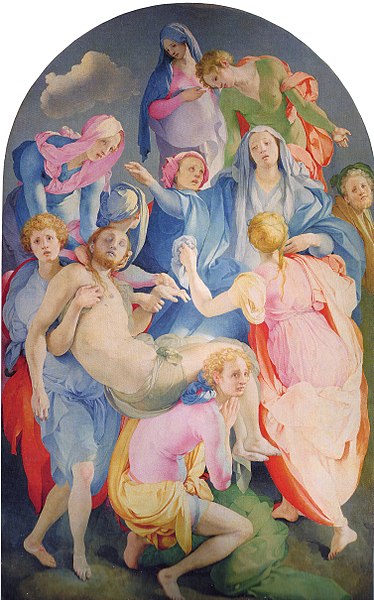
In the Passion cycle (1522–25) (above) for the Certosa near Florence, he borrowed ideas from the German artist Albrecht Dürer, whose engravings and woodcuts were circulating in Italy. His mature style is best exemplified in the Deposition (below) painted soon after this for Santa Felicità, Florence.


Madonna and Child with the Young Saint John - Jacopo Pontormo
Jacopo Pontormo
Madonna and Child with the Young Saint John, c.  1527
Oil on Wood
Galleria degli Uffizi, Florence, Italy

The composition is a great plastic concentration, echoing Michelangelo's Tondo Doni. The elongated forms derive from a typology of a heroic nature, possibly drawn from Michelangelo's Medici tombs in San Lorenzo, but Leonardo's influence is also still present, in the affectionate attitude of the Madonna bending towards the Child.


The figures are solid and well-defined, and the chiaroscuro, rendered with feeling, moulds the golden flesh surfaces with a yellowish light. More


File:Jacopo Pontormo - Kreuzabnahme Christi.jpg
Pontormo (1494–1557)
The Deposition, from 1526 until 1528
Oil on canvas
313 × 192 cm (123.2 × 75.6 in)
Chiesa Santa Felicità, Florence


This painting suggests a whirling dance of the grief-stricken. They inhabit a flattened space, comprising a sculptural congregation of brightly demarcated colors. The vortex of the composition droops down towards the limp body of Jesus off center in the left. Those lowering Christ appear to demand our help in sustaining both the weight of his body (and the burden of sin Christ took on) and their grief. No Cross is visible; the natural world itself also appears to have nearly vanished: a lonely cloud and a shadowed patch of ground with a crumpled sheet provide sky and stratum for the mourners. If the sky and earth have lost color, the mourners have not; bright swathes of pink and blue envelop the pallid, limp Christ. More


Pontormo (1494–1557)
Madonna and Child with Saints, c. 1518
Oil on wood
214 x 185 cm
San Michele Visdomini, Florence

Pontormo executed this painting for the chapel of Francesco di Giovanni Pucci in the church San Michele Visdomini in Florence. The painting, usually mentioned as the Pucci Altarpiece, portrays the Virgin with St John the Evangelist, Joseph, holding the baby Jesus, the young St John, St Francis and St James, the latter being the artist's self-portrait.

The figures are arranged in two areas, divided by a vertical axis, which forms the height of a triangle, at whose apex is the Virgin's head. 


The compositions of both the right part and the left part, although symmetrical and populated by an identical number of figures, are organized very differently. The complex twisting of the bodies and the many different directions of the gestures suggest the use of a grid of extremely complicated and dynamic geometrical schemes. The lines of vision go in all possible directions; in no instance do they cross or match, this emphasizing the psychological isolation of the figures. The facial features and expressions of the older Joseph and St John the Evangelist, as well as the laughing putti, are exaggeratedly pronounced. In short, everything combines to create an atmosphere of restless instability. More


Pontormo (1494–1557)
Madonna and Child with St. Joseph and Saint John the Baptist, c. 1521-27
Oil on canvas transferred from wood
120 x 99 cm
The Hermitage, St. Petersburg

In this superb example of Pontormo's style, the theme of a premonition of the predestined Passion grows smoothly from the centre to the edges and from the surface into the depth. From the infant amusing himself wit a young goldfinch, our gaze shifts to the Virgin's sad face, then to the resigned faces of Joseph and John the baptist, before finally plunging into the agitated gloom of the firmament, in front of the ominous cross looms More

Pontormo became more and more of a recluse in later life. A diary survives from 1554 to 1557, but the important frescoes in San Lorenzo on which he worked during the last decade of his life are now known only from drawings; in these the influence of Michelangelo is apparent. Numerous drawings survive, and paintings are to be found in various galleries in Europe and America, as well as in Florence.


Pontormo (1494–1557)
The Annunciation detail Virgin Annunciate, c. from 1527 until 1528
Fresco
Capponi Chapel, church of Santa Felicita in Florence

The Annunciation is a wall painting by the Italian mannerist artist Jacopo Pontormo, executed in 1527–1528 as part of his commission to decorate the Capponi Chapel in the church of Santa Felicita, Florence.

It is frescoed around the window on the wall adjacent to Pontormo's masterpiece, the famous Deposition from the Cross. Pontormo depicts the Annunciation, the revelation to Mary by the Archangel Gabriel that she would conceive a child to be born the Son of God, in a lively composition, with both figures in an elastic contrapposto. More


Pontormo (1494–1557)
Venus and Cupid, c. 1532-34
Oil on wood
128 x 197 cm
Galleria degli Uffizi, Florence

Venus turns her massive body into the picture plane, confronting the viewer with it and with the incestuous kiss she gives her young son - a juxtaposition recalling more conventional allegories of Charity. Her coolly classical face resembles the second of the two masks, symbols of the misleading nature of dreams. More


Acknowledgement: Wikipedia, Britannica