Showing posts with label Barbara Villiers. Show all posts

Sunday, August 16, 2015

The 11 Windsor Beauties by Sir Peter Lely, painted in the early to mid-1660s.

The ‘Windsor Beauties’ series, were a set of eleven portraits of celebrated women at the Restoration court. The series was commissioned, or assembled, by Anne Hyde, Duchess of York, probably around 1662-5; painted by Peter Lely (1618–1680) depicting the most beautiful ladies of the court of King Charles II of England. 

Peter Lely (1618–1680)
Portrait of Frances Theresa Stuart, Duchess of Richmond and Lennox, circa 1662 and circa 1665
Medium oil on canvas
125.8 × 102.7 cm (49.5 × 40.4 in)
Hampton Court Palace

Frances Teresa Stewart, Duchess of Richmond and Lennox (8 July 1647 – 15 October 1702) was a prominent member of the Court of the Restoration and famous for refusing to become a mistress of Charles II of England. For her great beauty she was known as La Belle Stuart and served as the model for an idealised, female Britannia.

she caught the eye of Charles II, who fell in love with her. The king's infatuation was so great that when the queen's life was despaired of in 1663, it was reported that he intended to marry Stewart, and four years later he was considering the possibility of obtaining a divorce to enable him to make her his wife because she had refused to become his mistress.

Following the war with the Dutch, Charles had a commemorative medal cast, in which her face was used as a model for Britannia; this subsequently became customary for medals, coins and statues. She continued to appear on some of the copper coinage of the United Kingdom until the decimalization of the currency in 1971.[2] She also appeared on the fifty pence piece in 2006. More on Frances Teresa Stewart

Lely flattered his subjects, and gave each portrait a similar languorous and ‘sleepy eyed’ air, said to have been influenced by the features of the noted court beauty Barbara Villiers, Duchess of Cleveland who was painted many times by Lely. Only one of the sitters, Frances Teresa Stuart actually held the position of Maid of Honour in the Royal Household. Some of the others were noted courtesans, while others were respected members of the nobility.
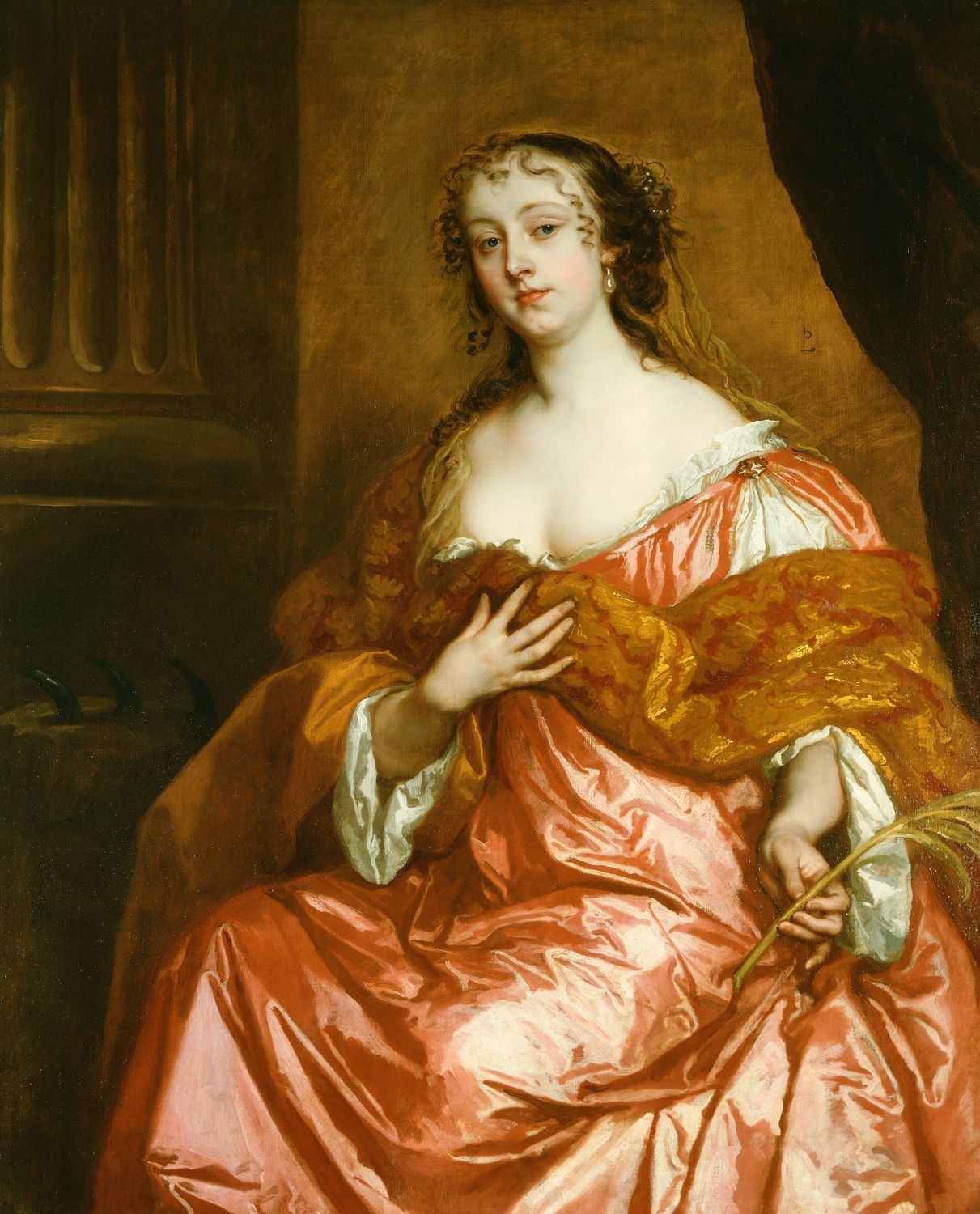
Peter Lely (1618–1680)
La Belle Hamilton, Elizabeth, Countess of Gramont, circa 1663
Oil on canvas
125.1 × 101.6 cm (49.3 × 40 in)
Hampton Court Palace

Elizabeth, Countess de Gramont (née Hamilton; 1640 – 3 June 1708), was an Irish-born courtier and a lady-in-waiting to Louis XIV's queen consort, Maria Theresa of Spain. Shewas born in Strabane, Ireland. She became a member of the English court in 1661. She was described as a great beauty and became known for her judgement, charm and sensibility. She was much courted, by — among others — the Duke of York, the Duke of Richmond and the Heir of Norfolk, but she reportedly rejected them all.

She was married in London to Philibert, Count de Gramont, a French exile at the English court. "La belle Hamilton" was one of the great beauties of the English court. When Gramont was given permission to return to France, however, he left in a haste.

She followed her spouse to France in 1669, where she was made Dame du Palais to the French queen. She was a woman of considerable wit, and held her own at the court of Louis XIV, but her husband pursued his gallant exploits to the close of a long life. In 1696, her spouse was afflicted with a grave illness, and after he recovered, he turned to a religious life, in which she followed him. She died one year after being widowed. More on Elizabeth

In 1674, after the death of Anne Hyde, the pictures were hanging as a group in the White Room at Whitehall. Eleven pictures are mentioned in the inventory, although only ten are identified today as belonging to the group. The series was taken from Whitehall to Windsor. During the reign of Queen Anne they were hung in the Queen’s Waiting Room and later in the Queen’s State Bedchamber. They were at Hampton Court by June 1835. More on The Windsor Beauties

Peter Lely (1618–1680)
Jane Needham, Mrs Myddleton (1646-92) with a cornucopia, possibly as Demeter
Oil on canvas
124.1 × 101.6 cm (48.9 × 40 in)
Hampton Court Palace

Jane Myddelton or Middleton (1645–1692), was a reputed English beauty of the Restoration period. Sshe was born at Lambeth during the latter part of 1645, and baptised in Lambeth Church on 23 January 1646.

Jane was married at Lambeth Church on 18 June 1660 to Charles Myddelton of Ruabon, third surviving son of Sir Thomas Myddelton of Chirk. Myddelton and his wife lived in London and appear to have subsisted for a time upon the bounty of relatives. A legacy from Lady Needham fell in upon that lady's death in 1666, and another upon Sir Thomas Myddelton's death in the same year.

After the accession of James II, "Mrs. Myddelton" enjoyed an annual pension of £500 from secret service money. Her husband, who had for some years held a place of about £400 a year in the prize office, died insolvent in 1691. She died in the following year, and was buried beside her husband in Lambeth Church.

As a married woman was much courted by men; she is now thought to have taken just two lovers, Ralph Montagu and Laurence Hyde, 1st Earl of Rochester. Antonia Fraser writes that her life "was founded on masculine support in return for sexual favours", but also that her affairs "were seen more as a tribute paid to her great beauty". She was an amateur artist capable of contributing to the iconography of her portraits. Besides that by Peter Lely in the "Windsor Beauties" series, there was second Lely portrait (1666) commissioned by Robert Spencer, 2nd Earl of Sunderland for another series. More on Jane Myddelton

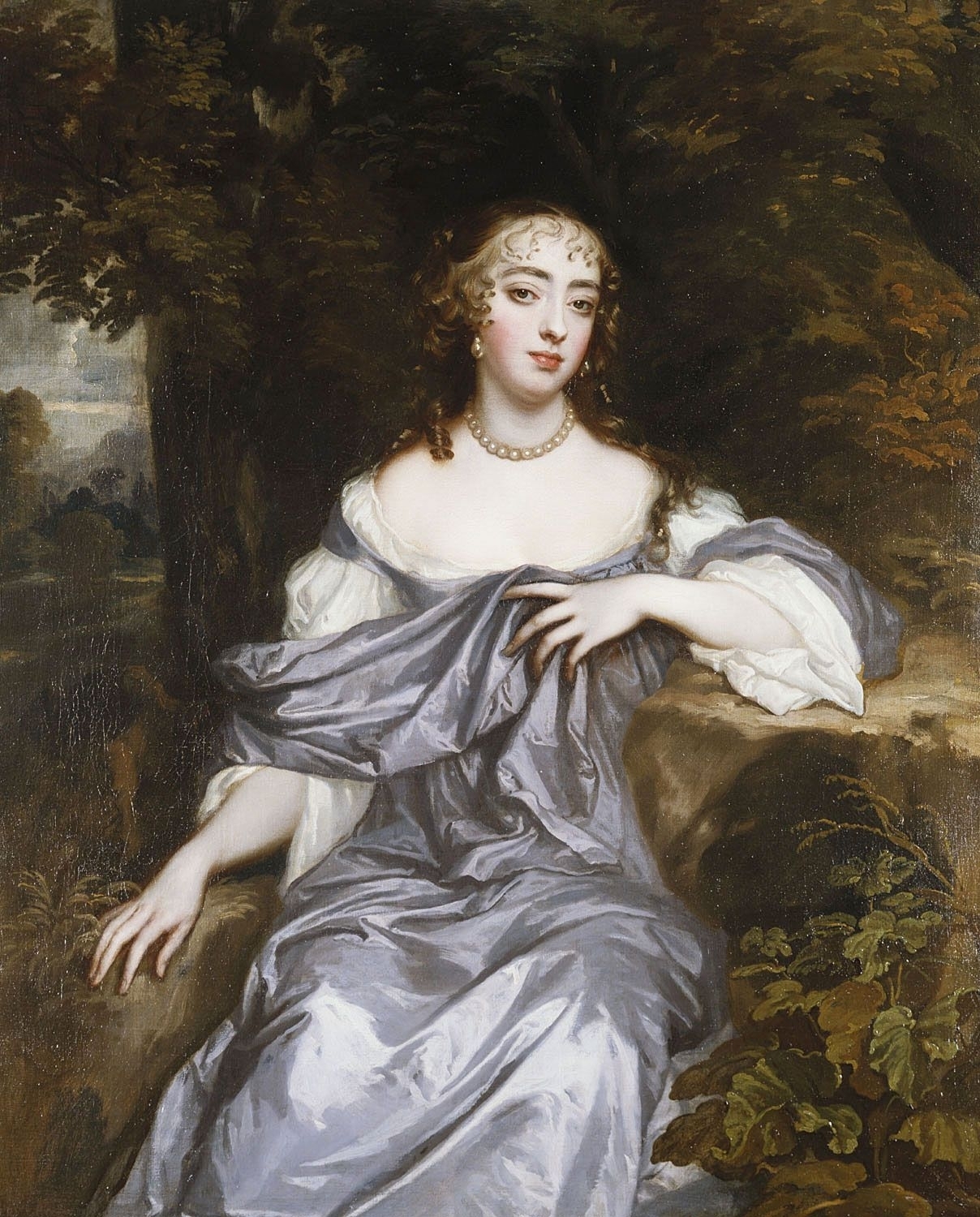
Peter Lely (1618–1680)
Margaret Brooke, Lady Denham (ca 1647-67)
Oil on canvas
124.5 × 101 cm (49 × 39.8 in)
Hampton Court Palace

Margaret Brook, Lady Denham,  (ca 1647-67), was married to a man twice her age. Determined to make her own way at Court and in Restoration England. The way to social advancement for a pretty young woman, was to catch the eye of the king or his brother. Her attempts to set her cap at King Charles II were thwarted by the king’s principal mistress Barbara Palmer, turning her attention to his brother, the Duke of York. By June 1666 the Duke of York was wholly given up her. Lady Denham, declared that she woul not be his mistress, but would be owned publicly.  The affair ended in tragedy with her sudden death. She believed she had been poisoned and insisted before she died that an autopsy should be carried out. No trace of poison was found but it did not allay public suspicion that her husband Sir John Denham had murdered her with a poisoned cup of cocoa at the behest of the jealous Duchess of York, an early example of death by chocolate. More on Margaret Brook

Peter Lely (1618–1680)
Frances Brooke, Lady Whitmore (d. 1690), circa 1665
Frances Brooke, Lady Whitmore was the sister was Margaret Brooke, Lady Denham, above
Oil on canvas
124.4 × 101.3 cm (49 × 39.9 in)
Hampton Court Palace

Hon. Frances Brooke (1640 – c. 1690) was a British courtier. She was styled Hon. Frances Brooke, and then Lady Whitmore. She was granted the style of a daughter of a baron. 

Her father was Sir William Brooke (1601–1643), and her mother was Penelope Hill ( -c.1694). Frances was first married to Sir Thomas Whitmore ( -1682), had three children with him. She then married Matthew Harvey ( -c.1693/94). She lead a life of quiet domesticity away from the hurly burly of court life. More on Frances Brooke

Peter Lely (1618–1680)
Mary Bagot, Countess of Falmouth and Dorset (1645-79)
circa 1664 and circa 1665
Oil on canvas
124.3 × 101.3 cm (48.9 × 39.9 in)
Current location
Hampton Court Palace

Mary, Countess of Falmouth and Dorset (1645 – 1679) was a British courtier. She was one of the Windsor Beauties painted by Sir Peter Lely. Her portrait by Lely was erroneously named "Elizabeth, Countess of Falmouth" and also as "Countess of Ossory" in some portrait prints and books in the 18th and 19th centuries, many of which were later reprinted, compounding the error.

Her father was Col. Henry Bagot, and mother was Dorothea Arden. She married Charles Berkeley, 1st Earl of Falmouth in 1663. He died at the Battle of Lowestoft. The widowed Countess of Falmouth, lady-of-the-bedchamber to the Queen appears in the various lists of the King’s mistresses, though apparently not as one of the main contenders. She then married Charles Sackville, 6th Earl of Dorset in June 1674. This second marriage for Mary Bagot terminated after five years with her death in childbirth. More on Mary Bagot

Peter Lely (1618–1680)
Henrietta Boyle, Countess of Rochester (1646-87)
circa 1665
Oil on canvas
124.4 × 101.4 cm (49 × 39.9 in)
Hampton Court Palace

Henrietta Hyde, Countess of Rochester (née Boyle; 1646 – 12 April 1687) was an English noblewoman, daughter of the Richard Boyle, 1st Earl of Burlington, whose namesake went on to build the stunning Chiswick House. She was born in Wiltshire, England to Sir Richard Boyle, 2nd Earl of Cork and Elizabeth Boyle, Countess of Cork. In 1665 she married Laurence Hyde, 1st Earl of Rochester; becoming sister-in-law to Anne Hyde, Duchess of York. She was later Governess to Anne's daughter, Princess Anne, between 1677 and 1682 . Henrietta had four children. 

Like most of the Boyle dynasty, who in the space of two generations had become almost all-powerful in the south of Ireland, Henrietta was strong-minded and acquisitive, and could be ruthless in asserting her rights. During the last two years of her life, when her husband was Chief Minister to his brother-in-law King James II, Henrietta took full advantage of his power to claim every possible privilege. She clashed bitterly with her husband's niece, the future Queen Anne over who should have the best apartments in Whitehall Palace. She died 1687 in her 42nd year. More on Henrietta Boyle

File:Barbara Villiers, Duchess of Cleveland, 1662 by Lely.jpg
Peter Lely (1618–1680)
Barbara Villiers, 1st Duchess of Cleveland (ca 1641-1709)
circa 1665
Oil on canvas
124.5 × 101.4 cm (49 × 39.9 in)
Hampton Court Palace

Barbara Palmer, 1st Duchess of Cleveland, Countess of Castlemaine, also known as Lady Castlemaine (27 November 1640 – 9 October 1709) was an English courtesan from the Villiers family and perhaps the most notorious of the many mistresses of King Charles II of England, by whom she had five children, all of whom were acknowledged and subsequently ennobled. Her influence was so great that she has been referred to as "The Uncrowned Queen." Her immediate contemporary was Madame de Montespan, mistress of King Louis XIV of France.

Barbara was the subject of many portraits, in particular by court painter Sir Peter Lely. Her extravagance, foul temper and promiscuity provoked diarist John Evelyn into describing her as the "curse of the nation", whereas Samuel Pepys often noted seeing her, admiringly.

Barbara's 1st cousin Elizabeth Villiers (later 1st Countess of Orkney 1657–1733) was the only acknowledged mistress of King William III. More on Barbara Palmer

Peter Lely (1618–1680)
Anne Digby, Countess of Sunderland (ca 1646-1715)
before 1666
Oil on canvas
124.9 × 101.8 cm (49.2 × 40.1 in)
Hampton Court Palace

Anne Spencer, Countess of Sunderland (née Digby; c. 1646 – 26 April 1715) was the wife of Robert Spencer, 2nd Earl of Sunderland and the daughter of George Digby, 2nd Earl of Bristol and Lady Anne Russell.

Sunderland had previously broken off their long-standing engagement. He told his friends that he had reason enough and was resolved never to have her. He soon had second thoughts and their mothers worked together to produce a reconciliation which resulted in an entirely successful marriage. She was a lady-in-waiting to Mary of Modena during the reign of James II, and was present at the birth of the Prince of Wales, signalling to the king that his new child was a boy.

She is alleged to have had an affair with Henry Sidney, Earl of Romney, her husband's uncle. Her devotion to her husband was never seriously questioned; his biographer considered that it was principally his happy marriage which sustained Sunderland through a long and unhappy life.

She had at least five children by Sunderland, only one of whom outlived her. More on Anne Spencer

File:Elizabeth Wriothesley, Countess of Northumberland.jpg
Peter Lely (1618–1680)
Lady Elizabeth Wriothesley, later Countess of Northumberland, later Countess of Montagu (1646-90), mother of Lady Elizabeth Percy, Countess of Ogle
circa 1665
Oil on canvas
125.7 × 103.5 cm (49.5 × 40.7 in)
Hampton Court Palace

Elizabeth Percy, Countess of Northumberland (née Wriothesley; 1646 – 19 September 1690), was a British courtier. Her father was Thomas Wriothesley, 4th Earl of Southampton, and her mother was Lady Elizabeth Leigh, daughter of the 1st Earl of Chichester.


She married Joceline Percy, 11th Earl of Northumberland, on 23 December 1662. They had two children. She traveled with her husband to Italy, where he was taken ill and died in Turin, the next year. Upon his death, being a wealthy heiress, she married Ralph Montagu, 1st Duke of Montagu, at Titchfield, Hampshire, on 24 August 1673. More on Elizabeth Wriothesley

Peter Lely (1618–1680)
Henrietta of England, Duchess of Orléans seated in a landscape
c. 1662
Oil on Canvas

Henrietta of England (16 June 1644 (26 June n.s.) – 30 June 1670) was the youngest daughter of King Charles I of England, Scotland and Ireland and his wife, Henrietta Maria of France. Fleeing England with her governess at the age of three, she moved to the court of her first cousin Louis XIV of France, where she was known as Minette. After she married Philippe of France, brother of King Louis XIV, she became known as Madame. Very popular with the court, her marriage was marked by frequent tensions. Henrietta was instrumental in negotiating the Secret Treaty of Dover prior to her unexpected death in June 1670. More on Henrietta of England

Sir Peter Lely (14 September 1618 – 30 November 1680) was a painter of Dutch origin, whose career was nearly all spent in England, where he became the dominant portrait painter to the court. Lely was born Pieter van der Faes to Dutch parents in Soest in Westphalia, where his father was an officer serving in the armed forces of the Elector of Brandenburg. Lely studied painting in Haarlem. He became a master of the Guild of Saint Luke in Haarlem in 1637. 

He arrived in London in around 1641. His early English paintings, mainly mythological or religious scenes, or portraits set in a pastoral landscape. Lely's portraits were well received, and became the most fashionable portrait artist in England. He became a freeman of the Painter-Stainers' Company in 1647 and was portrait artist to Charles I. His talent ensured that his career was not interrupted by Charles's execution, and he served Oliver Cromwell, whom he painted "warts and all", and Richard Cromwell. 

After the English Restoration in 1660, Lely was appointed as Charles II's Principal Painter in Ordinary in 1661. Lely became a naturalised English subject in 1662. 

Among his most famous paintings are a series of 10 portraits of ladies from the Royal court, known as the "Windsor Beauties", formerly at Windsor Castle but now at Hampton Court Palace; a similar series for Althorp; a series of 12 of the admirals and captains who fought in the Second Anglo-Dutch War, known as the "Flagmen of Lowestoft", now mostly owned by the National Maritime Museum in Greenwich; and his Susannah and the Elders at Burghley House.

His most famous non-portrait work is probably Nymphs by a fountain in Dulwich Picture Gallery.

Lely was knighted in 1680. He died soon afterwards at his easel in Covent Garden, while painting a portrait of the Duchess of Somerset, and was buried at St Paul's Church, Covent Garden. More on Sir Peter Lely


Please visit my other blogs: Art CollectorMythologyMarine ArtPortrait of a Lady, The OrientalistArt of the Nude and The Canals of VeniceMiddle East Artists365 Saints and 365 Days, also visit my Boards on Pinterest

Images are copyright of their respective owners, assignees or others. Some Images may be subject to copyright

I don't own any of these images - credit is always given when due unless it is unknown to me. if I post your images without your permission, please tell me.

I do not sell art, art prints, framed posters or reproductions. Ads are shown only to compensate the hosting expenses.

If you enjoyed this post, please share with friends and family.

Thank you for visiting my blog and also for liking its posts and pages.

Please note that the content of this post primarily consists of articles available from Wikipedia or other free sources online.

Saturday, August 8, 2015

19 Portraits of Barbara Villiers; Duchess of Cleveland and mistress to King Charles II

Sir Peter Lely. A 17th Century
Portrait of Barbara Villiers
Oil on Canvas
28 ins x 23½ ins (71 cms x 60 cms)
Private collection

Sir Peter Lely (14 September 1618 – 30 November 1680) was a painter of Dutch origin, whose career was nearly all spent in England, where he became the dominant portrait painter to the court. Lely studied painting in Haarlem. He became a master of the Guild of Saint Luke in Haarlem in 1637.

He arrived in London in around 1641. His early English paintings, mainly mythological or religious scenes, or portraits. Lely's portraits were well received, and he succeeded Anthony van Dyck as the most fashionable portrait artist in England. He became a freeman of the Painter-Stainers' Company in 1647 and was portrait artist to Charles I. His talent ensured that his career was not interrupted by Charles's execution, and he served Oliver and Richard Cromwell. More on Sir Peter Lely


Barbara was the subject of many portraits, in particular by court painter Sir Peter Lely. Her extravagance, foul temper and promiscuity provoked diarist John Evelyn into describing her as the "curse of the nation", whereas Samuel Pepys often noted seeing her, admiringly.

Barbara Palmer, 1st Duchess of Cleveland, Countess of Castlemaine, also known as Lady Castlemaine (27 November 1640 – 9 October 1709) was an English courtesan from the Villiers family and perhaps the most notorious of the many mistresses of King Charles II of England, by whom she had five children, all of whom were acknowledged and subsequently ennobled. Her influence was so great that she has been referred to as "The Uncrowned Queen."

Henri Gascar  (1635–1701)
Portrait of Barbara Palmer, 1st Duchess of Cleveland (1641-1709), mistress of Charles II of England, circa 1650-1700
Oil on canvas
Height: 43 cm (16.9 in); Width: 38 cm (14.9 in)
National Trust

Henri Gascar (1635 – 1 Jan 1701) was a French-born portrait painter who achieved artistic success in England during the reign of Charles II. He painted many leading ladies at court, including several of the King's mistresses, before returning to Paris. He subsequently relocated to Rome, where he died in 1701.

Born at the parish of St. Margaret's, Westminster, London, she was the only child of the 2nd Viscount Grandison, William Villiers, and his wife, Mary Bayning. On 20 September 1643, her father died in the English Civil War from a wound sustained at the Battle of Newbury while fighting for the Royalists; leaving his widow and daughter in straitened circumstances. Shortly after Lord Grandison's death, Barbara's mother married Charles Villiers, 2nd Earl of Anglesey, a cousin of her late husband.

File:Barbara Villiers.jpg
Peter Lely  (1618–1680)
Portrait of Barbara Palmer, née Villiers, Lady Castlemaine and Duchess of Cleveland, c. 17th century
Oil on canvas
Schorr Collection

Barbara Villiers was considered to be one of the most beautiful of the Royalist women, but her lack of fortune left her with reduced marriage prospects. On 14 April 1659 she married Roger Palmer (later 1st Earl of Castlemaine) against his family's wishes; his father predicted that she would make him one of the most miserable men in the world. Palmer was a Roman Catholic. The two separated in 1662, following the birth of her first son. They remained married for his lifetime.

File:Barbara Palmer (née Villiers), Duchess of Cleveland by Sir Peter Lely.jpg
Peter Lely (1618–1680)
Barbara Palmer, Duchess of Cleveland, circa 1666
Oil on canvas
H 124.5 x W 101 cm
National Portrait Gallery, London

Barbara Villiers, Duchess of Cleveland as St. Catherine of Alexandria, c.1665-70 (oil on canvas) Posters & Prints by Sir Peter Lely
Peter Lely (1618–1680)
Barbara Villiers, Duchess of Cleveland as St. Catherine of Alexandria, c.1665-70
Oil on canvas
Private collection

Barbara became King Charles' mistress in 1660, while still married to Palmer, and whilst Charles was still in exile at The Hague. The Palmers had joined the ambitious group of supplicants who sailed for Brussels at the end of 1659. As a reward for her services, the King created her husband Baron Limerick and Earl of Castlemaine in 1661. In many contemporary accounts, including Pepys's Diary, she is referred to as "Lady Castlemaine".

John Michael Wright  (1617–1694)
Barbara Palmer (née Villiers), Duchess of Cleveland, circa 1670
Oil on canvas Edit this at Wikidata
Height: 122.8 cm (48.3 in); Width: 133 cm (52.3 in)
National Portrait Gallery

Barbara Villiers was a skilful manipulator of her image and was frequently portrayed. Wright depicts her as a shepherdess, a guise that may reflect her role in a court masque. More on this painting

John Michael Wright (May 1617 – July 1694) was a portrait painter in the Baroque style. Described variously as English and Scottish, Wright trained in Edinburgh, and acquired a considerable reputation as an artist and scholar during a long sojourn in Rome. There he was admitted to the Accademia di San Luca, and was associated with some of the leading artists of his generation. He took up permanent residence in England from 1656, and served as court painter before and after the English Restoration. A convert to Roman Catholicism, he was a favourite of the restored Stuart court, a client of both Charles II and James II, and was a witness to many of the political maneuverings of the era. In the final years of the Stuart monarchy he returned to Rome as part of an embassy to Pope Innocent XI. More

By 1662, Barbara, the King's mistress, had more influence at the court than his queen consort, Catherine of Braganza. Barbara chose to give birth to their second child at Hampton Court Palace while he and the queen were honeymooning. In the summer of 1662 she was appointed Lady of the Bedchamber despite opposition from Queen Catherine and Edward Hyde, 1st Earl of Clarendon, chief advisor to the King and a bitter enemy of Barbara's. 

Workshop of Peter Lely  (1618–1680)
Portrait of Barbara Villiers, Duchess of Cleveland and Countess Castlemaine (1640–1709), circa 1670
Oil on canvas
Height: 231 cm (90.9 in); Width: 137 cm (53.9 in)
Private collection

Barbara's influence over the King waxed and waned. Her victory in being appointed as Lady of the Bedchamber was followed by rumours of an estrangement between her and the King, the result of his infatuation with Frances Stuart. In December 1663, Barbara announced her conversion to Roman Catholicism. Historians disagree as to why she did so. Some believe it was an attempt to consolidate her position with the King, and some believe it was a way of strengthening her ties with her Catholic husband. The King treated the matter lightly, saying that he was interested in ladies' bodies, but not their souls. The Court was equally flippant, the general view being that the Church of Rome gained nothing and the Church of England lost nothing.

Anonymous, style of Sir Peter Lely (Soest 1618 – London 1680)
Barbara Villiers, Countess of Castlemaine and Duchess of Cleveland (1640-1709), between circa 1620 and circa 1709
Oil on canvas
Height: 121.9 cm (47.9 in); Width: 97.8 cm (38.5 in)
National Trust

A three-quarter-length portrait of a young woman, seated, turned slightly to the left, head inclined to the right, gazing at the spectator, her cheek resting on her left hand and her right hand which is on her lap is holding a bunch of forget-me-nots which she is feeding to a lamb on the right. She wears a white décolleté chemise under a grey gown which has fallen down on her lap and she is seated beheath a large tree and a distant tree-filled landscape with sky can be seen on the left. More on this painting

In June 1670 Charles created her Baroness Nonsuch (as she was the owner of Nonsuch Palace). She was also, briefly, granted the ownership of Phoenix Park in Dublin as a present from the King. She was made Countess of Castlemaine and Duchess of Cleveland in her own right. However, no one at court was sure if this was an indication that she was being jettisoned by Charles, or whether this was a sign that she was even higher in his favours. The dukedom was made with a special remainder which allowed it to be passed to her eldest son, Charles FitzRoy, despite his illegitimacy.

Peter Lely (1618–1680)
Barbara Villiers, Countess of Castlemaine and Duchess of Cleveland
Oil on canvas
76.2 x 66.1 cm
UCL Art Museum

Barbara was known for her dual nature. Diarist John Evelyn called her "the curse of the nation"; yet, others described her as great fun, keeping a good table and with a heart to match her famous temper. Lady Barbara took advantage of her influence over the King, using it to her own benefit. She would help herself to money from the Privy Purse and take bribes from the Spanish and the French. She was famously extravagant and promiscuous. 

Sir Peter Lely 1618–1680
Portrait of an Unknown Woman, c. c.1670–5
Oil paint on canvas
1251 × 1003 mm
Tate

Lely's debt to van Dyck's work is evident in the seated three-quarter-length composition, the rich billowing curtain and the stone window opening to the left. While the identity of the sitter is uncertain, her bared breast suggests that she is some powerful man's mistress rather than a lady of impeccable virtue. Her left hand rests on a golden object, perhaps the jar that symbolises the reformed biblical sinner Mary Magdalene. Her other hand quietens an attentive spaniel, a breed often identified with the Stuart royal family.The inscription on the ledge, 'Dutchess of Cleveland', was probably added a century later. More on this painting

While the King had taken other mistresses, Barbara took other lovers too. Her lovers benefited financially from the arrangement. The King, who was no longer troubled by Barbara's infidelity. As the result of the 1673 Test Act, which essentially banned Catholics from holding office, Barbara lost her position as Lady of the Bedchamber, and the King cast her aside completely from her position as a mistress. The King advised Barbara to live quietly and cause no scandal, in which case he "cared not whom she loved".

Peter Lely (1618–1680)
Barbara Villiers, Countess of Castlemaine and Duchess of Cleveland
Oil on canvas
I have no further description, at this time

In 1676 she travelled to Paris with her four youngest children, but returned to England four years later. She was reconciled with the King, who was seen enjoying an evening in her company a week before he died in February 1685. She died at the age of 68 on 9 October 1709 at Chiswick Mall after suffering from oedema, known at the time as dropsy. Today, this would be described as oedema of the legs, with congestive heart failure.

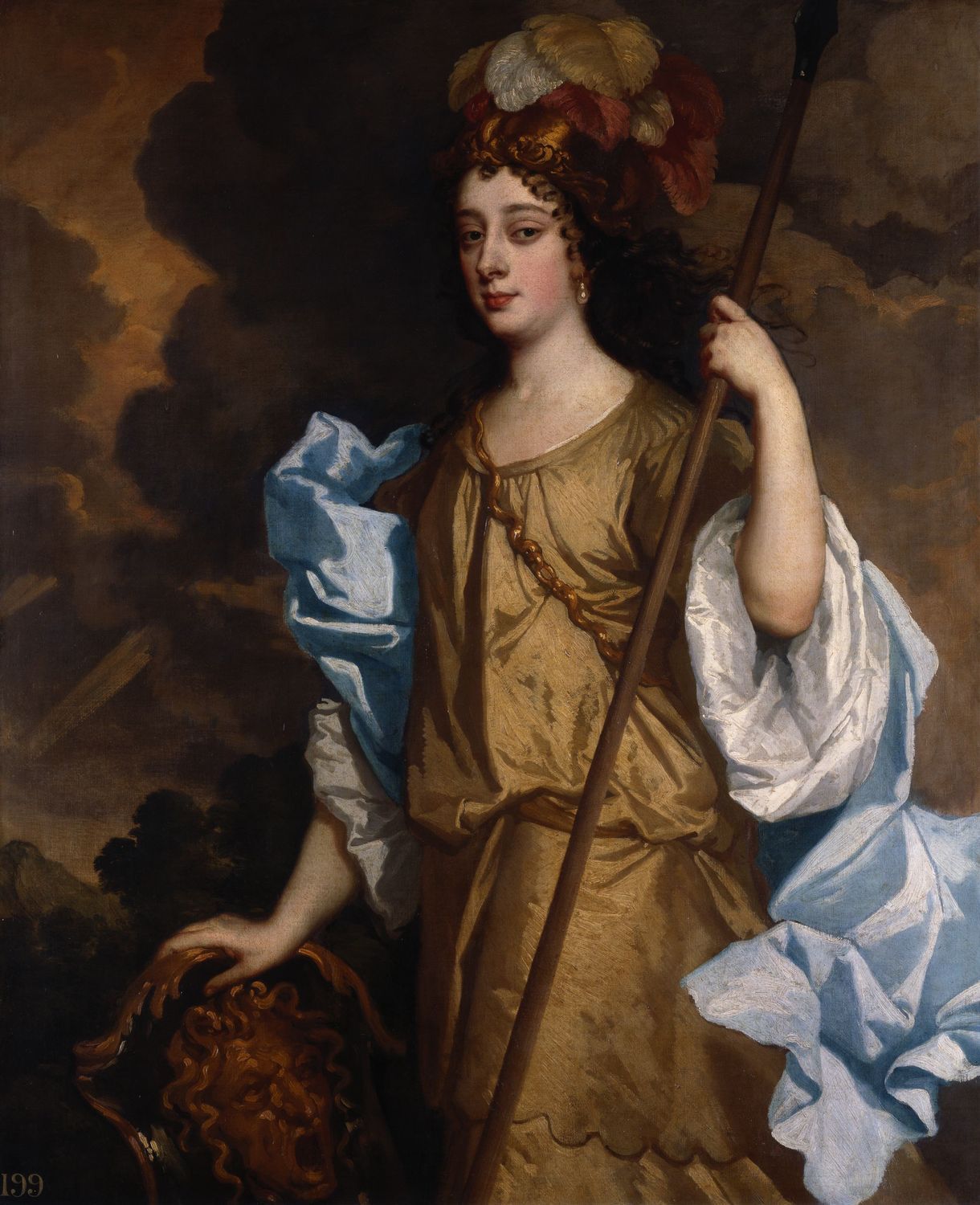
Peter Lely (1618–1680)
Barbara Palmer, 1st Duchess of Cleveland as Minerva, the Roman goddess of war and wisdom, circa 1665
Oil on canvas
124.5 × 101.4 cm (49 × 39.9 in)
Hampton Court Palace

Of her six children, five were acknowledged by Charles as his:
  • Lady Anne Palmer, later FitzRoy (1661–1722), probably daughter of Charles II, although some people believed she bore a resemblance to the Earl of Chesterfield. She later became the Countess of Sussex.
  • Charles Palmer, later FitzRoy (1662–1730), styled Lord Limerick and later Earl of Southampton, created Duke of Southampton (1675), later 2nd Duke of Cleveland (1709)
  • Henry FitzRoy (1663–1690), created Earl of Euston (1672) and Duke of Grafton (1675)
  • Charlotte FitzRoy (1664–1718), later Countess of Lichfield. She gave birth to twenty children.
  • George FitzRoy (1665–1716), created Earl of Northumberland (1674) and Duke of Northumberland (1683)
  • Barbara (Benedicta) FitzRoy (1672–1737) – Barbara Villiers claimed that she was Charles's daughter, but she was probably the child of her mother's second cousin and lover, John Churchill, later Duke of Marlborough
File:Barbara Palmer (née Villiers), Duchess of Cleveland with her son, Charles Fitzroy, as Madonna and Child by Sir Peter Lely (2).jpg
Peter Lely (1618–1680)
Duchess of Cleveland with her son, Charles Fitzroy, as Madonna and Child, c. 1664
Oil on canvas
National Portrait Gallery

Peter Lely (1618–1680)
Barbara Villiers, Countess of Castlemaine and Duchess of Cleveland (1641-1709) with her Daughter, Lady Charlotte Fitz Roy (1664 - 1718), c. 1664 - 1666
Oil on canvas
1822 x 1283 mm (71 3/4 x 50 1/2 in)
Hatchlands Park, Surrey

William Sherwin
Barbara Villiers, Countess of Castlemaine and Duchess of Cleveland (1640-1709) as a Shepherdess
Oil on canvas
743 x 622 mm (29 1/4 x 24 1/2 in)
Blickling Hall, Norfolk

William Sherwin (1645–1709) was an English engraver, born at Wallington, Hertfordshire, where his father was rector around 1645. On his print of his father, dated 1672, he styles himself engraver to the king by patent. He married Elizabeth Pride, great-niece and ward of George Monck, 1st Duke of Albemarle, whose heir-at-law she eventually became, and there exists a pedigree of the Moncks of Potheridge engraved by Sherwin expressly to show his wife's claim to that position.

Between 1670 and 1711 he engraved in the line style a number of portraits. These comprise large plates of Charles II, Catherine of Braganza, Prince Rupert, Baron Gerard of Brandon, the Duchess of Cleveland, and Slingsby Bethell. 

Sherwin was one of the first workers in mezzotint, a technique he learned from Prince Rupert. He dedicated to the Prince a pair of large portraits of Charles II and his queen engraved by the method; the former of these is dated 1669, the earliest found on an English mezzotint. More on William Sherwin

Barbara Villiers, Countess of Castlemaine, 1st Duchess of Cleveland, Peter Lely
Studio of Sir Peter Lely (Westphalia 1618-1680 London)
Portrait of Barbara Villiers, Countess of Castlemaine, 1st Duchess of Cleveland (1640-1709)
Oil on canvas
82½ x 52¾ in. (209.6 x 134 cm.)
Private collection

Peter Lely (1618–1680)
Barbara Villiers (1641–1709), Countess of Castlemaine and Duchess of Cleveland, Granddaughter of Barbara St John
Oil on canvas
123 x 101 cm
Lydiard House

Barbara, Countless of Castlemaine Posters & Prints by Anonymous
Anonymous
Barbara Villiers, Countess of Castlemaine, 1st Duchess of Cleveland
Oil on canvas
I have no further description, at this time

File:Barbara Palmer (née Villiers), Duchess of Cleveland by Sir Godfrey Kneller, Bt.jpg
Sir Godfrey Kneller (1646–1723)
Barbara Palmer (née Villiers), Duchess of Cleveland, circa 1705
Oil on canvas
49 in. x 39 3/4 in. (1245 mm x 1010 mm)
National Portrait Gallery, London

Sir Godfrey Kneller, 1st Baronet (born Gottfried Kniller; 8 August 1646 – 19 October 1723) was the leading portrait painter in England during the late 17th and early 18th centuries, and was court painter to English and British monarchs from Charles II to George I. His major works include The Chinese Convert (1687; Royal Collection, London); a series of four portraits of Isaac Newton painted at various junctures of the latter's life; a series of ten reigning European monarchs, including King Louis XIV of France; over 40 "Kit-cat portraits" of members of the Kit-Cat Club; and ten "beauties" of the court of William III, to match a similar series of ten beauties of the court of Charles II painted by his predecessor as court painter, Sir Peter Lely. More on Sir Godfrey Kneller


Please visit my other blogs: Art CollectorMythologyMarine ArtPortrait of a Lady, The OrientalistArt of the Nude and The Canals of VeniceMiddle East Artists365 Saints and 365 Days, also visit my Boards on Pinterest

Images are copyright of their respective owners, assignees or others. Some Images may be subject to copyright

I don't own any of these images - credit is always given when due unless it is unknown to me. if I post your images without your permission, please tell me.

I do not sell art, art prints, framed posters or reproductions. Ads are shown only to compensate the hosting expenses.

If you enjoyed this post, please share with friends and family.

Thank you for visiting my blog and also for liking its posts and pages.

Please note that the content of this post primarily consists of articles available from Wikipedia or other free sources online.