Showing posts with label Edouard Vuillard. Show all posts

Friday, October 27, 2017

05 Paintings, PORTRAIT OF A LADY, of the 18th & 19th C., with Footnotes. #16

John Duncan Fergusson, R.B.A. 1874–1961
In the Patio: Margaret Morris Fergusson
Oil on canvas
71 x 61 cm
 Scottish National Gallery of Modern Art

This is a portrait of the artist's wife Margaret Morris (1891-1980), an influential innovator in modern dance and an accomplished artist in her own right. She studied dance in Paris and by 1910 was established in London with her own dance school, becoming London’s youngest theatre manager two years later. Morris met Fergusson in Paris in 1913 and they moved to Glasgow in 1939. Together they collaborated on many dance projects and Morris helped to lay the foundations for modern dance practice. Fergusson's paintings often have erotic overtones - here the shapes of the fruit echo the forms of the breasts. He has used a reduced palette of colours and created harmony within the composition through the repeated use of arcs, on the head, still-life elements and arches in the background..More on this painting

John Duncan Fergusson, (b Leith , 9 Mar. 1874; d Glasgow, 30 Jan. 1961). Scottish painter (mainly of landscapes and figure subjects) and occasional sculptor, the best known of the Scottish Colourists. From about 1895 he made regular visits to Paris and he lived there 1907–14. His early work was Whistlerian and he then came under the influence of Manet, but by 1907 he had adopted the bold palette of Fauvism and became the most uncompromising adherent to the style among British artists (Blue Beads, 1910, Tate, London). More on John Duncan Fergusson

GUILLAUME SEIGNAC, French (1870-1924) 
Indolence
Oil on canvas
24 x 20 3/4 inches 
Private collection

An idle dreamer, one who lives a life of indolence and ease. The lotus-eaters or lotophagi are a mythical people found in Homer’s Odyssey. Odysseus discovers them in a state of dreamy forgetfulness and contentment induced by their consumption of the legendary lotus fruit. Having lost all desire to return to their homelands, they want only to remain in Lotus-land living a life of idle luxury. Use of the term dates from the first half of the 19th century. More on Indolence

Guillaum Seignac (1870–1924) was a French academic painter. He was born in Rennes in 1870, and died in Paris in 1924. He started training at the Académie Julian in Paris, where he spent 1889 through 1895. He had many teachers there, including Gabriel Ferrier, William-Adolphe Bouguereau, and Tony Robert-Fleury. In addition to his training in the academic style, much of Seignac's work displayed classical themes and style, for example, his use of diaphanous drapery covering a woman's body is reminiscent of classical style, in particular the sculptor Phidias. In 1897, Guillaume Seignac regularly exhibited at the Salon and won several honors, including in 1900 honorable mention and in 1903 a Third Class medal. More Guillaum Seignac

Guillaum Seignac made several paintings named 'Indolence' using the same model


Edouard Vuillard, (1868-1940)
Yvonne Printemps au fauteuil, c. 1921' (lower right)
Peinture à la colle on canvas
51 1/8 x 38 1/8 in. (129.9 x 96.9 cm.)
Private collection

Yvonne Printemps (French; 25 July 1894 – 19 January 1977) was a French singer and actress who achieved stardom on stage and screen in France and internationally.

She made her debut as a performer at the age of 12 in a revue at La Cigale in Paris. At 21 she was singled out by the actor, director and playwright Sacha Guitry as a leading lady. In 1919 they were married, and worked closely together until 1932, when they divorced. Printemps never remarried, but had a personal and professional partnership with the actor Pierre Fresnay which lasted until his death in 1975.

Edouard Vuillard,  (1868-1940)
Yvonne Printemps and Sacha Guitry, c. 1917
Oil, paper
89 x 63 cm
Museu de Arte de São Paulo - São Paulo, Brazil

Yvonne Printemps. As a performer, Printemps was famed for the quality of her singing voice and for her personal charm. Among those who composed for her were André Messager, Reynaldo Hahn, Noël Coward and Francis Poulenc. Her voice could have led her to an operatic career, but guided by Guitry she concentrated on operette and other types of musical show, along with non-musical plays and films. In addition to her many successes in Paris she appeared to great acclaim in the West End of London, and on Broadway in New York. More on Yvonne Printemps

Jean-Édouard Vuillard (11 November 1868 – 21 June 1940) was a French painter and printmaker associated with the Nabis. The son of a retired captain, he spent his youth at Cuiseaux (Saône-et-Loire); in 1878 his family moved to Paris in modest circumstances. After his father's death in 1884, Vuillard received a scholarship to continue his education. In the Lycée Condorcet Vuillard met Ker Xavier Roussel (also a future painter and Vuillard's future brother in law), Maurice Denis, musician Pierre Hermant, writer Pierre Véber, and Lugné-Poe.

Vuillard was a member of the Symbolist group known as Les Nabis (from the Hebrew and Arabic term for "prophets" and, by extension, the artist as the "seer" who reveals the invisible). However, he was less drawn to the mystical aspects of the group and more drawn to fashionable private venues where philosophical discussions about poetry, music, theatre, and the occult occurred. Because of his preference for the painting of interior and domestic scenes, he is often referred to as an "intimist," along with his friend Pierre Bonnard. He executed some of these "intimist" works in small scale, while others were conceived on a much larger scale made for the interiors of the people who commissioned the work. More Jean-Édouard Vuillard

Joseph Farquharson, R.A., 1846-1935
A GIRL RESTING ON THE DUNES
Oil on canvas
30.5 by 46cm., 12 by 18in.
Private collection

Joseph Farquharson, R.A., 1846-1935 was a tremendously skilled and popular painter who became renowned for his snowscapes, particularly those featuring sheep, and his countryside scenes. Many of his paintings were completed in the North East of Scotland at Finzean. Born in Edinburgh in 1846, Farquharson studied first at the Life School at the Royal Scottish Academy. He exhibited at the Royal Academy from 1873 and was elected an Associate in 1900. In 1880 he travelled to Paris where he studied under Carolus Duran, and in 1885 he went to Egypt. He died in 1935.

The remarkable realism of Farquharson’s work can be attributed to his desire to work in "plein air". However, this had to be carried out in a way which was adapted to the rigours of the Scottish climate: by constructing a painting hut on wheels, complete with a stove and large glass window for observing the scenery. Also, to achieve as realistic a result as possible when painting the sheep which frequently appear in his snowscapes, he owned a flock of "imitation" sheep which could be placed as required in the landscape of his choice. The unusual titles of many of Farquharson's paintings are worthy of note, and many of them were taken from poems by Burns, Milton, Shakespeare and Gray. More on Joseph Farquharson


Images are copyright of their respective owners, assignees or others

We do not sell art, art prints, framed posters or reproductions. Ads are shown only to compensate the hosting expenses.


If you enjoyed this post, please share with friends and family.

Sunday, April 23, 2017

11 Paintings, PORTRAIT OF A LADY, with Footnotes. # 20

HOWARD CHANDLER CHRISTY, American (1873-1952)
Portrait of a Lady, c. 1902
Oil on canvas
73 1/2 x 36 inches
Private Collection

Howard Chandler Christy (January 10, 1872 – March 3, 1952) was an American artist and illustrator, famous for the "Christy Girl" -- a colorful and illustrious successor to the "Gibson Girl" -- who became the most popular portrait painter of the Jazz Age era. Christy painted such luminaries as Lt. Col. Theodore Roosevelt, and Presidents Harding, Coolidge, Hoover, Roosevelt, and Truman. Other famous people include William Randolph Hearst, the Prince of Wales (Edward the VIII), Eddie Rickenbacker, Benito Mussolini, Prince Umberto, Amelia Earhart. From the 1920s until the 1940s, Christy was well known for capturing the likenesses of congressmen, senators, industrialists, movies stars, and socialites. More Howard Chandler Christy 

Auguste Toulmouche, (French, 1829-1890)
Admiring her looks, c.  1881
Oil on canvas
25 3/4 x 18 1/4in (65.4 x 46.4cm)
Private Collection

Auguste Toulmouche (September 21, 1829 – October 16, 1890) was a French painter who painted in the academic realism style.  He studied design with a local sculptor and painting with a local portraitist.  In 1846, he moved to Paris.  There he entered the studio of Swiss artist Charles Gleyre and, by 1848, was ready to make his Salon debut.  He was only nineteen years old. He won a third class medal in 1852 and a second class medal in 1861.  In 1870, he was awarded the Legion of Honour.

Toulmouche is best known for his depictions of richly clad women set against the backdrop of luxurious interiors.  His paintings have been called “elegant trifles” and the ladies who feature in them have been referred to as “Toulmouche’s delicious dolls.”  One critic even compared the interiors of a Toulmouche painting to daintily decorated jewel boxes.  

In 1862, Toulmouche married a cousin of Claude Monet.  This alliance led to his being asked to mentor the young Monet.

Auguste Toulmouche died in Paris on October 16, 1890.  Those paintings of his that are not now in private collections can be found hanging in some of the finest museums in the world. More Auguste Toulmouche

JULIEN DUPRE (studio of) French (1851-1910)
Haying
Oil on canvas
18 x 21 1/2 inches
Private Collection

Julien Dupré (March 18, 1851 – April 16, 1910) was a French painter. He was born in Paris on March 18, 1851 to Jean Dupré (a jeweler) and Pauline Bouillié and began his adult life working in a lace shop in anticipation of entering his family's jewelry business. The war of 1870 and the siege of Paris forced the closure of the shop and Julien began taking evening courses at the Ecole des Arts Décoratifs and it was through these classes that he gained admission to the École des Beaux-Arts.

In the mid-1870s he traveled to Picardy and became a student of the rural genre painter Désiré François Laugée (1823–1896), whose daughter Marie Eléonore Françoise he would marry in 1876; the year he exhibited his first painting at the Paris Salon.

Throughout his career Dupré championed the life of the peasant and continued painting scenes in the areas of Normandy and Brittany until his death on April 16, 1910. More

Gustav Klimt (1862–1918)
Portrait of Emilie Louise Flöge, c. 1902
Oil on canvas
181 × 84 cm (71.3 × 33.1 in)
Vienna Museum

Emilie Louise Flöge (30 August 1874 in Vienna – 26 May 1952 in Vienna) was an Austrian fashion designer, and businesswoman. She was the life companion of the painter Gustav Klimt.

Her first job was as a seamstress, but she later became a couturière. In 1895, Pauline, her elder sister, opened a dressmaking school and Emilie worked there. In 1899 the two sisters won a dressmaking competition.

After 1891, Klimt portrayed her in many of his works. Experts believe that his painting The Kiss (1907–08) shows the artist and Emilie Flöge as lovers (below). Klimt was painting many ladies from the upper echelons of Viennese society and thus, was able to introduce Emilie Flöge to a prosperous client base. More Emilie Louise Flöge

Gustav Klimt (1862–1918)
The Kiss, c. 1907–1908
Oil on canvas
180 × 180 cm (70.9 × 70.9 in)
Austrian Gallery Belvedere, Vienna, Austria.

Gustav Klimt (July 14, 1862 – February 6, 1918) was an Austrian symbolist painter and one of the most prominent members of the Vienna Secession movement. Klimt is noted for his paintings, murals, sketches, and other objets d'art. Klimt's primary subject was the female body, and his works are marked by a frank eroticism. In addition to his figurative works, which include allegories and portraits, he painted landscapes. Among the artists of the Vienna Secession, Klimt was the most influenced by Japanese art and its methods.
Early in his artistic career, he was a successful painter of architectural decorations in a conventional manner. As he developed a more personal style, his work was the subject of controversy that culminated when the paintings he completed around 1900 for the ceiling of the Great Hall of the University of Vienna were criticized as pornographic. He subsequently accepted no more public commissions, but achieved a new success with the paintings of his "golden phase," many of which include gold leaf. More Gustav Klimt

MARTHA SUSAN BAKER, American (1871-1911)
Bessie McCoy, Insouciance (Carefree), c. 1906
Oil on canvas
44 x 30 inches
Private Collection

Martha Susan Baker, American, 1871 - 1911, both studied and taught at the Art Institute of Chicago and was world-renowned particularly for her miniature paintings on ivory (An example of which is in the Louvre, below).

MARTHA SUSAN BAKER, American (1871-1911)
Mademoiselle / Martinet, c. 1911
Ivory
H. in m 0.122; L. in m 0.090
Musée du Louvre

Unfortunately, in 1911, Miss Baker contracted appendicitis and died at the young age of 39. At the time of Baker's death and at the height of her career, the artist had been commissioned to paint a portrait of President Taft. Her murals can be found in the Fine Arts Building in Chicago. More Martha Susan Baker

Edouard Vuillard, 1868 - 1940
Lucy Hessel Reading, 1913
Oil on canvas
The Jewish Museum, New York

Madame Lucy Hessel, was the artist’s protectress over a period of some forty years.  In a deep blue velvet jacket, she is pictured studying books and papers.  To the upper-right, above the fireplace, is a mirror, reflecting an open window and the garden beyond.  The setting is likely the country house in Normandy where Vuillard was a frequent guest of the Hessels.  The closeness of their relationship is emphasized by the striking fact that the subject is caught within her private domain at an intimate and informal moment, suggestive at the same time of Vuillard’s admiration for earlier French (Fragonard) and Dutch (Vermeer) masters of the interior. More Madame Lucy Hessel

Jean-Édouard Vuillard (11 November 1868 – 21 June 1940) was a French painter and printmaker associated with the Nabis. The son of a retired captain, he spent his youth at Cuiseaux (Saône-et-Loire); in 1878 his family moved to Paris in modest circumstances. After his father's death in 1884, Vuillard received a scholarship to continue his education. In the Lycée Condorcet Vuillard met Ker Xavier Roussel (also a future painter and Vuillard's future brother in law), Maurice Denis, musician Pierre Hermant, writer Pierre Véber, and Lugné-Poe.

Vuillard was a member of the Symbolist group known as Les Nabis (from the Hebrew and Arabic term for "prophets" and, by extension, the artist as the "seer" who reveals the invisible). However, he was less drawn to the mystical aspects of the group and more drawn to fashionable private venues where philosophical discussions about poetry, music, theatre, and the occult occurred. Because of his preference for the painting of interior and domestic scenes, he is often referred to as an "intimist," along with his friend Pierre Bonnard. He executed some of these "intimist" works in small scale, while others were conceived on a much larger scale made for the interiors of the people who commissioned the work. More Jean-Édouard Vuillard

ÈMILE EISMAN-SEMENOVSKY, 1857 Poland - Paris 1911 (attr.)
Oriental Beauty
Oil on panel
27 cm x 21 cm
Private Collection

Émile Eisman-Semenowsky (* 1859 in Poland , † 1911 in France ) was a French painter of Polish descent.

There are very few documented sources on Émile Eisman-Semenovsky's biography. He was born in the part of Poland annexed by Russia. He emigrated early, studied painting outside Poland. At the beginning of the 1880s he came to Paris and became known here as a painter of sentimental women's portraits. He worked as an assistant to Jan van Beers. Apart from the numerous women's portraits, he created a few genre and nude pictures. His paintings were adapted to the taste of the French bourgeoisie. Many works were portrayed as women of the Middle East or the ancient world. In France he was attributed to Polish or Russian painters. More Émile Eisman-Semenowsky

MARCEL DYF, French (1899-1985)
Jeune Femme Rousse/ Young Red Head
Oil on canvas
21 1/2 x 18 1/4 inches
Private Collection

Marcel Dyf (1899–1985) was a French impressionist painter. He was born as Marcel Dreyfus on October 7, 1899 in Paris. He grew up in Normandy, in the towns of Ault, Deauville and Trouville. He started a career as an engineer, but soon decided to become a painter. In 1922, he moved to Arles, where he was trained as a painter and set up a studio.

He painted frescoes in the cityhalls of Saint-Martin-de-Crau and Saintes-Maries-de-la-Mer. He also painted frescoes in the Museon Arlaten and in the dining hall of the Collège Ampère, both of which are in Arles. He also designed windows inside the Église Saint-Louis in Marseille.

In 1935, he moved to Maximilien Luce's old studio on the Avenue du Maine in Paris. By 1940, because of the German invasion of France during the Second World War, he returned to Arles. He quickly joined the French Resistance in Corrèze and the Dordogne. He later moved back to Paris, and finally moved in Saint-Paul-de-Vence. However, in the 1950s, he started wintering in Paris and summering in Cannes, where he attracted the attention of American art collectors. More

Marc Chagall, (French, Vitebsk 1887–1985 Saint-Paul-de-Vence)
Marc ChagallBride with Fan, c. 1911
Oil on canvas
18 x 15 in. (45.7 x 38.1 cm)
The Metropolitan Museum of Art

Marc Chagall conjured up his native Russia in the works he painted from 1910 to 1914 while he was living in the French capital. Similarly, in the small painting The Betrothed, he evoked his far-away fiancée Bella Rosenfeld, whom he would marry in 1915 upon his return to Vitebsk, Russia. The picture's palette of only blue and white is unusual within the artist's oeuvre, yet the brighter colors showing through the white paint suggest that Chagall reused an old canvas. Pierre Matisse, the son of artist Henri Matisse, had coveted the works of Chagall since 1924, when he first met the artist in Paris. Chagall was loath to part with his work, but in 1941 Pierre, who then owned an art gallery in New York, was able to mount an exhibition of Chagall's work that became a "blockbuster"; this was followed by sixteen more exhibitions at the gallery through 1982. More Bride with Fan

Marc Zakharovich Chagall (1887 – 28 March 1985)was a Russian-French artist. An early modernist, he was associated with several major artistic styles and created works in virtually every artistic medium, including painting, book illustrations, stained glass, stage sets, ceramic, tapestries and fine art prints.
Chagall saw his work as "not the dream of one people but of all humanity. According to art historian Michael J. Lewis, Chagall was considered to be "the last survivor of the first generation of European modernists". Using the medium of stained glass, he produced windows for the cathedrals of Reims and Metz, windows for the UN, and the Jerusalem Windows in Israel. He also did large-scale paintings, including part of the ceiling of the Paris Opéra.
Before World War I, he traveled between St. Petersburg, Paris, and Berlin. During this period he created his own mixture and style of modern art based on his idea of Eastern European Jewish folk culture. He spent the wartime years in Soviet Belarus, becoming one of the country's most distinguished artists and a member of the modernist avant-garde, founding the Vitebsk Arts College before leaving again for Paris in 1922.

He experienced modernism's "golden age" in Paris, where "he synthesized the art forms of Cubism, Symbolism, and Fauvism, and the influence of Fauvism gave rise to Surrealism". "When Matisse dies," Pablo Picasso remarked in the 1950s, "Chagall will be the only painter left who understands what colour really is" More Marc Chagall


Wojciech Weiss, (Polish, 1875-1950)
Portrait of Maria Skrzywan in Spanish costume, c. 1946
Oil on canvas
31 3/4 x 25 3/4in (80.5 x 65.5cm)
Private Collection

Maria Skrzywan (born 1900 in Kordelówka, near Winnica , died 1978 ) was a Polish psychologist, the first dean of the Faculty of Pedagogy at the University of Warsaw , founded in 1953.

She graduated from a Polish grammar school in Kiev. Then undertook legal studies at the University of Warsaw, which she changed to psychology. Since 1928 she was an assistant professor. In 1931, she was awarded a doctoral degree by prof. Wladyslaw Witwicki. She lectured at the Warsaw University conducting classes in educational and development psychology.

During World War II she participated in secret teaching, was arrested and imprisoned. After the war she organized the first university psychological studies in Poland and created the first textbook for students. She was the editor of the editorial staff of "Educational Psychology". After the death of prof. Baleya took the position of head of the Chair of Educational Psychology at the Faculty of Psychology at the University of Warsaw . In 1955 she became a professor.

She was the promoter of her doctoral thesis, Anna Matczak , promoting the award of honorary doctorate of the University of Warsaw to the French psychologist Jean Piaget on 14 May 1958.


She died on April 23, 1978. More Maria Skrzywan

Wojciech Weiss (4 May 1875 – 7 December 1950) was a prominent Polish painter and draughtsman of the Young Poland movement. He was born in Bukovina to a Polish family in exile . He gave up music training to study art at the Academy of Fine Arts in Kraków under Leon Wyczółkowski. Weiss originally painted historical or mythological paintings, but later switched to Expressionism after being profoundly influenced by Stanisław Przybyszewski. Weiss later became a member of the Vienna Secession. He was one of the first Polish Art Nouveau poster designers. Near the end of his life, he made several significant contributions to paintings of the Socialist realism in Poland. More Wojciech Weiss 


Acknowledgement: Hargesheimer Art AuctionsBonhams, Shannon's, and others

Images are copyright of their respective owners, assignees or others

We do not sell art prints, framed posters or reproductions. Ads are shown only to compensate the hosting expenses.

If you enjoyed this post, please share with friends and family.

Thursday, February 9, 2017

14 Paintings, PORTRAITS OF A LADY, with Footnotes. # 12

Adam de Coster, MECHELEN, 1585/6 - 1643 ANTWERP
A YOUNG WOMAN HOLDING A DISTAFF BEFORE A LIT CANDLE
oil on canvas
52 3/4  by 37 3/8  in.; 134 by 94.9 cm.
 Private Collection

Adam de Coster (c. 1586 in Mechelen – 4 May 1643 in Antwerp) was a Flemish painter who was a prominent member of the Antwerp Caravaggisti. He is mainly known for his genre scenes with strong chiaroscuro effects. Details about the life and training are sketchy. It is known he was originally from Mechelen where he was born. In 1607 he is recorded in Antwerp on his admission as a master to the local Guild of Saint Luke.

Despite the lack of documentary evidence, it is assumed that de Coster travelled to Italy in his formative years. Here he would have been in touch with the works of Caravaggio and his followers, which would have such an important influence on his style and subject matter. Some of the recently rediscovered works of de Coster were part of Italian collections. The only evidence for any foreign travel is a document which places him in Hamburg in 1635. De Coster did have strong personal ties with Italy as some of his close relatives emigrated to Italy where they worked as painters.

He spent his active career in Antwerp where he seems to have enjoyed a high reputation. This is confirmed by the fact that Anthony van Dyck painted his Portrait in grisaille and an engraving freely cut after this portrait by Pieter de Jode II was included in van Dyck’s "Iconography", a collection of portraits of leading personalities of van Dyck’s time. Below his portrait de Coster is described as a Pictor Noctium i.e. a ‘Painter of Nights’, a clear reference to his preference for dramatic illuminated scenes. More Adam de Coster

Eliseo Visconti, 1866 - 1944
Unknown
Oil on board
14x11 inches
Private Collection

Eliseu Visconti, born Eliseo d'Angelo Visconti (30 July 1866, Giffoni Valle Piana, Italy – 15 October 1944, Rio de Janeiro, Brazil) was an Italian-born Brazilian painter, cartoonist, and teacher. He is considered one of the very few impressionist painters of Brazil. He is considered the initiator of the art nouveau in Brazil.

He entered, in 1884, the Liceu de Artes e Ofícios do Rio de Janeiro, where he studied under Victor Meireles. Parallel to his studies in the Liceu, he entered the Brazilian Imperial Academy studying under professors Henrique Bernardelli, Rodolfo Amoedo and Jose Maria de Medeiros. In 1888 he received a gold medal at the Academy. Like many of his contemporaries, including some of his teachers, he was involved in the plight to renew the Academy's teaching methods, deemed obsolete and was among the creators of the short-lived" Ateliê Livre", together professors João Zeferino of Costa, Rodolfo Amoedo, Henrique Bernardelli and Rodolpho Bernardelli. More Eliseo Visconti

John Sloan, (1871–1951)
Look of a Woman, 1903
Oil on canvas
32 x 24 inches (81.3 x 61 cm)
Private Collection

John French Sloan (August 2, 1871 – September 7, 1951) was a twentieth-century painter and etcher and one of the founders of the Ashcan school of American art. He was also a member of the group known as The Eight. He is best known for his urban genre scenes and ability to capture the essence of neighborhood life in New York City, often observed through his Chelsea studio window. Sloan has been called "the premier artist of the Ashcan School who painted the inexhaustible energy and life of New York City during the first decades of the twentieth century" and an "early twentieth-century realist painter who embraced the principles of Socialism and placed his artistic talents at the service of those beliefs." More  John Sloan

Charles Henry Tenre, 1854 - 1926
La Marchande de Violettes/ The Violet Merchant, c. 1900
The Merchant of Violets
Oil on canvas
 130 x 91 cm
Private Collection

Charles Henry Tenré , born in Saint-Germain-en-Laye on14 October 1854 , and died in Paris 16th the29 January 1926 , is a French painter , known for his refined genre scenes and elegant portraits in the style of the Belle Époque. Henry spent his childhood in a bourgeois milieu in Saint-Germain-en-Laye and frequented the collections of the museum open to the castle a few years after his birth. He studied at the Ecole des Beaux, where he studied with Edmond Yon, a landscape painter of the Barbizon school , Gustave Boulanger and Jules Lefebvre, who taught him the art of portraiture.

Charles Henry Tenré exhibited at Salon of French artists in 1883 and throughout his life. Some of his paintings are reproduced as prints and postcards . He earned an honorable mention in 1891 and a silver medal in 1911. He was awarded a bronze medal in 1900 at the Universal Exhibition in Paris and was named Knight of the Legion of Honor .

He died in Paris in 1926. More Charles Henry Tenré

Francesco Hayez, (1791–1882)
Italian: La Meditazione/ Meditation on the History of Italy, c. 1851
Oil on canvas
90 cm (35.4 in). Width: 70 cm (27.6 in).
Galleria d'Arte Moderna (Milan)

Three years before Hayez painted this work, was a year seething with revolutions in Europe.  They began in France in the February of that year and soon spread throughout Europe. The reasons behind the revolutions were varied; dissatisfaction with the political leaders, people demanded a more democratic rule with more say on how the country should be run.  The poor were fed up with their lot in life, and the desire for the unification of Italy, and for the Milanese in particular, it was about freeing themselves from Austrian rule.

Milan, was a hotbed of unrest and it was there that the Cinque Giorante insurrections took place between March 18th and March 22nd 1848. The insurrection failed. Hayez, who personally experienced the insurrections and was a great supporter of Italian unification, was disappointed,  as reflected in this painting.

The demeanour of the model is one of meditation and downhearted about the failure.  She sits on a leather-backed chair her head slightly lowered but she has a penetrating stare.   She symbolizes the disappointment.  On her lap is a book, the title of which we see on its spine, is The History of Italy.  In her left hand she holds a black wooden cross, symbolizing the martyrdom of the Milanese citizens who died opposing the Austrian troops.  On the cross are carved the dates of the insurrection (Cinque Giornate).

Francesco Hayez (10 February 1791 – 21 December 1882) was an Italian painter, the leading artist of Romanticism in mid-19th-century Milan, renowned for his grand historical paintings, political allegories and exceptionally fine portraits.

Hayez came from a relatively poor family from Venice. He was brought up by his mother's sister, who had married a well-off shipowner and collector of art. From childhood he showed a predisposition for drawing, so his uncle apprenticed him to an art restorer. Later he became a student of the painter Francesco Maggiotto with whom he continued his studies for three years. He was admitted to the painting course of the New Academy of Fine Arts in 1806. In 1809 he won a competition from the Academy of Venice for one year of study at the Accademia di San Luca in Rome. He remained in Rome until 1814, then moved to Naples where he was commissioned by Joachim Murat to paint a major work depicting Ulysses at the court of Alcinous. In the mid-1830s he attended the "Salotto Maffei" salon in Milan.

Francesco Hayez lived long and was prolific. His output spanned both historic paintings, and Neoclassic style grand themes, either from biblical or classical literature. He also painted scenes from theatrical presentations of his day.  More Francesco Hayez

Franz Obermuller, (Vienna 1876-1918)
Portrait of a Gypsy Girl
Oil on Wood
26 x 19.5 cm
Private Collection

Franz Obermuller, Austrian, 1869 - 1917was an Austrian painter who was born in 1869. He was a well-known portrait and genre painter of the turn of the 20th century. He worked in Meran (South Tyrol) and later in Vienna. Several works by the artist have been sold at auction. The artist died in 1917.

Franz Obermüller (Austrian, 1869–1917)
Portrait of a gypsy girl in front of a landscape
Medium:
oil on canvas
57.5 x 46 cm. (22.6 x 18.1 in.)
Private Collection

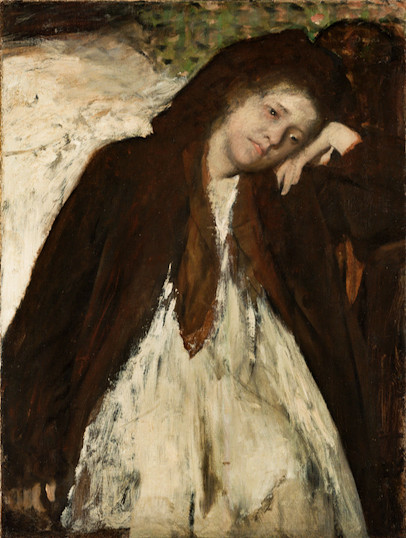
Edgar Degas, (French, 1834 - 1917)
The Convalescent, c. 1872-1887
Oil on canvas
65.7 × 49.8 cm (25 7/8 × 19 5/8 in.)
Getty Center

Although the identity of the sitter in this portrait is a mystery, Edgar Degas conveyed her character by capturing the overwhelming sorrow to which she has succumbed. Posed with her head tilted and leaning against the back of her left hand, she appears weary. Her languorous expression and red-rimmed eyes, together with the limp right arm hanging at her side, suggest a physical or emotional malady, though nothing in the painting confirms the cause of her affliction. Hidden beneath a brown robe and full white gown, her pose is ambiguous; it is unclear if she sits, stands, or leans. The Convalescent attests to Degas's interest in the world of women--their physical characteristics and surroundings, and their complex emotional and psychological conditions. More The Convalescent

Edgar Degas (19 July 1834 – 27 September 1917) was a French artist famous for his paintings, sculptures, prints, and drawings. He is especially identified with the subject of dance; more than half of his works depict dancers. He is regarded as one of the founders of Impressionism, although he rejected the term, preferring to be called a realist. He was a superb draftsman, and particularly masterly in depicting movement, as can be seen in his renditions of dancers, racecourse subjects and female nudes. His portraits are notable for their psychological complexity and for their portrayal of human isolation.

At the beginning of his career, Degas wanted to be a history painter, a calling for which he was well prepared by his rigorous academic training and close study of classic art. In his early thirties, he changed course, and by bringing the traditional methods of a history painter to bear on contemporary subject matter, he became a classical painter of modern life. More on Edgar Degas

Eduard Veith, (Neutitschein 1856-1925 Vienna)
Three-Quarter Length Portrait of a Lady with Hat in a Yellow Dress
Mixed media with oil on artist’s board
82 x 68.5 cm,
Private Collection

Veith, Eduard, BORN 30 Mar 1856, Neutitschem - DIED 18 Mar 1925, Wien. Son of the carpenter Julius Veith. He was educated at the Wiener Kunstgewerbeschule, where Ferdinand Laufberger was his teacher. he finished his studies in Paris.

He created the paintings on the ceiling of the Maria Theresia Room in the Hofburg, the Dianabad in Vienna, the Neues Deutsches Theater in Prague and many other theatres. He was also popular as a painter of portraits of women.

From 1890 onwards he was a member of the Wiener Künstlerhaus. In 1911 he married Bertha Griesbeck and in 1920 he became a professor. He died in 1925. His grave at the Döblinger Friedhof in Vienna has a sculpture by Georg Leisek (1869-1936). More Veith, Eduard

CIRCLE OF GINERVA CANTOFOLI, (italian 1608-1672) 
A SYBIL 
Oil on canvas
34 1/4 x 28 1/4 in. (87 x 71.8cm) 
Private Collection

The siby were women that the ancient Greeks believed were oracles. The earliest sibyls, according to legend,[1] prophesied at holy sites. Their prophecies were influenced by divine inspiration from a deity; originally at Delphi and Pessinos, the deities were chthonic deities. In later antiquity, various writers attested to the existence of sibyls in Greece, Italy, the Levant, and Asia Minor. More siby

Ginevra Cantofoli (1618–1672) was an Italian painter. She was active in the Baroque period. Cantfoli received her training as an artist from Elisabetta Sirani in Bologna. She painted works for several churches. These works included a Last Supper for the Church of San Procolo, a St. Thomas of Villanova for San Giacomo Maggiore, and a St. Apollonia for the Church of La Morte. More Ginevra Cantofoli

Edouard Vuillard, 1868 – 1940
Lucie Hessel, c. 1905
Oil on cardboard 
16 x 18 in. (40.6 x 45.7 cm) 
Norton Simon Museum

Vuillard liked to say, “I do not paint portraits. I paint people in their homes.” And indeed, pictures like this one enlist domestic surroundings to suggest their sitters’ personalities and relationships to the artist. Here casually posed in a room crowded with picture frames, Lucie Hessel was the wife of Vuillard’s dealer. She was also the artist’s friend, his confidant, his muse and, ultimately, his lover, the subject of over a hundred paintings. An inscription in the upper right-hand corner of this portrait indicates that Vuillard painted it as a gift for her. More Lucie Hessel

Edouard Vuillard, 1868 – 1940
Naked women and white mat
Toner on paper
76 x 99 cm
Private collection

Jean-Édouard Vuillard (11 November 1868 – 21 June 1940) was a French painter and printmaker associated with the Nabis. The son of a retired captain, he spent his youth at Cuiseaux (Saône-et-Loire); in 1878 his family moved to Paris in modest circumstances. After his father's death in 1884, Vuillard received a scholarship to continue his education. In the Lycée Condorcet Vuillard met Ker Xavier Roussel (also a future painter and Vuillard's future brother in law), Maurice Denis, musician Pierre Hermant, writer Pierre Véber, and Lugné-Poe.

Vuillard was a member of the Symbolist group known as Les Nabis (from the Hebrew and Arabic term for "prophets" and, by extension, the artist as the "seer" who reveals the invisible). However, he was less drawn to the mystical aspects of the group and more drawn to fashionable private venues where philosophical discussions about poetry, music, theatre, and the occult occurred. Because of his preference for the painting of interior and domestic scenes, he is often referred to as an "intimist," along with his friend Pierre Bonnard. He executed some of these "intimist" works in small scale, while others were conceived on a much larger scale made for the interiors of the people who commissioned the work. More Jean-Édouard Vuillard

Jacopino del Conte, (1510–1598)
Lucrece
Private Collection

Lucrece (died c. 510 BC) legendary heroine of ancient Rome. According to tradition, she was the beautiful and virtuous wife of the nobleman Lucius Tarquinius Collatinus. Her tragedy began when she was raped by Sextus Tarquinius, son of Lucius Tarquinius Superbus, the tyrannical Etruscan king of Rome. After exacting an oath of vengeance against the Tarquins from her father and her husband, she stabbed herself to death. Lucius Junius Brutus then led the enraged populace in a rebellion that drove the Tarquins from Rome. The event (traditionally dated 509 bce) marks the foundation of the Roman Republic. The story is first found in the work of the earliest Roman historian, Fabius Pictor (late 3rd century bce). Its classic form is Livy’s version (late 1st century bce). Lucretia’s story is also recounted in Shakespeare’s narrative poem The Rape of Lucrece. More Lucrece

Jacopino del Conte (1510–1598) was an Italian Mannerist painter, active in both Rome and Florence. A native of Florence, he initially apprenticed with the influential painter and draftsman Andrea del Sarto.

Conte's first frescoes, including Annunciation to Zachariah (1536), Preaching of Saint John the Baptist (1538), and Baptism of Christ (1541) were in the Florentine-supported Oratory of San Giovanni Decollato, located in Rome. Conte completed the fresco decoration of the chapel of San Remigio in San Luigi dei Francesi. In 1552, he painted another work for the San Giovanni Decollato Oratory, the altarpiece Deposition, whose designs are sometimes attributed to Daniele da Volterra.

Although the specific dates of his birth and death were not documented, in his final year Jacopino del Conte would have been 89 years old. More Jacopino del Conte

Stephen Pan, b. 1963
Ballerinas
Oil on canvas
60 x 90 cm
Private Collection

Stephen Pan was born in Shanghai in 1963. Pan was five, when his grandfather, famous for calligraphy and poetry, Bo Yin Pan, gave him the first lessons in drawing and painting. Ironically, in spite of his close relationship with formal Chinese traditions in art, Pan fell deeply in love with the paintings of the Renaissance and French Impressionist periods. By age 13 Pan won the first of a series of National Art Excellence awards in China for his beautifully rendered oil paintings. Pan began his teaching career in Shanghai at age 20

His uncle sponsored his immigration to the United states to continue his artistic career. In 1997, Pan was offered a position at the academy of Art College in San Francisco. Pan is a versatile artist in the classic European oil painting tradition. Since 1987 he has focused primarily on original figurative oil paintings on canvas.More Stephen Pan


Please visit my other blogs: Art CollectorMythologyMarine ArtPortrait of a Lady, The OrientalistArt of the Nude and The Canals of VeniceMiddle East Artists365 Saints and 365 Days, also visit my Boards on Pinterest

Images are copyright of their respective owners, assignees or others. Some Images may be subject to copyright

I don't own any of these images - credit is always given when due unless it is unknown to me. if I post your images without your permission, please tell me.

I do not sell art, art prints, framed posters or reproductions. Ads are shown only to compensate the hosting expenses.

If you enjoyed this post, please share with friends and family.

Thank you for visiting my blog and also for liking its posts and pages.

Please note that the content of this post primarily consists of articles available from Wikipedia or other free sources online.