Showing posts with label Marc Chagall. Show all posts

Sunday, April 23, 2017

11 Paintings, PORTRAIT OF A LADY, with Footnotes. # 20

HOWARD CHANDLER CHRISTY, American (1873-1952)
Portrait of a Lady, c. 1902
Oil on canvas
73 1/2 x 36 inches
Private Collection

Howard Chandler Christy (January 10, 1872 – March 3, 1952) was an American artist and illustrator, famous for the "Christy Girl" -- a colorful and illustrious successor to the "Gibson Girl" -- who became the most popular portrait painter of the Jazz Age era. Christy painted such luminaries as Lt. Col. Theodore Roosevelt, and Presidents Harding, Coolidge, Hoover, Roosevelt, and Truman. Other famous people include William Randolph Hearst, the Prince of Wales (Edward the VIII), Eddie Rickenbacker, Benito Mussolini, Prince Umberto, Amelia Earhart. From the 1920s until the 1940s, Christy was well known for capturing the likenesses of congressmen, senators, industrialists, movies stars, and socialites. More Howard Chandler Christy 

Auguste Toulmouche, (French, 1829-1890)
Admiring her looks, c.  1881
Oil on canvas
25 3/4 x 18 1/4in (65.4 x 46.4cm)
Private Collection

Auguste Toulmouche (September 21, 1829 – October 16, 1890) was a French painter who painted in the academic realism style.  He studied design with a local sculptor and painting with a local portraitist.  In 1846, he moved to Paris.  There he entered the studio of Swiss artist Charles Gleyre and, by 1848, was ready to make his Salon debut.  He was only nineteen years old. He won a third class medal in 1852 and a second class medal in 1861.  In 1870, he was awarded the Legion of Honour.

Toulmouche is best known for his depictions of richly clad women set against the backdrop of luxurious interiors.  His paintings have been called “elegant trifles” and the ladies who feature in them have been referred to as “Toulmouche’s delicious dolls.”  One critic even compared the interiors of a Toulmouche painting to daintily decorated jewel boxes.  

In 1862, Toulmouche married a cousin of Claude Monet.  This alliance led to his being asked to mentor the young Monet.

Auguste Toulmouche died in Paris on October 16, 1890.  Those paintings of his that are not now in private collections can be found hanging in some of the finest museums in the world. More Auguste Toulmouche

JULIEN DUPRE (studio of) French (1851-1910)
Haying
Oil on canvas
18 x 21 1/2 inches
Private Collection

Julien Dupré (March 18, 1851 – April 16, 1910) was a French painter. He was born in Paris on March 18, 1851 to Jean Dupré (a jeweler) and Pauline Bouillié and began his adult life working in a lace shop in anticipation of entering his family's jewelry business. The war of 1870 and the siege of Paris forced the closure of the shop and Julien began taking evening courses at the Ecole des Arts Décoratifs and it was through these classes that he gained admission to the École des Beaux-Arts.

In the mid-1870s he traveled to Picardy and became a student of the rural genre painter Désiré François Laugée (1823–1896), whose daughter Marie Eléonore Françoise he would marry in 1876; the year he exhibited his first painting at the Paris Salon.

Throughout his career Dupré championed the life of the peasant and continued painting scenes in the areas of Normandy and Brittany until his death on April 16, 1910. More

Gustav Klimt (1862–1918)
Portrait of Emilie Louise Flöge, c. 1902
Oil on canvas
181 × 84 cm (71.3 × 33.1 in)
Vienna Museum

Emilie Louise Flöge (30 August 1874 in Vienna – 26 May 1952 in Vienna) was an Austrian fashion designer, and businesswoman. She was the life companion of the painter Gustav Klimt.

Her first job was as a seamstress, but she later became a couturière. In 1895, Pauline, her elder sister, opened a dressmaking school and Emilie worked there. In 1899 the two sisters won a dressmaking competition.

After 1891, Klimt portrayed her in many of his works. Experts believe that his painting The Kiss (1907–08) shows the artist and Emilie Flöge as lovers (below). Klimt was painting many ladies from the upper echelons of Viennese society and thus, was able to introduce Emilie Flöge to a prosperous client base. More Emilie Louise Flöge

Gustav Klimt (1862–1918)
The Kiss, c. 1907–1908
Oil on canvas
180 × 180 cm (70.9 × 70.9 in)
Austrian Gallery Belvedere, Vienna, Austria.

Gustav Klimt (July 14, 1862 – February 6, 1918) was an Austrian symbolist painter and one of the most prominent members of the Vienna Secession movement. Klimt is noted for his paintings, murals, sketches, and other objets d'art. Klimt's primary subject was the female body, and his works are marked by a frank eroticism. In addition to his figurative works, which include allegories and portraits, he painted landscapes. Among the artists of the Vienna Secession, Klimt was the most influenced by Japanese art and its methods.
Early in his artistic career, he was a successful painter of architectural decorations in a conventional manner. As he developed a more personal style, his work was the subject of controversy that culminated when the paintings he completed around 1900 for the ceiling of the Great Hall of the University of Vienna were criticized as pornographic. He subsequently accepted no more public commissions, but achieved a new success with the paintings of his "golden phase," many of which include gold leaf. More Gustav Klimt

MARTHA SUSAN BAKER, American (1871-1911)
Bessie McCoy, Insouciance (Carefree), c. 1906
Oil on canvas
44 x 30 inches
Private Collection

Martha Susan Baker, American, 1871 - 1911, both studied and taught at the Art Institute of Chicago and was world-renowned particularly for her miniature paintings on ivory (An example of which is in the Louvre, below).

MARTHA SUSAN BAKER, American (1871-1911)
Mademoiselle / Martinet, c. 1911
Ivory
H. in m 0.122; L. in m 0.090
Musée du Louvre

Unfortunately, in 1911, Miss Baker contracted appendicitis and died at the young age of 39. At the time of Baker's death and at the height of her career, the artist had been commissioned to paint a portrait of President Taft. Her murals can be found in the Fine Arts Building in Chicago. More Martha Susan Baker

Edouard Vuillard, 1868 - 1940
Lucy Hessel Reading, 1913
Oil on canvas
The Jewish Museum, New York

Madame Lucy Hessel, was the artist’s protectress over a period of some forty years.  In a deep blue velvet jacket, she is pictured studying books and papers.  To the upper-right, above the fireplace, is a mirror, reflecting an open window and the garden beyond.  The setting is likely the country house in Normandy where Vuillard was a frequent guest of the Hessels.  The closeness of their relationship is emphasized by the striking fact that the subject is caught within her private domain at an intimate and informal moment, suggestive at the same time of Vuillard’s admiration for earlier French (Fragonard) and Dutch (Vermeer) masters of the interior. More Madame Lucy Hessel

Jean-Édouard Vuillard (11 November 1868 – 21 June 1940) was a French painter and printmaker associated with the Nabis. The son of a retired captain, he spent his youth at Cuiseaux (Saône-et-Loire); in 1878 his family moved to Paris in modest circumstances. After his father's death in 1884, Vuillard received a scholarship to continue his education. In the Lycée Condorcet Vuillard met Ker Xavier Roussel (also a future painter and Vuillard's future brother in law), Maurice Denis, musician Pierre Hermant, writer Pierre Véber, and Lugné-Poe.

Vuillard was a member of the Symbolist group known as Les Nabis (from the Hebrew and Arabic term for "prophets" and, by extension, the artist as the "seer" who reveals the invisible). However, he was less drawn to the mystical aspects of the group and more drawn to fashionable private venues where philosophical discussions about poetry, music, theatre, and the occult occurred. Because of his preference for the painting of interior and domestic scenes, he is often referred to as an "intimist," along with his friend Pierre Bonnard. He executed some of these "intimist" works in small scale, while others were conceived on a much larger scale made for the interiors of the people who commissioned the work. More Jean-Édouard Vuillard

ÈMILE EISMAN-SEMENOVSKY, 1857 Poland - Paris 1911 (attr.)
Oriental Beauty
Oil on panel
27 cm x 21 cm
Private Collection

Émile Eisman-Semenowsky (* 1859 in Poland , † 1911 in France ) was a French painter of Polish descent.

There are very few documented sources on Émile Eisman-Semenovsky's biography. He was born in the part of Poland annexed by Russia. He emigrated early, studied painting outside Poland. At the beginning of the 1880s he came to Paris and became known here as a painter of sentimental women's portraits. He worked as an assistant to Jan van Beers. Apart from the numerous women's portraits, he created a few genre and nude pictures. His paintings were adapted to the taste of the French bourgeoisie. Many works were portrayed as women of the Middle East or the ancient world. In France he was attributed to Polish or Russian painters. More Émile Eisman-Semenowsky

MARCEL DYF, French (1899-1985)
Jeune Femme Rousse/ Young Red Head
Oil on canvas
21 1/2 x 18 1/4 inches
Private Collection

Marcel Dyf (1899–1985) was a French impressionist painter. He was born as Marcel Dreyfus on October 7, 1899 in Paris. He grew up in Normandy, in the towns of Ault, Deauville and Trouville. He started a career as an engineer, but soon decided to become a painter. In 1922, he moved to Arles, where he was trained as a painter and set up a studio.

He painted frescoes in the cityhalls of Saint-Martin-de-Crau and Saintes-Maries-de-la-Mer. He also painted frescoes in the Museon Arlaten and in the dining hall of the Collège Ampère, both of which are in Arles. He also designed windows inside the Église Saint-Louis in Marseille.

In 1935, he moved to Maximilien Luce's old studio on the Avenue du Maine in Paris. By 1940, because of the German invasion of France during the Second World War, he returned to Arles. He quickly joined the French Resistance in Corrèze and the Dordogne. He later moved back to Paris, and finally moved in Saint-Paul-de-Vence. However, in the 1950s, he started wintering in Paris and summering in Cannes, where he attracted the attention of American art collectors. More

Marc Chagall, (French, Vitebsk 1887–1985 Saint-Paul-de-Vence)
Marc ChagallBride with Fan, c. 1911
Oil on canvas
18 x 15 in. (45.7 x 38.1 cm)
The Metropolitan Museum of Art

Marc Chagall conjured up his native Russia in the works he painted from 1910 to 1914 while he was living in the French capital. Similarly, in the small painting The Betrothed, he evoked his far-away fiancée Bella Rosenfeld, whom he would marry in 1915 upon his return to Vitebsk, Russia. The picture's palette of only blue and white is unusual within the artist's oeuvre, yet the brighter colors showing through the white paint suggest that Chagall reused an old canvas. Pierre Matisse, the son of artist Henri Matisse, had coveted the works of Chagall since 1924, when he first met the artist in Paris. Chagall was loath to part with his work, but in 1941 Pierre, who then owned an art gallery in New York, was able to mount an exhibition of Chagall's work that became a "blockbuster"; this was followed by sixteen more exhibitions at the gallery through 1982. More Bride with Fan

Marc Zakharovich Chagall (1887 – 28 March 1985)was a Russian-French artist. An early modernist, he was associated with several major artistic styles and created works in virtually every artistic medium, including painting, book illustrations, stained glass, stage sets, ceramic, tapestries and fine art prints.
Chagall saw his work as "not the dream of one people but of all humanity. According to art historian Michael J. Lewis, Chagall was considered to be "the last survivor of the first generation of European modernists". Using the medium of stained glass, he produced windows for the cathedrals of Reims and Metz, windows for the UN, and the Jerusalem Windows in Israel. He also did large-scale paintings, including part of the ceiling of the Paris Opéra.
Before World War I, he traveled between St. Petersburg, Paris, and Berlin. During this period he created his own mixture and style of modern art based on his idea of Eastern European Jewish folk culture. He spent the wartime years in Soviet Belarus, becoming one of the country's most distinguished artists and a member of the modernist avant-garde, founding the Vitebsk Arts College before leaving again for Paris in 1922.

He experienced modernism's "golden age" in Paris, where "he synthesized the art forms of Cubism, Symbolism, and Fauvism, and the influence of Fauvism gave rise to Surrealism". "When Matisse dies," Pablo Picasso remarked in the 1950s, "Chagall will be the only painter left who understands what colour really is" More Marc Chagall


Wojciech Weiss, (Polish, 1875-1950)
Portrait of Maria Skrzywan in Spanish costume, c. 1946
Oil on canvas
31 3/4 x 25 3/4in (80.5 x 65.5cm)
Private Collection

Maria Skrzywan (born 1900 in Kordelówka, near Winnica , died 1978 ) was a Polish psychologist, the first dean of the Faculty of Pedagogy at the University of Warsaw , founded in 1953.

She graduated from a Polish grammar school in Kiev. Then undertook legal studies at the University of Warsaw, which she changed to psychology. Since 1928 she was an assistant professor. In 1931, she was awarded a doctoral degree by prof. Wladyslaw Witwicki. She lectured at the Warsaw University conducting classes in educational and development psychology.

During World War II she participated in secret teaching, was arrested and imprisoned. After the war she organized the first university psychological studies in Poland and created the first textbook for students. She was the editor of the editorial staff of "Educational Psychology". After the death of prof. Baleya took the position of head of the Chair of Educational Psychology at the Faculty of Psychology at the University of Warsaw . In 1955 she became a professor.

She was the promoter of her doctoral thesis, Anna Matczak , promoting the award of honorary doctorate of the University of Warsaw to the French psychologist Jean Piaget on 14 May 1958.


She died on April 23, 1978. More Maria Skrzywan

Wojciech Weiss (4 May 1875 – 7 December 1950) was a prominent Polish painter and draughtsman of the Young Poland movement. He was born in Bukovina to a Polish family in exile . He gave up music training to study art at the Academy of Fine Arts in Kraków under Leon Wyczółkowski. Weiss originally painted historical or mythological paintings, but later switched to Expressionism after being profoundly influenced by Stanisław Przybyszewski. Weiss later became a member of the Vienna Secession. He was one of the first Polish Art Nouveau poster designers. Near the end of his life, he made several significant contributions to paintings of the Socialist realism in Poland. More Wojciech Weiss 


Acknowledgement: Hargesheimer Art AuctionsBonhams, Shannon's, and others

Images are copyright of their respective owners, assignees or others

We do not sell art prints, framed posters or reproductions. Ads are shown only to compensate the hosting expenses.

If you enjoyed this post, please share with friends and family.

Sunday, November 8, 2015

14 Paintings, Art for today, Impressionist & Modern Art, Marc Chagall, Henri de Toulouse-Lautrec, Pablo Picasso, Pierre Bonnard,

Marc Chagall 1887 - 1985 L'HOMME AU PARAPLUIE Signed Marc Chagall (lower left) Gouache on paper 26 by 20 in. 66.3 by 51 cm Executed in 1927-28.:
L'HOMME AU PARAPLUIE
Signed Marc Chagall (lower left)
Gouache on paper
26 by 20 in.
66.3 by 51 cm
Executed in 1927-28.

Executed in 1927-28, L’Homme au parapluie is an important early example of Chagall’s lifelong fascination with the pageantry of the circus. Chagall first developed an interest in this theme during his formative years in Vitebsk, and later in Paris, where he frequently attended performances at the Cirque d’Hiver Bouglione in the company of Ambroise Vollard. More

Marc Chagall 1887 - 1985 LE VIOLONISTE Signed Chagall (lower left) Gouache, India ink and charcoal on paper 19 1/4 by 25 1/4 in. 49.5 by 65 cm Executed in 1926-27.:
LE VIOLONISTE
Signed Chagall (lower left)
Gouache, India ink and charcoal on paper
19 1/4 by 25 1/4 in.
49.5 by 65 cm
Executed in 1926-27.

Although this picture is specifically concerned with the musician, Chagall's pictorial characters had many levels of significance.  To him, they represented the many faces of man's emotional character, both fun-loving and tragic.  He once wrote, "I have always considered the clowns, acrobats, and actors as being tragically human who, for me, would resemble characters from certain religious paintings. More

Marc Chagall 1887 - 1985 LA MÈRE ET L'ENFANT Signed Chagall and dated 1947-51 (lower right); signed Marc Chagall and dated 1947-51 on the reverse Oil on canvas 36 1/4 by 28 3/4 in. 92 by 73 cm Painted in 1947-51.:
LA MÈRE ET L'ENFANT
Signed Chagall and dated 1947-51 (lower right); signed Marc Chagall and dated 1947-51 on the reverse
Oil on canvas
36 1/4 by 28 3/4 in.
92 by 73 cm
Painted in 1947-51. 

Painted in the late 1940s, La Mère et l’enfant embodies the new optimism and hope that characterizes Chagall’s work from this important period of transition. Having initially struggled to adapt to life in the United States, Chagall had achieved great success there, culminating in the 1946 retrospective at The Museum of Modern Art in New York. By this time he was also slowly beginning to recover from the tragedy of Bella’s death in 1944, and had begun a relationship with Virginia Haggard McNeil with whom he would father a son. More

Henri de Toulouse-Lautrec 1864 - 1901 À ARMENONVILLE, EN CABINET PARTICULIER Signed with the monogram TL (upper left) Peinture à l'essence on board 26 3/8 by 20 1/2 in. 67 by 52.2 cm Painted in 1899:
À ARMENONVILLE, EN CABINET PARTICULIER
Signed with the monogram TL (upper left)
Peinture à l'essence on board
26 3/8 by 20 1/2 in.
67 by 52.2 cm
Painted in 1899.

Armenonville, en cabinet particulier, 1899, belongs to the great series of voyeuristic depictions of intimate encounters that fascinated Toulouse-Lautrec throughout 1890s.  While many of these scenes took place in brothels, the artist also depicted these heated scenarios as they played out in theater boxes, cafés, and other spaces of social engagement.  A brilliant interpreter of his time, Lautrec focused his attention on the game of pursuit that lead to sexual confrontation. More

Pablo Picasso 1881 - 1973 NU AUX JAMBES CROISÉES Signed Picasso and dated 1903 (upper left) Pastel and black crayon on paper 22 1/2 by 18 in. 57.5 by 45.8 cm Painted in 1903.:
NU AUX JAMBES CROISÉES
Signed Picasso and dated 1903 (upper left)
Pastel and black crayon on paper
22 1/2 by 18 in.
57.5 by 45.8 cm
Painted in 1903.

Picasso created this stunning pastel nude in Barcelona in 1903.  The year marked the apotheosis of Picasso’s celebrated Blue period (late 1901-1904), and the present work is imbued with a sense of fragility and melancholy that was to become synonymous with this phase of his career.  The pictures of the Blue period are often characterized by poignant images of forlorn women and despondent men, often isolated and lost in thought. More

Pablo Picasso 1881 - 1973 VIOLON Oil, sand and charcoal on canvas 21 5/8 by 17 in. 55 by 43.2 cm Painted in autumn-winter 1912.:
VIOLON
Oil, sand and charcoal on canvas
21 5/8 by 17 in.
55 by 43.2 cm
Painted in autumn-winter 1912.

Painted in 1912, Violon belongs to an immensely important period of artistic development for Picasso which saw the beginning of his shift from analytic to synthetic cubism. Using the motif of a guitar – or as in the present painting, a violin – Picasso embarked on a series of works in which he developed the cubist idiom of the previous decade, exploring a range of materials from the cut paper and newspaper of his papiers collés to the sand of Violon and the thick cardboard of his cutouts. More

Pablo Picasso 1881 - 1973 VUE D'UNE FENÊTRE Dated 2 Mai XXIX (on the reverse) Oil on canvas 51 1/8 by 76 7/8 in. 130 by 195 cm Painted on May 2, 1929:
VUE D'UNE FENÊTRE
Dated 2 Mai XXIX (on the reverse)
Oil on canvas
51 1/8 by 76 7/8 in.
130 by 195 cm
Painted on May 2, 1929.

With its powerful grisaille palette and extraordinary attention to spatial perspective, this composition of the artist's studio-sanctuary is one of Picasso's rare forays into architectural subject matter.  The picture dates from the beginning of May 1929 and has select stylistic precedents in his oeuvre.  More

Pablo Picasso 1881 - 1973 LA FEMME AU TAMBOURIN  Aquatint with grattoir, 1939, Baer’s fifth (final) state, signed in pencil, numbered 8/30, published by Galerie Louise Leiris, Paris, in 1943, on Arches wove paper, framed Plate: 26 1/4 by 20 1/4 in. 66.6 by 51.3 cm Sheet: 30 1/8 by 22 1/2 in. 76.5 by 57 cm Conceived in 1939 and printed in 1943.:
LA FEMME AU TAMBOURIN 
Aquatint with grattoir, 1939, Baer’s fifth (final) state, signed in pencil, numbered 8/30, published by Galerie Louise Leiris, Paris, in 1943, on Arches wove paper, framed
Plate: 26 1/4 by 20 1/4 in. 66.6 by 51.3 cm
Sheet: 30 1/8 by 22 1/2 in. 76.5 by 57 cm
Conceived in 1939 and printed in 1943.

Picasso conceived this striking portrait of Dora Maar when Europe was on the brink of war in 1939.  With images of the Spanish Civil war still fresh in his memory, the subject of a nation at peril seemed too overwhelming for him to face yet again.  Instead, he turned his attention to his immediate environment, featuring still-lifes constructed from the contents of his studio and many portraits of his lover, Dora Maar. More

Pablo Picasso 1881 - 1973 LA GOMMEUSE Signed Picasso (upper left); inscribed Recuerdo a Mañach en el día de su santo and fully painted on the reverse Oil on canvas 31 7/8 by 21 1/4 in. 81.3 by 54 cm Painted in Paris in 1901.:
LA GOMMEUSE
Signed Picasso (upper left); inscribed Recuerdo a Mañach en el día de su santo and fully painted on the reverse
Oil on canvas
31 7/8 by 21 1/4 in.
81.3 by 54 cm
Painted in Paris in 1901.

Picasso's extraordinary La Gommeuse is among the rare and coveted pictures created during the artist's Blue Period (1901-1904). The painting dates from the second half of 1901, following Picasso's widely-praised exhibition at Vollard's gallery that June and amidst the sobering aftermath of his friend Casagemas' suicide earlier in the year. More

Pablo Picasso 1881 - 1973 NU, LES BRAS CROISÉS Dated 13.2.60 & 18.2.60 on the reverse Oil on canvas 39 3/8 by 31 7/8 in. 100 by 81 cm Painted on February 18, 1960.:
NU, LES BRAS CROISÉS
Dated 13.2.60 & 18.2.60 on the reverse
Oil on canvas
39 3/8 by 31 7/8 in.
100 by 81 cm
Painted on February 18, 1960.

The woman featured in this striking painting is Jacqueline Roque, Picasso's devoted second wife who remained with him until the time of his death in 1973. Picasso's renderings of Jacqueline constitute the largest group of images of any of the women in his life. More

Pablo Picasso 1881 - 1973 FEMME DANS UN FAUTEUIL Signed Picasso and dated XXIX (lower right) Oil on canvas 32 by 20 in. 81.2 by 58 cm Painted on March 2, 1929.:
FEMME DANS UN FAUTEUIL
Signed Picasso and dated XXIX (lower right)
Oil on canvas
32 by 20 in.
81.2 by 58 cm
Painted on March 2, 1929

One of the most loaded images of Picasso's Surrealist production is his terrifyingly fantastic depiction of his wife, Olga, abstracted beyond the point of recognition.  Femme dans un fauteuil is among Picasso's most memorable pictures from 1929, as it is emblematic of both the personal and professional forces at play that year.  Olga had spent the first weeks of 1929 in a clinic recovering from a haemorrhaging condition, and now reemerged in Picasso's daily life. More

Pablo Picasso 1881 - 1973 FEMME ENDORMIE Signed Picasso (lower right), dated Boisgeloup 28 juin XXXIII (lower left) & dedicated Pour Bibi Souvenir Souvenirs (upper right) Oil on canvas 4 by 8 in. 10 by 18 cm Painted in 1933.:
FEMME ENDORMIE
Signed Picasso (lower right), dated Boisgeloup 28 juin XXXIII (lower left) & dedicated Pour Bibi Souvenir Souvenirs (upper right)
Oil on canvas
4 by 8 in.
10 by 18 cm
Painted in 1933

A recumbent Marie-Thérèse is the subject of this intimate canvas from 1933.   This theme dominated the artist's most successful pictures of the 1930s, when he was swept up in a romance with a much younger woman who satisfied his every physical desire.  In paintings, sculpture, etchings and drawings Picasso celebrated his lover's body, even sharing her form with his friends in his art. More

Pierre Bonnard 1867 - 1947 NU S'HABILLANT Signed Bonnard (lower left) Oil on canvas 29 by 17 3/4 in. 74 by 45 cm Painted in 1925:
NU S'HABILLANT
Signed Bonnard (lower left)
Oil on canvas
29 by 17 3/4 in.
74 by 45 cm
Painted in 1925.

Painted in luminous yellows, blues and pinks, the present work is one of Bonnard’s major nudes. Bonnard’s paintings of the female nude are the most renowned within his oeuvre. The primary model for these canvases was the eccentric Marthe de Meligny, a young woman of elusive origin whom Bonnard met in Paris in 1893 and would become his wife in 1925. More

Pierre Bonnard 1867 - 1947 LES COQUELICOTS Signed Bonnard (lower left)  Oil on canvas 27 3/4 by 22 7/8 in. 70.5 by 58 cm Painted circa 1914-15.:
LES COQUELICOTS
Signed Bonnard (lower left)
Oil on canvas
27 3/4 by 22 7/8 in.
70.5 by 58 cm
Painted circa 1914-15.

Les Coquelicots belongs to a group of Bonnard’s still lifes featuring the white vase with a cherry motif, often filled with a bouquet of flowers. The vibrancy of his palette and the richness and spontaneous arrangement of the flowers in this work represent a lively and colorful celebration of nature. Discussing this subject matter, Bonnard revealed to a friend in 1943: "I often see interesting things to paint around me, but for me to have the desire to paint them, they must have a special seduction – beauty – what one could call beauty. More


Monday, September 7, 2015

Our Art for this week - Mami Urakawa, Nelson Shanks, Louvre Abu Dhabi, Siamese King, Marc Chagall, Leonardo da Vinci, Rembrandt, Dalí, Pablo Picasso,

A photo republished by the AP shows ISIS destroying a tomb at the ancient site of Palmyra.
A photo republished by the AP shows ISIS destroying a tomb at the ancient site of Palmyra.

As ISIS and other groups continue to destroy important heritage sites and ancient artifacts, archaeologists and other onlookers continue to scramble to find ways to counter the destruction. The latest effort comes from an organization called the Institute for Digital Archaeology, which will distribute some 10,000 3D cameras in West Asia over the next year, in the hopes of documenting archaeological sites and objects before they’re gone, the Daily Beast reports. More

A black and white reproduction of La famille (1935) – one of the works purported to be up for sale in the coming year. 

Picasso’s ‘inheritance without love’
Pablo Picasso passed away in 1973. The same year, his grandson Pablito (Marina’s brother) died in a hospital after swallowing bleach. Four years later, his former mistress Marie-Thérèse Walter hanged herself, and his second wife, Jacqueline Roque, shot herself in 1986.

Maurice Rheims, an expert appraiser, spent five years determining the status the heirs, and cataloging the 1,885 paintings, 7,089 drawings, 3,222 ceramic works, 17,411 prints and 1,723 plates, 1,228 sculptures, 6,121 lithographs, 453 lithographic stones, 11 tapestries and eight rugs left by the artist.


Although conflicting reports of the distribution have been made, the widow’s share amounted to roughly three-tenths of the art, or $52 million in 1977, after taxes; the three illegitimate children, Maya, Claude and Paloma, were awarded one-tenth, or $18 million worth of art; meanwhile, Marina and Bernard each received one-fifth of the the art, slices valued at $35 million. Additionally, Bernard received the chateau at Boisgeloup in Normandy, while Marina inherited the sumptuous La Californie... More at: The Conversation


Vincent van Gogh, “Wheat Stack Under a Cloudy Sky” (1889)

Vincent van Gogh’s reds have been turning white due to a rare lead mineral in his paint as the missing link. .” Interestingly, it’s a different issue than the recent analysis of the fading of red in Renoir’sMadame Léon Clapisson” (1883), where the red lake pigment made of cochineal insects was separating.  More at: Hyperallergi

Rembrandt, Susanna and the Elders (1647)

Berlin's Gemäldegalerie announced they've made a shocking discovery about the museum's Rembrandt masterpiece Susanna and the Elders (1647), Focus reports. An X-ray analysis of the oil painting has revealed that the it had at one time undergone extensive alterations.

According to the daily Berliner Morgenpost art restorer Claudia Laurenze-Landsberg, who conducted the analysis, noticed tiny pigments on the canvas that didn't exist in the 17th century. What's more, some parts of the painting were in a style that she didn't recognize as Rembrandt's. She found out that in the 18th century large parts of the painting were simply painted over, and entire sections were washed out using solvents and re-painted in a more modern, light shade. More at: Art Net

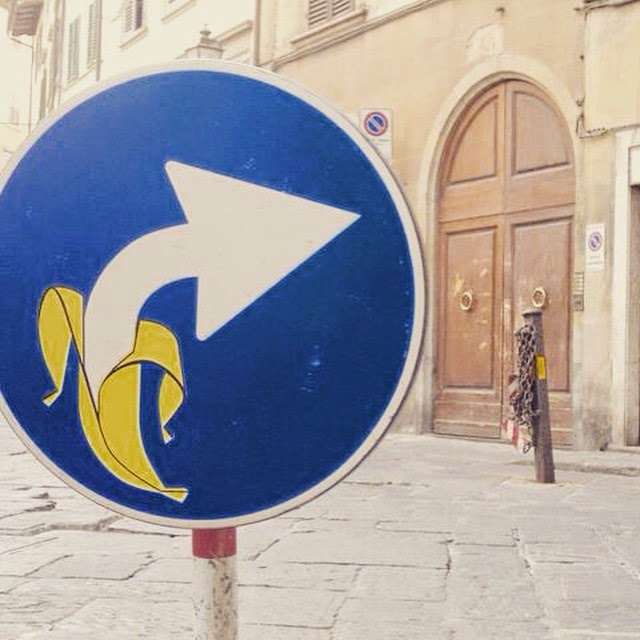
The Japanese-born, Florence-based street artist Mami Urakawa was arrested for tampering with road signs in Kyoto and Osaka. She, along with her boyfriend Clet Abraham, transformed some 60 signs between late December and early January. More at: Hyperallergic

Monica Lewinsky Casts a Shadow on Bill Clinton’s Presidential Portrait. Nelson Shanks worked this iconic garment into the portrait subtly: the painting depicts Clinton standing prominently before the mantel in the Oval Office while the dress makes an inconspicuous appearance in the form of a shadow behind him. (Shanks also opted to leave Clinton’s wedding ring out of the painting.) Apparently, the 42nd president’s controversial sexual relationship with a White House intern will persist as a visual and metaphorical blight on his terms in office

Official opening, of the Louvre Abu Dhabi, date probably in 2016. The 5,000-strong workforce is expected to swell to 7,500 over the coming months. “We shall deliver the building at the end of 2015,” its architect Jean Nouvel tells The Art Newspaper.

The crown of the Siamese King offered in 1861 to Napoleon III in the Château de Fontainebleau was stolen in the early hours of Sunday morning, 1 March, along with around 15 other precious artefacts from eastern Asia. More at: The Art Newspaper

A painting by Jean-Leon Gerome of Napoleon III receiving a delegation from the King of Siam in the ballroom at the Chateau de Fontainebleau in 1864.

Marc Chagall (Russian/French, 1887-1985) 'Then the old woman mounted on Ifrit's back' Lithograph, 1948, printed in colours, , on laid, with margins, signed and numbered 23/90 and inscribed 'pl.7' in pencil, printed by Albert Carman, New York, published by Pantheon, Paris, 370 x 280mm (14 1/2 x 11in)(I)

Leonardo da Vinci's self portrait. - Photo: courtesy Muscarelle Museum of Art

Newly Discovered Leonardo da Vinci Portrait on Display at the College of William and Mary

A newly discovered self-portrait of Leonardo da Vinci which was unearthed five years ago within the Codex on theFlight of Birds, one of only 20 of da Vinci's remaining codices, which includes both text and 18 sketches of birds, is currently on exhibit at the Muscarelle Museum of Art at the College of William & Mary in Williamsburg, Virginia.

The show features over 20 precious drawings in addition to the portrait, including a study for Virgin of the Rocks (1483–1486). Eight works by da Vinci's rival Michelangelo Buonarroti are also on display.

"Leonardo Da Vinci And The Idea Of Beauty" is on display at the Muscarelle Museum of Art at the College of William & Mary from February 21–April 5, 2015. It will be on display at the Museum of Fine Arts, Boston from April 15 through June 14, 2015. More at: Art Net & Muscarelle Museum of Art