Showing posts with label Man Ray. Show all posts

Friday, March 3, 2023

12 Photographs, PORTRAIT OF A LADY, Ady Fidelin, the first black model and muse, by Man Ray, Pablo Picasso and Lee Miller, with Footnotes. #171

MAN RAY (1890-1976)
Ady Fidelin, c. 1936
Silver print
23 x 17.5 cm.
Private collection

Ady Fidelin was born in 1915 in Pointe-à-Pitre into one of Guadeloupe’s oldest Creole families, immigrating to France in the wake of the catastrophic 1928 cyclone that devastated the Caribbean, killing thousands. The death of her mother during this traumatic event and the passing of her father a few years later precipitated her migration to Paris to join family members who had made the passage before her. She arrived in France in one of the successive waves of émigres from the island, lured by the hope of a better life in the storm’s aftermath. 

"Under the lively and cheerful pen of Gisèle Pineau, Ady Fidelin, muse and lover of Man Ray, finds her place in the sun" ELLE

Harper Bazaar’s publisher William Randolph Hearst, like many magazine proprietors, prohibited the use of black models in his publications. But somehow (possibly with the help of Bazaar’s editor Carmel Snow, who took issue with Hearst’s stance on race), a photograph of Adrienne by Man Ray featured in the September 1937 edition, making Ady Fidelin the first ever black woman to appear in a major fashion magazine. The two page spread was titled ‘The Bushongo of Africa Sends His Hats to Paris’. More on black models

Once in America, unbeknownst to Ady, Man Ray began a relationship with Juliet Browner whom he married in 1946, even as Ady struggled to save his works from German covetousness before returning them to her after Liberation. Although they maintained a correspondence at least until 1961, Man Ray barely speaks of her in his 1963 autobiography, following in this an earlier assessment where he had made his companion "a subordinate in the service of his brilliant partner " . However, in the 1970s he published a series of prints inspired by Ady 

Wendy A. Grossman and Sala E. Patterson believe that "Fidelin has been sidelined, victim of a conventional history that privileges racial or ethnic character over individuality, and the male artist over the female muse” . At the end of the 1950s, she married André Art, her companion for more than a decade. She spent the last moments of her life in Albi and died anonymously at the age of 88. More on Ady Fidelin


Lee Miller
Ady Fidelin, c. 1937
Hotel Vaste Horizon, Mougins, France

Fidelin’s relationship with Man Ray, first registered in entries in his date book in December of 1935, subsequently led to her introduction to Picasso and the circle of creatives who would become her virtual family for the next five years. 

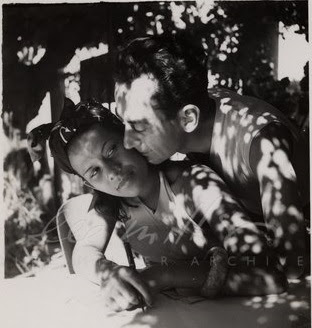
Lee Miller
Man Ray and Ady Fidelin, c. 1937
Mougins, France

She appears in close to 400 photographs by Man Ray, as well as several paintings, drawings, prints and a short film by the American artist. She was also photographed by Wols (Alfred Otto Wolfgang Schulze) and was the subject of a recently identified painting by Picasso. More on Ady Fidelin

Ady Fidelin, Marie Cuttoli and her husband, Man Ray, Picasso and Dora Maar, 1937

Lee Miller
Picnic (Nusch Eluard, Paul Eluard, Roland Penrose, Man Ray, Ady Fidelin)
Gelatin silver print, 1937 (2012)
8 in. x 7 3/4 in. (203 mm x 197 mm)
National Portrait Gallery

Penrose met American-born photographer and photojournalist Lee Miller (1907-77) in Paris in 1937, and this photograph depicts them on holiday with friends at Mougins in the South of France. 

Man Ray
Lee Miller with Ady Fidelin, c. 1937
Île Sainte-Marguerite, Cannes

Elizabeth "Lee" Miller, Lady Penrose (April 23, 1907 – July 21, 1977), was an American photographer and photojournalist. She was a fashion model in New York City in the 1920s before going to Paris, where she became a fashion and fine art photographer. During the Second World War, she was a war correspondent for Vogue, covering events such as the London Blitz, the liberation of Paris, and the concentration camps at Buchenwald and Dachau.

In 1929, Miller intended to apprentice with the surrealist artist and photographer Man Ray. Although, at first, he insisted that he did not take students, Miller soon became his model and collaborator, as well as his lover and muse. More on Lee Miller

Pablo Picasso
Woman Seated on a Yellow and Pink Background II (Portrait of Ady Fidelin) September 8, 1937
Oil on canvas
81 x 60 cm.
Estate of Pablo Picasso

Man Ray
Adrienne Fidelin, Pablo Picasso, Dora Maar, 1937

Pablo Ruiz Picasso (25 October 1881 – 8 April 1973) was a Spanish painter, sculptor, printmaker, ceramicist and theatre designer who spent most of his adult life in France. One of the most influential artists of the 20th century, he is known for co-founding the Cubist movement, the invention of constructed sculpture, the co-invention of collage, and for the wide variety of styles that he helped develop and explore. Among his most famous works are the proto-Cubist Les Demoiselles d'Avignon (1907), and the anti-war painting Guernica (1937), a dramatic portrayal of the bombing of Guernica by German and Italian air forces during the Spanish Civil War. More on Pablo Picasso

Currently part of the collection of the private Dapper Museum in Paris, the Bangwa Queen figure can be seen in this photograph in the company of a woman believed to be Man Ray's lover, model, and muse, Adrienne Fidelin

Man Ray (American, 1890–1976)
Ady Fidelin, ca. 1937
Gelatin silver print
5.8 x 8.8 cm. (2.3 x 3.5 in.)
Private collection

Man Ray
Ady Fidelin & Nusch Eluard

Nusch Éluard (born Maria Benz; 21 June 1906 – 28 November 1946) was a French performer, model and surrealist artist.

Nusch arrived in France as a stage performer, variously described as a small-time actress, a traveling acrobat, and a "hypnotist's stooge". She met Paul Éluard in 1930 working as a model, married him in 1934, produced surrealist photomontage and other work, and is the subject of "Facile," a collection of Éluard's poetry published as a photogravure book, illustrated with Man Ray's nude photographs of her.

She was also the subject of several cubist portraits and sketches by Pablo Picasso in the late 1930s, and is said to have had an affair with him. Nusch worked for the French Resistance during the Nazi occupation of France during World War II. She died in 1946 in Paris due to a stroke. More on Nusch Éluard

Man Ray (born Emmanuel Radnitzky; August 27, 1890 – November 18, 1976) was an American visual artist who spent most of his career in Paris. He was a significant contributor to the Dada and Surrealist movements, although his ties to each were informal. He produced major works in a variety of media but considered himself a painter above all. He was best known for his pioneering photography, and was a renowned fashion and portrait photographer. He is also noted for his work with photograms, which he called "rayographs" in reference to himself. More on Man Ray


Please visit my other blogs: Art CollectorMythologyMarine ArtPortrait of a Lady, The OrientalistArt of the Nude and The Canals of VeniceMiddle East Artists365 Saints and 365 Days, also visit my Boards on Pinterest

Images are copyright of their respective owners, assignees or others. Some Images may be subject to copyright

I don't own any of these images - credit is always given when due unless it is unknown to me. if I post your images without your permission, please tell me.

I do not sell art, art prints, framed posters or reproductions. Ads are shown only to compensate the hosting expenses.

If you enjoyed this post, please share with friends and family.

Thank you for visiting my blog and also for liking its posts and pages.

Please note that the content of this post primarily consists of articles available from Wikipedia or other free sources online.


Monday, June 22, 2020

02 works, PORTRAIT OF A LADY, with Footnotes. #113

Man Ray, (1890–1976)
Dorothea Tanning, c. 1942
Gelatin silver print
 7/8 x 7 5/8 in. (25 x 19.3 cm.)
Private collection

Dorothea Margaret Tanning, American painter and writer (born Aug. 25, 1910, Galesburg, Ill.—died Jan. 31, 2012, New York, N.Y.), was a prominent Surrealist, but her artistic career was overshadowed by that of her famous husband, German painter and sculptor Max Ernst, to whom she was married for 30 years (1946–76); her own dreamlike imagery, however, was considered more Gothic in nature than surreal. Tanning moved to New York City in 1936, where she established and made her living as a fashion illustrator. At a party in 1942, she met Ernst (then married to his third wife, art patron Peggy Guggenheim), and the two moved in together about a week after Ernst viewed her work and persuaded his wife to include Tanning’s self-portrait, Birthday (1942), in which she appears clothed but bare breasted and shoeless (Below). In 1944 Tanning was given her first solo show. After Tanning and Ernst married in 1946, the couple moved to Sedona, Ariz. 

Her paintings embodied not only the visible world but also the intangible that animated the life force. Tanning and Ernst moved to France during the communist witch hunts conducted by U.S. Sen. Joseph McCarthy, and there she began work in the late 1960s on soft fabric sculptures. After the death of Ernst in 1976, Tanning returned to New York City and launched a career as a novelist . Dorothea Margaret Tanning

Dorothea Tanning
Birthday, c. 1942
Oil on canvas
40 1/4 x 25 1/2 in.
Philadelphia Museum of Art.


Man Ray (born Emmanuel Radnitzky; August 27, 1890 – November 18, 1976) was an American visual artist who spent most of his career in France. He was a significant contributor to the Dada and Surrealist movements, although his ties to each were informal. He produced major works in a variety of media but considered himself a painter above all. He was best known for his photography, and he was a renowned fashion and portrait photographer. Man Ray is also noted for his work with photograms, which he called "rayographs" in reference to himself. More on Man Ray


Images are copyright of their respective owners, assignees or others. Some Images may be subject to copyright
I don't own any of these images - credit is always given when due unless it is unknown to me. if I post your images without your permission, please tell me.
I do not sell art, art prints, framed posters or reproductions. Ads are shown only to compensate the hosting expenses.
 If you enjoyed this post, please share with friends and family.
 Thank you for visiting my blog and also for liking its posts and pages.

 Please note that the content of this post primarily consists of articles available from Wikipedia or other free sources online.

Friday, February 16, 2018

04 Paintings, PORTRAIT OF A LADY, of the 18th & 19th C., with Footnotes. #20

John Wesley Jarvis, (American, 1780-1838)
Maria Holmes, American 1780-1834)
Oil on canvas
28 1/4" x 24 1/4"
Private collection

The subject is depicted in a black dress with lace shawl, her body angled slightly to her right, with part of a red painted chair visible behind her. 

Mary Jane Holmes (April 5, 1825 – October 6, 1907) was a bestselling and prolific American author who published 39 popular novels, as well as short stories. Her first novel sold 250,000 copies; and she had total sales of 2 million books in her lifetime, second only to Harriet Beecher Stowe.

Portraying domestic life in small-town and rural settings, she examined gender relationships, as well as those of class and race. She also dealt with slavery and the American Civil War with a strong sense of moral justice. Since the late 20th century she has received fresh recognition and reappraisal, although her popular work was excluded from most 19th-century literary histories. More on Mary Jane Holmes 

John Wesley Jarvis (1780 or 1781 – January 14, 1839) was an American painter, born at South Shields, England. His father was an American mariner, who moved his family to the United States in the mid-1780s. The Jarvis family settled in Philadelphia; there he spent his childhood and began his artistic training. His formal instruction began around 1796.

Jarvis moved to New York in 1801. Within a year he was working on his own as an engraver. In 1803 he entered into a partnership with Joseph Wood. His partnership with Wood lasted seven years. Together they executed engravings, miniatures, and larger portraits. He enjoyed great popularity, though his conviviality and eccentric mode of life affected his work. General Andrew Jackson was one of his sitters. 


While New York always remained his home base, he continued his habit of extended residences in other cities for most of the rest of his life. 


Jarvis rose to the top of his profession by 1814, when he took over an unprecedented commission for six full-length portraits of the naval heroes of the War of 1812 for the City of New York. For over a decade, he remained the premier portrait painter in New York./


As early as the 1820s, however, he received some personal setbacks. In 1823 he was sued successfully by his apprentice John Quidor for breach of contract, and the following year he lost custody of his children in a court battle with his estranged second wife. A decade later, in 1834, he suffered a debilitating stroke while in New Orleans. Partially paralyzed and mentally incapacitated, he spent the rest of his life in New York City, cared for by his sister. He died there in 1840, in poverty. More on John Wesley Jarvis 


JUSTUS SUSTERMANS, (ANTWERP 1597-1681 FLORENCE)
Portrait of Vittoria della Rovere, (1622-1694)
Oil on canvas 
66.8 x 52 cm.
Private collection

Vittoria della Rovere, Grand Duchess of Tuscany (1622-1694) was the wife of Ferdinando II de’ Medici. She was the daughter of Federigo-Ubaldo della Rovere (1604–1648) and Claudia de’ Medici.

She is best known as the last heir of the art collection assembled by her family in Urbino and as the person who, through marriage, passed them on to the Grand Duchy of Tuscany.  Always interested in worldly and cultural affairs, she spoke Spanish and French, knew Latin and sponsored a variety of literati, becoming patroness in 1654 of a literary academy in Siena called Le Assicurate, devoted exclusively to women. More on Vittoria della Rovere

Justus Sustermans (28 September 1597 – 23 April 1681) also known as Giusto Sustermans, was a Flemish painter working in the Baroque style. He was born in Antwerp and died in Florence.

Sustermans is chiefly notable for his portraits of members of the Medici family as he was their court painter. His work can be found in both the Palatina Gallery and the Uffizi Gallery in Florence, and in many other galleries around the globe. During his lifetime he was fêted as the finest portrait painter in Italy.

He first studied in Antwerp under Willem de Vos (a nephew of the painter Maerten de Vos), becoming his assistant in 1609. He then spent three and a half years in Paris, where he studied and collaborated with Frans Pourbus the younger. He was eventually invited to Florence under the patronage of the Medici family where he studied Italian portraitists such as Il Guercino, the Spanish Diego Velázquez and France’s Pierre Mignard. While in Italy he also became influenced by the Venetian artists. More on Justus Sustermans

Pablo Picasso, 1881–1973
Dora Maar assise
Ink, gouache and oil paint on paper on canvas
689 x 625 mm
Tate

Henriette Theodora Markovitch, pseudonym Dora Maar (November 22, 1907 in the 6th arrondissement of Paris – July 16, 1997 in Paris) was a painter who exhibited with the Surrealist group, before becoming a photographer and reporter. She was Picasso's mistress in the late 1930s and the war years, and one of his most important models during that period. A formidable personality, she was instrumental in encouraging Picasso's political awareness. He also admitted to being somewhat afraid of her. This work shows Dora as a smart, independent French woman, with her hands crossed elegantly in her lap. More on this painting

Pablo Ruiz y Picasso, also known as Pablo Picasso (25 October 1881 – 8 April 1973), was a Spanish painter, sculptor, printmaker, ceramicist, stage designer, poet and playwright who spent most of his adult life in France. Regarded as one of the greatest and most influential artists of the 20th century, he is known for co-founding the Cubist movement, the invention of constructed sculpture, the co-invention of collage, and for the wide variety of styles that he helped develop and explore. One of his most famous works are the proto-Cubist Les Demoiselles d'Avignon (1907).

Picasso demonstrated extraordinary artistic talent in his early years, painting in a naturalistic manner through his childhood and adolescence. During the first decade of the 20th century, his style changed as he experimented with different theories, techniques, and ideas. His work is often categorized into periods. While the names of many of his later periods are debated, the most commonly accepted periods in his work are the Blue Period (1901–1904), the Rose Period (1904–1906), the African-influenced Period (1907–1909), Analytic Cubism (1909–1912), and Synthetic Cubism (1912–1919), also referred to as the Crystal period.

Exceptionally prolific throughout the course of his long life, Picasso achieved universal renown and immense fortune for his revolutionary artistic accomplishments, and became one of the best-known figures in 20th-century art. More on Pablo Picasso

Man Ray, 1890 - 1976
Portrait of Dora Maar, 1936

In 1935, Maar was commissioned to photograph the set of Jean Renoir's The Crime of Monsieur Lange. It was here that Maar was introduced to Picasso. Two years later, after the breakup of his relationship with Marie-Thérèse Walter with whom he had his daughter Maya, Maar photographed Picasso in his studio as he painted one of the greatest works of his life and indeed the 20th century, Guernica. More on Dora Mar 

Man Ray (born Emmanuel Radnitzky; August 27, 1890 – November 18, 1976) was an American visual artist who spent most of his career in France. He was a significant contributor to the Dada and Surrealist movements, although his ties to each were informal. He produced major works in a variety of media but considered himself a painter above all. He was best known for his photography, and he was a renowned fashion and portrait photographer. Man Ray is also noted for his work with photograms, which he called "rayographs" in reference to himself. More on Man Ray


Images are copyright of their respective owners, assignees or others

We do not sell art, art prints, framed posters or reproductions. Ads are shown only to compensate the hosting expenses.

If you enjoyed this post, please share with friends and family.